
The Pro V1 edges out Kirkland with 3-5 extra yards and tighter manufacturing consistency, but you're paying $4.50 per ball versus $1.25. Kirkland's higher compression creates a firmer feel and actually generates more wedge spin, though Pro V1 delivers better feedback on delicate shots. For most amateur golfers, Kirkland offers 90% of premium performance at 30% of the cost; the real decision comes down to whether your skill level justifies that $3.25 premium.
When you're staring at a sleeve of $15 Kirkland balls next to a $50 box of Pro V1s, the burning question isn't about prestige; it's whether you're actually leaving yards on the table.
Here's what the data actually shows: Pro V1 delivers 3 to 5 more yards of total distance despite Kirkland producing marginally higher ball speed off the driver. That sounds counterintuitive, but it's not. Kirkland's firmer 90 compression generates raw speed, yet higher spin rates eat into that advantage through aerodynamic drag. Testing at 105 mph driver swing speed confirmed Pro V1's slight advantage in total distance over Kirkland balls. In head-to-head testing, Pro V1 went longer 5 times compared to Kirkland across various holes.
Pro V1 enhances the entire equation, lower launch, reduced spin, and better energy transfer through impact. Your Kirkland might leave the face hotter, but the Pro V1 flies smarter. The Pro V1's high-gradient core design specifically reduces unwanted spin while improving ball speed for optimal distance. Those 3-5 yards compound across 14 clubs and 18 holes.

Short game spin is where the marketing claims get murky, and where your scoring actually lives.
Here's what testing reveals: Kirkland actually generates higher wedge spin than Pro V1 in many scenarios, around 8,700 rpm versus 7,200 rpm. That's not a typo. The budget ball outspins the premium option. But raw spin numbers don't tell the complete story.
Pro V1's advantage shows up in consistency and feel. You'll notice more predictable stopping power shot after shot, which matters when you're attacking tucked pins. Kirkland's higher spin creates aggressive zip and check, but it can produce unpredictable bounce on faster greens. Testing with a lob wedge showed Pro V1 generating approximately 1,100 more rpm than Kirkland, demonstrating superior spin where precision matters most.
Both balls feature urethane covers, enabling legitimate greenside control. This softer urethane cover is a key component of the three-piece construction that enhances spin control and feel around the greens. Pro V1's softer feel gives you better feedback on delicate chips and pitches, an edge you'll appreciate around slick putting surfaces. Robot testing showed the performance difference between the two balls was nearly identical in wedge shots, with carry distances within one yard of each other.
Compression numbers create more confusion than clarity in golf ball marketing, and the Kirkland versus Pro V1 comparison proves exactly why. Both balls land in the high-compression range (Kirkland at 93-97, Pro V1 at 91), making them ideal for swing speeds above 105 mph. You'd expect a similar feel, but that's not what happens.
Here's what matters more: Kirkland's compression varies wildly, up to 15 points between balls in the same box. Pro V1 stays within 3 points. That consistency gap affects your game more than the raw number itself. This inconsistency stands in stark contrast to direct-to-consumer brands like Snell that have built their reputation on delivering tour-level quality control at lower price points.
You'll notice Kirkland delivers a firmer, almost "clicky" sensation despite its urethane cover. Pro V1 feels softer and more controlled. The difference isn't compression alone; it's construction quality and engineering precision working together. Both balls feature urethane covers that deliver high spin performance, which proves essential for control on approach shots and around the greens.
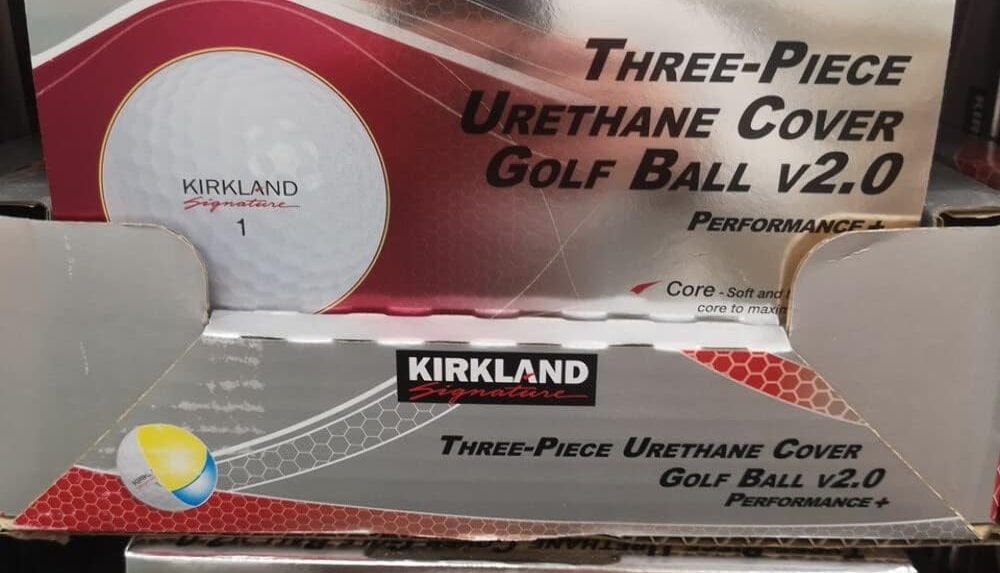
Three dollars per ball separates these two options, and that gap forces every golfer to answer a fundamental question about their game.
You're paying roughly $1.25 for a Kirkland ball versus $4.50 for a Pro V1. That's not a small difference; it's nearly four times the cost. When you lose three balls per round, you're burning $13.50 in Pro V1s compared to $3.75 in Kirklands.
Here's the honest math: those premium dollars buy you 3-5 yards of carry and marginally better greenside control. For scratch golfers chasing tournament wins, that matters. For everyone else? You're paying a hefty premium for performance differences you likely won't notice. Budget balls often provide solid performance for amateur players, focusing on distance and forgiveness for those scoring above 80. Kirkland's two-dozen packs deliver genuine durability and solid spin at a price that doesn't punish your mistakes.
While price dominates most Kirkland versus Pro V1 debates, manufacturing consistency reveals a more intricate story that's worth understanding.
Kirkland balls are primarily manufactured by Qingdao SM Parker in China, a reputable producer supplying other major brands. You're getting solid baseline quality from proven facilities. The compression rating hits 96.8 compared to Pro V1's 96, and cover hardness measures 78.7 versus 78.3, nearly identical specs.
Here's where it gets interesting: Kirkland shows higher variance in compression points and slightly less uniform dispersion patterns than Pro V1. You'll occasionally find dimple irregularities from molding imperfections, and some balls exceed USGA weight limits. The good news? Version 3.0 demonstrates marked improvements in batch consistency. You're not getting Pro V1 precision, but you're getting closer than expected. To verify these differences yourself, launch monitors without subscriptions like the FlightScope Mevo Gen2 or Swing Caddie SC4 Pro can capture ball speed, spin rates, and dispersion data without ongoing fees.
How do you actually decide between these two balls when the specs look so similar on paper? Start with your wallet and your honesty level. If you lose three balls a round, spending $4.16 per Pro V1 is lighting money on fire. Kirkland at $1.46 makes that sting disappear.
Now consider your swing speed. Below 105 mph? Kirkland's firmer compression works fine for your game. You won't sacrifice meaningful distance.
Here's where I draw the line: if you're breaking 85 and your short game actually matters to your scores, Pro V1's tighter dispersion and consistent greenside stopping power justify the premium. That control inside 50 yards separates these balls more than any driver metric. Advanced players who prioritize control and spin around the greens will notice the difference most dramatically.
Match the ball to your reality, not your aspirations.

Yes, you can use Kirkland golf balls in official tournament play if the specific model appears on the current USGA List of Conforming Golf Balls. Here's the catch: you've got to verify before you tee off. The list updates monthly, and some individual Kirkland balls have tested slightly over the weight limit. Don't assume conformity; check the list yourself to avoid a disqualification headache.
In wet conditions, Pro V1 gives you an edge. You'll notice your Kirkland balls rolling out farther on dewy greens, losing that vital stopping power when you need it most. Pro V1's advanced urethane cover and tighter manufacturing tolerances maintain more consistent spin rates, even when moisture interferes with club-face contact. If you're playing early morning rounds or rainy days regularly, Pro V1's reliability justifies its premium.
Kirkland balls actually outlast Pro V1s in most real-world conditions. You'll get 30+ holes from a Kirkland even after cart path strikes, while Pro V1s scuff faster. One player burned through 47 Pro V1s in 28 rounds versus just 23 Kirklands over 31 rounds. The V3 version shows improved durability with less cover peeling. Wedge shots damage both similarly, but you're replacing Kirklands less often.
No, you can't officially buy Kirkland golf balls outside Costco channels. They're exclusive to Costco's website and physical warehouses, and you'll need an active membership to purchase them. Sure, you'll find them on resale markets and secondary sellers, but I wouldn't trust the authenticity or pricing. This exclusivity is actually part of what keeps their price so low: no middlemen, no markup.
Both balls take the same hit in cold air, except for about 1.5% distance loss per 20°F drop. The real difference? Kirkland's slightly higher spin rates (around 5,000 rpm vs. Pro V1's 4,850 rpm) give you an edge holding frozen greens. If your swing speed drops when you're bundled up, Kirkland's 94-compression design actually works in your favor. Keep either ball warm in your pocket between shots.
Here's the truth: you're not leaving strokes on the table by playing Kirkland balls. They deliver 90% of the Pro V1 performance at 25% of the cost. If you're a single-digit handicapper who demands absolute consistency and tour-level spin control, spring for the Pro V1. Everyone else? Pocket the savings and spend that money on lessons instead. Your wallet will thank you.

