
The Bushnell Tour V7 Shift at $399.99 is the rangefinder to buy in 2026 if you only read this line. It’s fast, it’s accurate, and it shows the play-like number first, in green. Every unit in this guide returns the same yardage, so what the money above it buys is glass, screen and software.
The Short Answer
Out of these thirteen, the one most golfers should buy in 2026 is the Bushnell Tour V7 Shift, at $399.99. It grabs the flag fast, the image is sharp, and in slope mode the play-like number shows up first, in green. If you want GPS distances to the front, middle and back of the green in the eyepiece for the same money, get the Precision Pro Titan Elite at $399.99 instead. It’s IP67 sealed and it recharges over USB-C. On a firm budget the Cobalt Q-4 Slope at $180 reads the same distance for less, with a transferable lifetime warranty and nothing else attached.
Every Rangefinder in This Guide
Here are all thirteen rangefinders with their live September 2026 price, what each one is genuinely best at, and a one-line verdict, so you can find your budget and your use case before you read a word of the detail below.
| Product | Price | Best for | Verdict |
|---|---|---|---|
| Bushnell Tour V7 Shift | $399.99 | Best Overall | Sharpest glass under $400, and slope shows first in green. The one to buy. |
| Precision Pro Titan Elite | $399.99 | Best GPS in the Viewfinder | Sealed, rechargeable, green depth in the eyepiece. Same money as the Tour V7 Shift. |
| Precision Pro NX10 | $249.99 | Best Value | Strongest magnet near this price and a 3-year warranty. |
| Cobalt Q-6SM Slope | $450.00 | Best Premium | Repeats a reading to a tenth of a yard, over and over. |
| Bushnell Pro X3+ | $599.99 | Best Premium Optics | Slope factors temperature and altitude, not just elevation. |
| Cobalt Q-4 Slope | $180.00 | Best Boutique Value | Cheapest unit here, IPX7, transferable lifetime warranty. |
| Precision Pro Titan Slope | $299.99 | Best Slope Premium | Survives real submersion, recharges, no app needed. |
| Garmin Z82 | $599.99 | Best GPS + Laser Hybrid | Green overlay in the viewfinder. Still micro-USB. |
| Arccos Smart Laser | $299.99 | Best New Tech | Marks the pin for your Arccos stats. Needs a subscription. |
| Blue Tees Captain Pro | $249.98 | Best Budget | IP67 hardware today, smart features still unfinished. |
| Shot Scope Pro L5 | $229.99 | Best Value Feature Set | Free GPS maps, no subscription, genuinely fast laser. |
| FlightScope i4 | $499.00 | Best for Launch Monitor Fans | Builds a gapping profile and factors wind. Not waterproof. |
| Mileseey GenePro G1 | $499.99 | Best All-in-One | Laser, GPS, hole maps and scoring in one touchscreen unit. |
How This Guide Works
Golf rangefinders are the easiest category in golf to overspend in. The core job is already solved. The cheapest unit here and the most expensive one will both put you inside a yard of the flag, and both will be right. What separates them is glass quality, screen readability, water sealing, warranty, and whether the unit talks to something you already own.
That is the frame for all thirteen picks below. Every product here is a laser rangefinder or a laser-plus-GPS hybrid, from Bushnell, Precision Pro, Cobalt, Garmin, Blue Tees, Shot Scope, FlightScope, Arccos or Mileseey. They run cheapest first. That way you can see the exact point where your money stops buying a better yardage and starts buying convenience. It arrives lower than most buyers expect.
Prices are current as of September 3, 2026. Each one was checked against the retailer’s own live product feed, not a spec sheet. Two of these units were listed at a different price six weeks ago. If you are working from an older article, the numbers have moved.
Two things this guide does not do. It does not rank products against each other, because if your budget is tighter you still deserve a real answer, not a nudge toward the priciest option. And it does not claim a first-person session with every unit. Where Paul has covered a product on camera, that footage is the source. Where he has not, the entry is built from verified specifications and the honest limitation that goes with them.
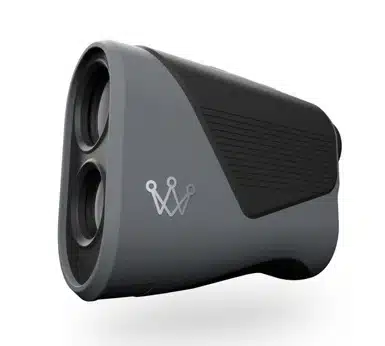
Cobalt Q-4 Slope: Best Boutique Value ($180)

The Cobalt Q-4 Slope is the strongest budget pick in this guide because it holds a half yard inside normal golf distances and it repeats that reading, which is the single thing cheap rangefinders usually fail at.
Cobalt is a small brand, so most golfers have never handled one. That is the trade you make here. You get no brand recognition in the group, and a laser that performs like units costing considerably more. Cobalt rates the Q-4 to half a yard within tested ranges. Independent testing has not instrumented it past 300 yards, which is well beyond where any of this matters to you on a golf course.
Caddytalk is another small brand worth knowing, and my Caddytalk Cube rangefinder review covers a laser that weighs just 140 grams.
The repeatability is why you should care. Cheap rangefinders drift. You shoot the flag and get 148, shoot again and get 153, and now you’re standing over your ball trusting neither number. That’s worse than carrying no rangefinder at all. The Q-4 doesn’t do that to you.
It’s rated IPX7 and it has proven itself in rain, though nobody has independently tested actual submersion. The warranty is the most generous here. It’s lifetime, you don’t need a receipt, and it transfers to the new owner if you sell it on.
Slope is on board and it toggles off, so the Q-4 is legal for any competition round you enter. Worth knowing what the accuracy spec actually covers: Cobalt quotes half a yard out to 200 yards, and that band is the one that has been checked. Beyond 300 yards nothing has been instrumented, so treat long readings as indicative. On a golf course you will almost never care, because the shots that decide your score happen well inside that window.
If you’re a weekend golfer playing 20 to 40 rounds a year, my PeakPulse LE600AG review covers a 5.7-ounce slope unit whose slope readings landed close to a Bushnell Tour V5.
The IPX7 claim is worth reading precisely too. Cobalt rates it for a metre of water for thirty minutes. Rain performance is proven. Actual submersion has never been independently verified, so the sensible way to hold it is fully rain-proof and probably fine in a puddle.
The honest limitation: acquisition speed. Cobalt’s own specification is 0.25 to 3.0 seconds, and that upper figure is real. On a dark pin against a treeline you will feel the unit hunting where a Bushnell would have locked on already. It is also a pure laser, with no GPS, no app, no screen and no front-and-back green numbers.
Who should skip it:
- Golfers who want a hole map, app connectivity or green-front-and-back yardages
- Anyone who needs the fastest possible lock in poor light
- Golfers who want a brand their playing partners recognise
Buy the Cobalt Q-4 Slope direct from Cobalt. Check the current price. We earn a commission if you make a purchase, at no additional cost to you.
Master the course with the Cobalt Q-4 Slope Rangefinder. Featuring lightning-fast yardages, slope-adjustment, and crystal-clear optics for pinpoint accuracy. Elevate your golf game today.
Shot Scope Pro L5: Best Value Feature Set ($229.99)

The Shot Scope Pro L5 is the pick in this guide for golfers who want GPS without an annual bill, because its course maps cover more than 36,000 courses and carry no subscription fee at all.
That last part matters more than it sounds. Most brands putting GPS in a rangefinder charge you annually for the map data. Over three years that fee can cost you more than the unit did. Shot Scope doesn’t.
The laser underneath is quick. Shot Scope’s second-generation rapid-fire holds a yard at playing distances. The longest verified on-camera reading is 498 yards, taken instantly. You will never need that on a golf hole. It does tell you the laser has enormous headroom on the 160-yard approach where speed actually matters to you.
It weighs 340 grams, which is substantial for this price bracket and helps you hold a steadier line on the flag.
Shot Scope quotes accuracy of a yard across a range far longer than a golf hole. The upper end of that range has never been instrumented, so read the headline maximum as a marketing ceiling rather than a tested figure. The yard at approach range is the number that matters to your scorecard.
Power is the quiet advantage here. It runs on a single CR2, and the quoted figure is roughly 5,800 measurements from one. Nobody has counted them. What is clear is that changing the cell is not something this rangefinder asks of you often, so one battery covers a season and then some.
One open question sits over the whole brand rather than this model. Reliability in sustained extreme heat is not settled, and it is worth watching if you play desert or deep-summer golf.
The honest limitation: the Pro L5 is water resistant, not waterproof, and the distinction is not pedantry. Water resistant survives a shower. It does not reliably survive a golf bag left out in sustained rain. Shot Scope does not publish an IP rating for it, so treat wet-weather use as a risk you are accepting. The second limitation is that the GPS maps require a paired phone, so this is not a standalone GPS device the way the pricier hybrids in this guide are.
Who should skip it:
- Golfers who play regularly in wet conditions, where the Cobalt Q-4 or Titan Slope are properly sealed
- Anyone who wants GPS without carrying a phone
- Golfers who want the absolute fastest acquisition in the category
Buy the Shot Scope Pro L5 direct with code GOLFAUTH. Check the current price. We earn a commission if you make a purchase, at no additional cost to you.

Use Code = GOLFAUTH for an Extra 15% Off
The Shot Scope Pro L5 golf rangefinder combines cutting-edge GPS accuracy with smart features to give golfers precise distance insights and improve shot strategy.
Blue Tees Captain Pro: Best Budget ($249.98)

The Blue Tees Captain Pro is the best-sealed budget rangefinder in this guide, carrying genuine IP67 dust and water protection, but its advertised smart features do not currently work as marketed.
Both halves of that sentence are true and you need both. The hardware is legitimately good. IP67 means fully sealed, and it holds up on you. There is a find-my-rangefinder function in the companion app that works, which sounds like a novelty right up to the day you leave the unit on a cart. The unit looks and feels more expensive than it is.
The software is where the Captain Pro falls short of its own advertising. The AI club recommendations do not function as the marketing describes. The GAME app integration is rough. And the display in Blue Tees’ own marketing imagery is not the display that arrives in your box. The company has publicly acknowledged that one.
All of that is firmware and it could be fixed. But you buy any product on what it does today, not on somebody’s roadmap.
Blue Tees rates the laser to a yard well past anything you will ever shoot. Inside playing distances that holds up. The headline maximum itself has not been verified and does not describe anything you will do on a golf hole.
Two more claims deserve a straight answer. The Flag Lock vibration is sold as proof you have the pin rather than the background. The most rigorous testing available contradicts that, though one test went the other way. Treat the buzz as a lock confirmation, not a guarantee of what you locked onto. True Distance, which folds slope, wind, elevation and temperature into a play-like number, works, but its consistency is uneven enough that you should sanity-check it against the raw yardage.
The subscription also moved after launch. Buyers at release got twelve free months. Later buyers get six, and the renewal price went up. That is not disqualifying, but it is not what the early reviews describe.
If you’d rather spend less, my Blue Tees Captain Air review covers the cheaper sibling with a dual-color display, a tournament-legal slope switch and an IP65 waterproof build.
The honest limitation: you are buying a well-sealed laser with a set of smart features that are, as of September 2026, unfinished. Blue Tees also halved the free subscription period that shipped at launch, so the ongoing cost is not what early reviews described.
Who should skip it:
- Anyone buying it specifically for the AI caddie or club recommendations
- Golfers who want the app ecosystem to be the reason for the purchase
- Value buyers who would rather have double the commission-free simplicity of the NX10 at the same price
Buy the Blue Tees Captain Pro direct from Blue Tees. Check the current price. We earn a commission if you make a purchase, at no additional cost to you.
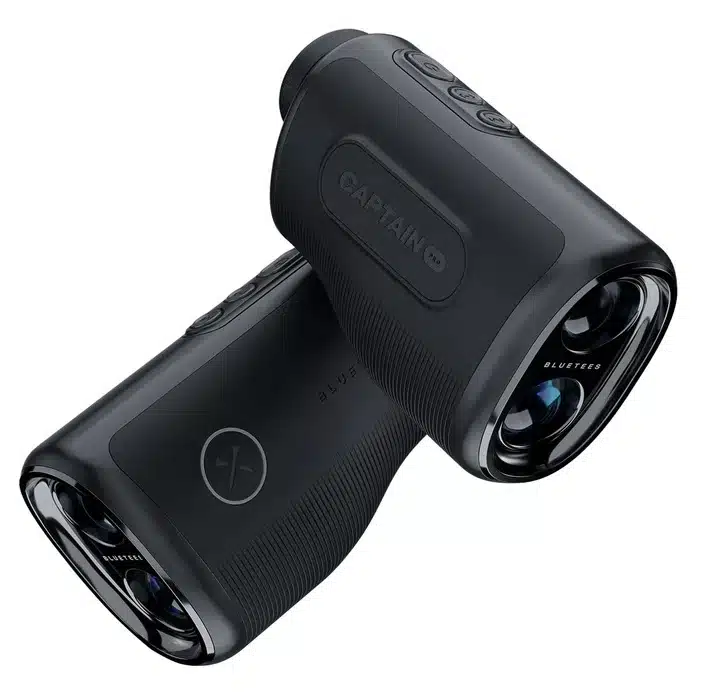
Master the course with the Blue Tees Captain Pro Rangefinder. Features 1000-yard range, Slope Switch technology, and Magnetic Strip. Get pin-point accuracy and crystal-clear optics for every shot.
Precision Pro NX10: Best Value ($249.99)

At $249.99 the Precision Pro NX10 is the value pick of this guide, because it pairs a quick, uncomplicated laser with the most tenacious cart magnet of anything here near its price and a three-year warranty.
Precision Pro raised that warranty from two years to three. That’s the kind of change a manufacturer only makes when field failure rates justify it, and at this price most brands are moving the other way.
The magnet deserves its own sentence. Rangefinder magnets are usually an afterthought. They hold on smooth tarmac and surrender on a rough cart path. The NX10’s does not let go. There is an orientation caveat, because it grips much better one way round than the other. Once you learn which way it sits, it stays.
Even a strong magnet won’t save you if you leave the laser on the cart, so here’s my advice on how to stop losing your rangefinder, from clamps to QR stickers.
Beyond that, the appeal is deliberate simplicity. You point, you shoot, you get your number, you put it back. It’s the sort of rangefinder you stop thinking about after two rounds, which in this category is the highest compliment available.
Precision Pro rates the flag pickup at 400 yards. That has not been verified at the stated maximum, which is normal for the category and only matters if you were buying on the headline number.
The pulse vibration is worth understanding correctly. It confirms the laser has locked onto something. It does not confirm that the something is the flagstick. That distinction sounds pedantic until you buzz on a tree at the back of a green and take one club too many.
The display divides opinion. Precision Pro sells it on sun readability and most of the record supports that, but there is a documented contradiction in the other direction, so if you play a lot of dawn and dusk golf, treat it as the weaker part of the package. The other feature nobody else offers is cosmetic and genuinely fun: more than thirty swappable skins, which still makes the NX10 the only customisable rangefinder in golf.
The honest limitation: two things, and both are corrections to what you may have read elsewhere. Precision Pro’s free lifetime battery replacement programme, which appears in a great deal of older coverage, has been discontinued. Do not buy the NX10 expecting it. Second, the IP54 rating that circulates for this unit is not supported; treat the NX10 as having no reliable water rating and keep it out of sustained rain.
Who should skip it:
- Wet-weather golfers, who should take the Cobalt Q-4 or the Titan Slope instead
- Anyone who wants GPS yardages or app connectivity
- Golfers expecting the discontinued battery programme
Buy the Precision Pro NX10 direct from Precision Pro. Check the current price. We earn a commission if you make a purchase, at no additional cost to you.

Master every shot with the Precision Pro NX10 Slope Rangefinder. Combining pinpoint accuracy and slope measurement, it’s designed to elevate your golf game effortlessly.
Arccos Smart Laser: Best New Tech ($299.99)

The Arccos Smart Laser is the right rangefinder only for golfers already running Arccos sensors, because every flag you shoot automatically marks that day’s pin position and sharpens your approach and putting statistics.
This is the product’s entire argument. For the right golfer it is a strong one. You can already mark a pin manually by walking to the hole and tapping your phone. Doing it from 150 yards, as a by-product of a yardage you were taking anyway, removes the friction that stops most people bothering.
It works with no internet connection on the course, and Arccos has measurably improved it through updates since release. Paul has said on camera that this is the rangefinder he reaches for most often, because he is already deep in the Arccos system and the convenience earns its place for him.
Accuracy sits around a yard. Professional testing supports it, though a minority of owners disagree, so hold it as strong rather than settled. The automatic pin setting is confirmed to work, with the caveat that its placement accuracy is not perfect.
The part that genuinely improves your golf is downstream of the rangefinder. Arccos scores approach play and putting against where the hole actually was that day. Without a pin position it estimates, and estimates blur exactly the statistics you bought the system to sharpen. A season of correctly placed pins is a materially better dataset than a season of guesses.
Arccos also markets a tour partnership around the platform. The partnership is real. The framing that presents it as evidence of on-course accuracy is marketing, and you should not weigh it in a purchase.
The honest limitation: this is the most important paragraph on this page for anyone considering this unit. The Smart Laser requires an active subscription to function. Not to switch on the smart features while the laser keeps working. To function at all. Arccos’ own support has confirmed the device should be treated as non-operational without one. The first year is included in the $299.99 purchase. After that it is roughly $300 per year, being the $199 Arccos membership plus a $99 Smart Laser subscription. Over three years that is a $900 running cost on a $300 device.
Who should skip it:
- Every golfer who does not already own and use Arccos sensors
- Anyone who wants a rangefinder that still works if they stop paying
- Golfers who mark pins manually and are not bothered by it
Buy the Arccos Smart Laser direct from Arccos. Check the current price. We earn a commission if you make a purchase, at no additional cost to you.
Experience the first rangefinder to offer "Plays Like" distances and AI-powered club recommendations. Syncs with the Arccos app for elite precision on every shot.
Precision Pro Titan Slope: Best Slope Premium ($299.99)

The Precision Pro Titan Slope is the most weather-proof rangefinder in this guide at $299.99, with an IP67 rating that has survived genuine submersion rather than just a rain shower.
That’s a meaningfully higher bar than most of this category clears. Plenty of rangefinders carry a water rating that’s never been tested beyond a marketing photo. This one has been under water and come back working.
It holds a yard in practice and it acquires quickly. The battery is rechargeable over USB-C, at roughly 50 rounds a charge. That last detail is worth more than it sounds. A rechargeable rangefinder never leaves you hunting a CR2 cell in the pro shop on the first tee.
The flag pickup is quoted at 400 yards, a figure that quietly grew from the 300 Precision Pro used to publish, and neither number has been verified at its maximum. Accuracy of a yard at real approach distances is well supported in practice, though no instrumented test exists.
The shell is magnesium alloy on the manufacturer’s own specification, which is worth stating because the brand’s retail listing contradicts it. Where a company disagrees with itself, take the spec sheet.
One more thing the spec sheet undersells. Because there is no radio and no screen to drive, the Titan Slope spends its power budget entirely on the laser, which is part of why the charge lasts the way it does.
The rechargeable battery is the practical star. Roughly 50 rounds a charge is the published figure, and in practice it looks conservative. What nobody can tell you yet is how that cell ages across several seasons, and Precision Pro’s own history with battery promises is reason enough to keep that question open.
The honest limitation: the display is an LCD rather than an OLED, and Precision Pro frames that as a deliberate advantage. It is not; it is a cost decision. In bright sun the screen is perfectly readable. At dusk it is clearly the weaker of the two Titan displays. Separately, ignore the “8K display comparable to an HDTV” line that appears in the marketing for this unit. That claim is not supported and does not describe anything real about a rangefinder viewfinder. The third limitation is scope: this is a pure laser with no GPS, no Bluetooth and no green front-and-back numbers.
Who should skip it:
- Golfers who want yardages to the front and back of the green in the viewfinder, who should step up to the Titan Elite
- Anyone who plays a lot of late evening golf and needs the brightest possible display
- Golfers who want app connectivity
Buy the Precision Pro Titan Slope direct from Precision Pro. Check the current price. We earn a commission if you make a purchase, at no additional cost to you.

Rugged, waterproof, and ultra-accurate.The Precision Pro Titan Slope features USB-C fast charging, vibration feedback, and a reliable 999-yard laser range.
Precision Pro Titan Elite: Best GPS in the Viewfinder ($399.99)

At $399.99 the Precision Pro Titan Elite is the pick if you want GPS in the viewfinder, because it’s the only unit on this list combining a sealed, rechargeable, genuinely durable body with the depth of the green shown in the eyepiece. It costs the same as the Tour V7 Shift, so the choice comes down to one question. Do you want the green numbers, or the sharper glass?
It is the same alloy-shell chassis as the Titan Slope, with GPS layered on top. You take a laser reading to the flag. You also see how much green sits in front of and behind it. That is the number deciding whether you take an extra club. It is tournament legal with slope switched off.
Precision Pro doesn’t publish which metal the alloy is, so treat “alloy shell” as the accurate description rather than any claim about magnesium content.
The quoted flag range here is also 400 yards, unverified at that maximum like everything else in the category, and Precision Pro’s own published figures do not fully agree with each other.
The display carries the same profile as its cheaper sibling. In sunlight it does the job and you will have no complaints. As the light flattens toward evening it becomes the weaker element of an otherwise strong package.
What the GPS actually changes about your golf is worth spelling out, because it is the whole reason to pay the extra over the Titan Slope. A laser number to a tucked pin tells you the carry. It tells you nothing about how much room sits behind the flag if you catch one. Seeing the depth of the green in the same eyepiece is what turns a yardage into a club decision, and it removes the second device most golfers were carrying to get it.
The honest limitation: three of them, and at this price you should hear all three. The GPS requires the phone app. It pairs easily and mostly stays paired, but it degrades over months of use and it will drop mid-round if your phone is configured to kill background applications. The battery figures conflict in Precision Pro’s own documentation, with the FAQ claiming roughly 50 rounds and the manual specifying 40-plus rounds falling to 10 to 12 with Bluetooth active; plan around the lower figure. And that slope switch moves too easily, so it can end up back on without you noticing, which in competition is a compliance risk worth checking on the first tee.
Who should skip it:
- Golfers who dislike phone apps, who should buy the Titan Slope and save $100 for the same body
- Anyone who already owns a GPS watch and would never use the green numbers
- Competitive players unwilling to check the slope switch before a round
Buy the Precision Pro Titan Elite direct from Precision Pro. Check the current price. We earn a commission if you make a purchase, at no additional cost to you.

The Precision Pro Titan Elite pairs pinpoint laser precision with green GPS data. Featuring adaptive slope, pulse vibration, and a strong cart magnet.
Bushnell Tour V7 Shift: Best Overall ($399.99)

At $399.99 the Bushnell Tour V7 Shift is my pick for 2026, and it’s the one I’d spend my own money on. It carries the best optics and the most readable display of anything in this guide below its price, and it is the biggest generational jump Bushnell has made in the Tour V line.
Two things carry it. The first is glass. It grabs a flag quickly and the image stays sharp. The display stays legible in bright sun and in the flat grey light of an evening round, which is exactly where cheaper screens give up on you. Paul has described exactly this on camera: fast to pick up the flag, sharp image, easy to read in bright sun or low light.
The second is the slope-first display. In slope mode the play-like number appears first, in green. You are not hunting for the adjusted figure behind the raw one. On an uphill approach that removes a calculation at exactly the moment you least want to be doing arithmetic.
Bushnell rates it to 500 yards on a flag and it comfortably beats that, with verified readings running roughly 24 percent past the published rating.
Bushnell also markets the Tour V line as the leading rangefinder in professional golf. Its dominance on tour bags is real and widely observed. The specific participation percentages the company publishes have never been independently counted, so take the standing as fact and the statistic as advertising.
The generational claim holds up better than most marketing does. Across the record this is the largest step Bushnell has taken between Tour V models. The two places you feel it are the ones that matter on a golf hole. How fast the flag comes in, and whether you can read the number without hunting for it.
One practical detail that gets skipped in spec comparisons is the magnet. It holds the unit on the cart rail so the rangefinder lives where your hand goes, rather than in a pocket you have to dig through between shots.
The honest limitation: the feature Bushnell leads its marketing with is Link-enabled club recommendation, and it only does anything if you own a Bushnell or Foresight launch monitor. It works, with real setup prerequisites, but for the large majority of buyers it is a capability that will never be switched on once. The water rating is also unverified: IPX6 is published but has not been independently tested.
Who should skip it:
- Golfers who want GPS distances to the front and back of the green, who should take the Titan Elite for the same money
- Anyone who needs a verified water rating for regular wet-weather play
- Budget buyers, since nothing here improves the number itself
Buy the Bushnell Tour V7 Shift at PlayBetter. Check the current price. We earn a commission if you make a purchase, at no additional cost to you.
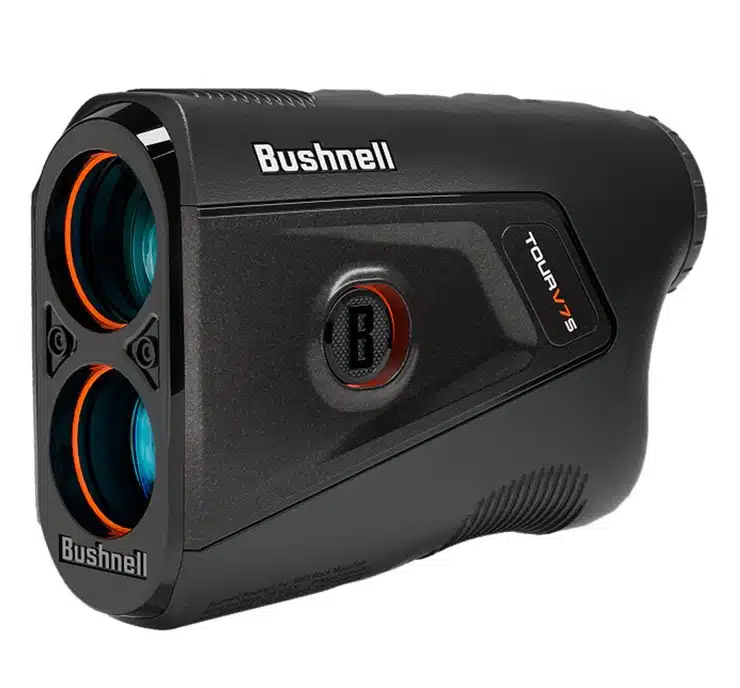
Experience unrivaled accuracy with the Bushnell Tour V7 Shift. Featuring PinSeeker with Visual JOLT, improved slope algorithms, and a built-in BITE magnetic mount. Get the most consistent yardages in golf. Shop the V7 today!
Cobalt Q-6SM Slope: Best Premium ($450)

At $450 the Cobalt Q-6SM Slope is the most repeatable rangefinder here, returning the identical reading to a tenth of a yard shot after shot on the same target.
Repeatability is a different property from accuracy. It is also the one that builds your trust in a device. Most rangefinders give you a number that is close enough, then a slightly different one two seconds later. You quietly start averaging in your head. The Q-6SM removes that. Cobalt has the best-documented repeatability record of the brands in this guide, though no instrumented test has established absolute accuracy against rivals, so treat “most consistent” as the supported claim rather than “most accurate”.
The optics are 7x and they’re excellent. The vibration confirmation fires only on a genuine flag lock, not on whatever’s behind it. The magnet is an N48, and it holds on a cart rail over rough cart paths where most magnets let go, although the frequently repeated “ten times stronger than ceramic” multiplier is unverified.
Acquisition is quoted from 0.25 seconds, and Cobalt is unusually honest in publishing a wide range rather than a single flattering figure. On a clean target it is quick. On a poor one it takes longer, which is true of every laser sold and rarely admitted.
The warranty reads well on paper, running lifetime the same way the cheaper Q-4’s does. What is not established is the service record behind it at any scale, so weigh the policy as a real commitment with an unproven execution history rather than as a settled advantage.
The IPX7 rating means you can play the whole round out in weather without thinking about the device, which combined with the tenth-of-a-yard consistency is what makes this the unit you stop second-guessing. Cobalt also leans on a quarter-century of rangefinder heritage in its marketing. There is a real history there, told generously.
The honest limitation: the Q-6SM will not display the true yardage and the slope-adjusted yardage simultaneously. You flip a switch to see the other one. It is a single fast flick with no re-shoot required, but it is the only rangefinder in this guide that forces the choice, and if you like sanity-checking the adjustment against the raw number it will irritate you every round. Also worth clearing up: the widely repeated stories about Cobalt’s founding lineage and US assembly are not supported. Buy it for the laser.
Who should skip it:
- Golfers who want raw and adjusted yardages side by side, who should take the Bushnell Tour V7 Shift
- Anyone who needs GPS or app features
- Buyers who want a brand with a service network
Buy the Cobalt Q-6SM Slope direct from Cobalt. Check the current price. We earn a commission if you make a purchase, at no additional cost to you.
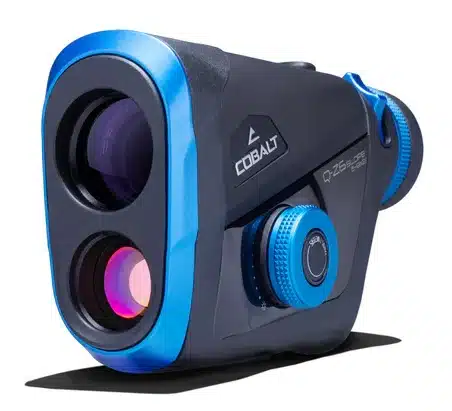
Master the course with the Cobalt Q-6SM. Features slope compensation, pin-lock vibration, and ultra-clear optics for elite accuracy. The ultimate tool for golfers seeking a competitive edge.
FlightScope i4: Best for Launch Monitor Fans ($499)

The FlightScope i4 at $499 is the best rangefinder for golfers who already own a launch monitor, because it builds a gapping profile across your whole bag and folds wind into the club it recommends.
As a plain laser it’s excellent. It holds a yard at practical distances, with a measurement speed FlightScope specifies at 0.05 seconds, confirmed as effectively instant in use. If you own a Mevo or Mevo Plus it also sits inside an ecosystem you are already using rather than adding a second one.
Smart Gapping is the differentiator. Its accuracy scales directly with what you feed it, which is a polite way of saying a careless profile gives you confident wrong answers.
FlightScope quotes a range running from five yards out to four figures. Accuracy of a yard is confirmed where you will use it and unverified at the far end, which is the same caveat every laser in this guide carries.
Battery life is quoted at roughly 15,000 measurements or 500 hours a charge. Nobody has counted that precisely, but it is consistent with how the unit behaves in use, and it puts charging firmly in the off-season category rather than the every-few-rounds one.
The wind integration is the piece most worth understanding before you spend. The mathematics FlightScope applies is sound. The weak link is the input. A wind figure taken where you are standing is not necessarily the wind up at the height your ball actually flies. No rangefinder solves that, which is a reason to treat the adjusted number as a strong opinion rather than an answer.
The honest limitation: two, and the first is a straightforward correction. FlightScope’s product page describes the i4 as waterproof. It is not. Treat it as splash resistant and nothing more. The second is a limit on the intelligence itself: the club recommendation knows your carry distances but has no knowledge of the hole. It cannot see that there is water short and a bunker long, so it will confidently hand you a club that is correct on distance and wrong on strategy. It is a distance tool with maths attached, not a caddie.
Who should skip it:
- Anyone unwilling to sit down and build a gapping profile properly, since without that you have paid $499 for a laser
- Golfers who play in the wet
- Buyers with no launch monitor, who should take the Titan Elite instead
Buy the FlightScope i4 at PlayBetter. Check the current price. We earn a commission if you make a purchase, at no additional cost to you.

Use Code GAMevo to get 5% off
The FlightScope i4 golf rangefinder delivers cutting-edge technology for golfers who demand pinpoint accuracy and actionable data. Perfect your swing and dominate the course with unrivaled distance measurement and shot analysis.
Mileseey GenePro G1: Best All-in-One ($499.99)

The Mileseey GenePro G1 at $499.99 packs more capability into one device than anything else in this guide: a laser accurate to half a yard, GPS, colour hole maps, scoring and a responsive touchscreen in a single unit.
Mileseey built its reputation on cheap marketplace products, so your scepticism about a $500 unit is reasonable. The hardware does not support it. The laser holds half a yard and repeats. The touchscreen is bright and genuinely responsive, which is more than several devices at twice the price manage. Battery life runs about 24 hours with GPS active, so you’re getting two to four rounds between charges, and the course database covers more than 43,000 courses with one documented gap.
The laser is rated to half a yard, and in practice it earns that, though the exact tolerance has not been independently established.
SmartSlope is the feature to hold loosely. Mileseey says it factors temperature, humidity and elevation into the play-like number. That has not been verified, and at least one owner has questioned its consistency, so treat the adjusted figure as a helpful steer rather than a calculation you trust blind.
The course database is genuinely broad and one documented gap has surfaced, which is a good outcome for a database of that size. And the scoring and mapping functions are the part that changes what you carry: if the alternative was a rangefinder plus a GPS watch plus a scoring app, one device that does all three competently is a real simplification rather than a spec-sheet flourish.
The honest limitation: two, and the second is the serious one. The Pin Pointer feature is marketed more loosely than it performs. It does not place a marker on the actual pin; it works from the centre of the green, and Mileseey’s own FAQ confirms this. More importantly, the ten-year warranty is genuine as a written policy, but documented owner experiences of actually claiming against it do not match the promise. That gap between policy and execution is the single largest risk in buying this device, and it is worth weighing against a brand with a shorter warranty it reliably honours. Marketing claims about millions of users and hundreds of patents are unverified and should not factor into the decision.
Who should skip it:
- Golfers who want one device doing one job well, who are better served by the Cobalt Q-4 or Titan Slope
- Anyone who weights warranty service heavily in a purchase
- Buyers who already own a GPS watch and would duplicate the function
Buy the Mileseey GenePro G1 direct with code GolfersAuthority. Check the current price. We earn a commission if you make a purchase, at no additional cost to you.

Take control of your shots with the Mileseey GenePro G1 GPS Rangefinder. This device provides lightning-fast distance readings to help you avoid hazards. Order now to secure your exclusive discount!
Bushnell Pro X3+: Best Premium Optics ($599.99)

The Bushnell Pro X3+ at $599.99 gives you the most trustworthy play-like distance in this guide, because its Slope with Elements calculation factors temperature and altitude rather than elevation alone.
That is the best-evidenced premium feature in this entire guide. Most slope functions adjust for the hill in front of you and stop there. On a cold morning at altitude, elevation alone is an incomplete answer. The Pro X3+ closes that gap.
It’s IPX7, so it’s fully sealed, and the 7x glass is superb. Like the Tour V7 Shift it talks to Bushnell and Foresight hardware, with the same heavy setup caveats attached.
Bushnell positions the Pro X3+ as the most powerful and precise laser it has built. In 2026 that superlative is contestable against the rest of this field, so read it as a strong flagship rather than a settled crown.
Long-range performance follows the same pattern. Consistent readings to flags past 600 yards are plausible and consistent with the record, but they have not been instrumented, so the honest version is that the laser has more reach than you will ever ask of it.
The Link club recommendation does work, and it is the reason this unit exists in its current form. It pulls your measured club distances off a Bushnell or Foresight launch monitor and puts a club in the eyepiece. The prerequisite list is long and the setup is real work, so the honest audience is narrow: someone who already owns the launch monitor and will actually do the configuration.
The honest limitation: the feature Bushnell markets hardest here is wind speed and direction, and it is not a reason to buy this rangefinder. It functions exactly as designed. It simply does not change which club you pull often enough to justify the premium, and buyers should discount it entirely when comparing against the Tour V7 Shift. The second limitation is physical: this is a large unit, sitting right at the boundary of too big to be comfortable, and it will not go in a trouser pocket. Third, the club recommendation setup is genuinely fiddly and will consume an evening.
Who should skip it:
- Golfers with no launch monitor and smaller hands, who get most of this in the Tour V7 Shift for $200 less
- Anyone buying primarily for the wind feature
- Buyers who want a pocketable rangefinder
Buy the Bushnell Pro X3+ at PlayBetter. Check the current price. We earn a commission if you make a purchase, at no additional cost to you.

The Bushnell Pro X3+ Golf Laser Rangefinder is a top choice for golfers seeking pinpoint accuracy and speed on the course. With advanced features, it delivers reliable distance measurements to help you lower your score and play smarter.
Garmin Z82: Best GPS + Laser Hybrid ($599.99)

The Garmin Z82 at $599.99 is the only rangefinder here that draws the shape of the green inside the viewfinder, overlaying the hole layout and the layup line on the image while you are aiming.
It carries more than 41,000 courses and picks up your course and hole automatically. Wind appears in the viewfinder too. As a laser it is accurate to the yard. At this price that is the floor, not an achievement.
Garmin markets accuracy to within ten inches of the flag and describes the Z82 as the most accurate laser on the market. Yard-level accuracy is supported. The ten-inch figure itself has never been independently verified, and the superlative is not supportable against this field, so neither should carry weight in your decision.
The wind reading in the eyepiece does work. What Garmin will not say is where that wind figure comes from, which means you cannot judge how good it is or when it might be wrong. An undisclosed dependency is not a scandal, but it is a reason to treat that number as softer than the laser beside it.
Battery behaviour is worth planning around rather than discovering. Ten to fifteen hours covers two rounds comfortably and three at a push, but it is a rechargeable device with a proprietary habit, and leaving it flat in a bag over winter is how owners find that out.
Where the Z82 is genuinely without rival is the visual. No other unit here draws the green in front of you while you aim, and for a golfer playing unfamiliar courses that picture answers a question a bare number cannot.
Garmin watch wearers have a more affordable route, and my Garmin Approach Z10 review covers the laser that pushes yardages straight to your wrist.
The honest limitation: the number in the viewfinder is not always the lasered number, and the display does not indicate which source it is showing. In edge cases the Z82 displays a GPS-derived figure with no visual difference from a laser reading. If you cannot tell which you are looking at, the value of laser precision is undermined, and that is the reason this unit sits last in a guide ordered by price rather than being crowned. Course detection has a documented glitch where it selects the wrong hole. Battery life runs 10 to 15 hours, so two to three rounds. And after $599.99 it still charges over micro-USB, not USB-C, contrary to several published specifications including some of our own older coverage.
Who should skip it:
- Most golfers, who are paying more than three times the price of the cheapest unit here for the same yardage
- Anyone who needs certainty about whether a reading is laser or GPS
- Buyers who want USB-C charging
Buy the Garmin Z82 at PlayBetter. Check the current price. We earn a commission if you make a purchase, at no additional cost to you.

Master every shot with the Garmin Approach Z82, a premium golf rangefinder blending precise GPS, advanced target lock, and 2D course maps for superior accuracy and confidence.
Frequently Asked Questions
What is the best value-for-money golf rangefinder?
For most buyers the answer is the Precision Pro NX10 at $249.99, because it gives you an uncomplicated laser, a cart magnet nothing at this price matches, and a warranty Precision Pro recently stretched from two years to three. If money is tighter, the $180 Cobalt Q-4 Slope reads just as well, backed by a warranty that outlives you, trading away acquisition speed and every app feature. Both give you the same number the most expensive unit in this guide gives you. What the extra money buys above that point is better glass, a clearer screen, proper sealing and software, not a truer distance to the flag.
What is the best rangefinder for the money in 2026?
Among these thirteen, the $399.99 Bushnell Tour V7 Shift is the best buy in 2026. It grabs the flag fast, the image is sharp, and in slope mode the play-like number shows first, in green. Everything above it in price buys extras like temperature and altitude in the slope number rather than a better core reading. If you want GPS green depth in the eyepiece for the same money, the $399.99 Precision Pro Titan Elite is the alternative, and if your budget is firm, the Cobalt Q-4 Slope at $180 reads the same distance for less.
What rangefinder do PGA pros use?
Bushnell dominates professional use and markets itself on that basis, and its current flagship is the model most associated with tour play. The specific participation percentages Bushnell publishes have not been independently counted, so treat the dominance as real and the exact figure as a marketing claim. It is also worth remembering that rangefinders are prohibited during PGA Tour competition rounds themselves; professional use happens in practice rounds and course preparation. For an amateur, tour association is close to irrelevant, because the accuracy difference between a tour-favoured unit and the cheapest rangefinder in this guide is smaller than the difference your ball striking makes.
What are the top 5 golf rangefinders?
Ranked by what you should actually buy, the five strongest picks of the thirteen here are these. The $399.99 Bushnell Tour V7 Shift overall, for its optics and display readability. The $399.99 Precision Pro Titan Elite if you want GPS green depth in the viewfinder. The $249.99 Precision Pro NX10 for outright value. The Cobalt Q-6SM Slope at $450 for repeatability. And the Cobalt Q-4 Slope at $180 if your budget is firm. That spread is deliberate. A golfer who cannot spend $400 still deserves a real recommendation rather than being pushed toward the most expensive option on the page.
Do I need slope on a golf rangefinder?
Slope is worth having if you play any course with meaningful elevation change, because it converts the raw distance into a play-like number and removes an error-prone mental calculation. It is illegal in competition under the Rules of Golf, so a rangefinder with slope must be able to switch it off, and every unit in this guide can. The practical concern is not whether slope exists but whether the switch is secure. On the Precision Pro Titan Elite that switch moves too easily, so check its position before a competitive round rather than discovering the problem in the scorer’s hut.
How I Picked
Every product here was selected against a documented research file. That file covers specification claims, manufacturer statements, published testing and known contradictions. All of it was re-checked against live retailer data on September 3, 2026.
Prices came from each retailer’s own product feed, not a press release. Every affiliate link here was followed to confirm it lands on the specific product page, not a homepage or a category listing. Two of the thirteen prices had moved since the last review cycle. That is why a guide like this is only as good as the day it was checked.
Where a claim is disputed, this guide says so. Several manufacturer statements in this category do not survive scrutiny. There is a discontinued battery programme still widely cited, an unsupported IP rating, a display specification describing nothing real, and a company-history claim repeated across the internet. Each is flagged in its entry rather than quietly dropped.
One note on first-hand use. Paul has covered the Bushnell Tour V7 Shift, Bushnell Pro X3+, Cobalt Q-6SM and Arccos Smart Laser on camera, and those four entries draw on that footage. The other nine are built from verified specifications, manufacturer documentation and published testing. They do not claim a personal session that is not on record. That distinction is deliberate. A guide claiming equal first-hand depth across thirteen products is usually claiming something it cannot show.
What to Look For in a Golf Rangefinder
Start with repeatability, not accuracy. Nearly every rangefinder sold today holds a yard, which is far finer than the difference your swing makes. What separates good from bad is whether the same target gives you the same number twice. A unit that reads 148, then 153, then 150 is worse than useless. You cannot tell which one to believe.
Decide whether you need slope, and whether you can switch it off. Slope adjusts for elevation and gives you a play-like number. It is also illegal in competition. Every unit here can disable it. Check that the switch is positive rather than easily nudged, because an accidentally active slope mode is a rules problem, not an inconvenience.
Read the water rating precisely. “Water resistant” and “IP67” are not the same claim. IP67 means sealed. Water resistant frequently means an untested marketing phrase. If you play in weather, this single specification should filter your shortlist before anything else does.
Work out whether GPS earns its place. A laser gives you the distance to the flag. GPS gives you the distance to the front and back of the green. That is what decides your club when the pin is tucked. If you already wear a GPS watch, paying for it twice adds you nothing.
Check the magnet and the battery. A magnet that fails on a rough cart path drops your rangefinder on tarmac. A rechargeable USB-C battery removes the CR2 hunt. Units giving roughly 50 rounds a charge are effectively a season between charges.

About the author
Paul Liberatore
Paul Liberatore is the founder of Golfers Authority and a former four-year golf gear contributor to Sports Illustrated. He tests golf equipment hands-on to help golfers make better buying decisions.