
The Garmin Approach S50 is the best golf watch for most golfers in 2026. Here is how all 11 compare on price, screen, battery and subscription traps.
Last updated: September 6, 2026
Golfers Authority is reader-supported. When you buy through links on our site, we may earn an affiliate commission at no extra cost to you.
The Short Answer: Which Golf Watch Should You Buy?
The Garmin Approach S50 at $399 is the best golf watch for most golfers. It weighs 29 grams, the AMOLED screen stays readable in full sun, and PlaysLike Distance adjusts your yardage for elevation without a yearly membership. That last part decides it: the cheaper Approach S44 puts the same feature behind a subscription that costs roughly $400 over five years, so the more expensive watch is the cheaper watch. Want everything built in? The Garmin Approach S70 at $699 is the most capable. Want the most watch for the least money? The Blue Tees PlayMaker+ at $199.
Best Golf Watches 2026: Quick Comparison
Every watch below earned its place for a different golfer, which is why these are awards rather than a ranking. The cheapest pick here is not a compromise and the most expensive is not automatically the best, so read the “best for” column before the price column. Two figures move fastest in this category and are worth re-checking before you buy: the street price, which shifted by $100 or more on two of these watches in the last month alone, and the subscription terms, which decide what your watch can still do in year three. Prices shown are the current market rate at the time of writing, with the link price noted separately where a Golfers Authority reader deal applies.
| Watch | Price | Best for | Verdict |
|---|---|---|---|
| Garmin Approach S50 | $399 | Most golfers | Elevation-adjusted yardages with no subscription. The best all-round buy. |
| Garmin Approach S70 | $699 | Every feature | The most capable golf watch made, if you will actually use it. |
| Voice Caddie T11 Pro | $349 ($299 via link) | Best display | Switches tee, approach and green views for you. No subscription ever. |
| Garmin fenix 8 | $849 | Multi-sport athletes | Full Garmin golf plus serious training. Heavy for golf alone. |
| Voice Caddie T9 | $199 ($299 list) | Big screen on a budget | Slope and green undulation both included on a 1.8-inch display. |
| Shot Scope V5 | $249 ($212 with GOLFAUTH) | Stats and shot tracking | 16 club tags and 100+ stats with zero subscription. |
| Garmin Approach S44 | $299 | Pure golf, modern screen | AMOLED without the health tracking. Slope costs extra. |
| Voice Caddie A3 | $169 ($199 list) | Under $200 | Slope and green contours on a color touchscreen. |
| Garmin Venu X1 | $599 | Everyday smartwatch wear | Biggest, thinnest display here. About two days on always-on. |
| Blue Tees PlayMaker+ | $199 | Best value | AMOLED and auto shot tracking. $49/yr for analytics after year one. |
| Garmin Approach S12 | $199 | Battery life | 30 hours GPS and 10 weeks in watch mode. Four buttons, no distractions. |
Most golfers spend half their round guessing. You look at a sprinkler head, pace off a few steps, check the wind, and just kind of hope you have the right club. That’s exactly how you end up in the front bunker when you thought you had plenty of club to carry it. The right distance isn’t just a number; it’s the difference between a confident swing and a hesitant poke.
I’ve tested 37 golf watches, and the truth is, most of them are either too complicated, too inaccurate, or dead by the 14th hole. I don’t want a computer on my wrist that requires an engineering degree to operate, and I definitely don’t want something that dies when I’m trying to close out a match. I want to look down and know exactly how far I have to the pin.
So I put the current crop of GPS golf watches to the test. I looked at everything from budget-friendly basics to premium models that track every metric imaginable. We’re going to break down the display quality, the battery life, the accuracy, and the features that actually matter on the course.

Best Overall GPS Watch: Garmin Approach S70 – $699
The Garmin Approach S70 is the most capable golf watch you can buy at $699, and the right pick only if you will genuinely use everything in it. You get Virtual Caddie club recommendations, full-color CourseView on 43,000+ courses, and a smartwatch that holds up off the course. Skip it if you mainly want accurate yardages, because the Approach S50 covers that for a lot less.

Most GPS watches give you a number and leave you to figure out the rest. You get 150 yards to the center, but you still have to factor in the wind in your face, the 10-foot elevation drop, and the fact that it’s 50 degrees outside. By the time you do all that math in your head, you’re second-guessing your club selection and rushing your swing. That’s how a good round turns into a frustrating one.
The Approach S70 was built to do all that math for you. It’s a $699 watch, which is a lot of money for something you wear on your wrist, so I wanted to see if the features actually earned that price tag.
The first thing I noticed when I fired it up was the 1.4-inch AMOLED touchscreen. It’s the same display technology you’d find on a high-end smartwatch, and it’s readable in direct sunlight without cranking the brightness. The 43,000 preloaded course maps aren’t just green blobs with numbers slapped on them. You get full-color CourseView maps with detailed hazard shapes, layup zones, and yardages to the front, middle, and back of every green. Tap anywhere on the map, and it gives you the distance to that exact spot.
The Virtual Caddie is where the S70 separates itself. It doesn’t just spit out an average distance. It pulls in wind speed, wind direction, elevation change, temperature, and your historical shot dispersion, then gives you a club recommendation with a visual chart showing where your shot is likely to land. What that actually means is you can see whether that 8-iron is going to leak into the right bunker before you even pull it from the bag. The PlaysLike Distance feature adjusts your yardage for uphill or downhill shots, so a flat 150 might play like 162 when you’re hitting into a raised green.
Off the course, you get 24/7 heart rate monitoring, HRV status, Pulse Ox, sleep scores, stress tracking, and Garmin’s Body Battery metric. Battery life runs up to 16 days in smartwatch mode and 20 hours in GPS mode, which covers a full weekend of 36-hole days with room to spare. You can also store music, receive smart notifications, and track workouts like strength training, running, and cycling.
The catch is the price and the subscription. At $699, this isn’t a casual purchase. And the Green Contour Data, which shows you slope direction for putting, requires an active Garmin Golf membership. It’s also 56 grams, which some players find heavy for daily wear.
This is for the data-obsessed golfer who wants the most complete caddie experience on their wrist and doesn’t mind paying a premium for the display and health tracking.
But what if you don’t want to pay $699 upfront only to get hit with another Garmin Golf membership fee to access the green slope data? That’s where the Voice Caddie T11 Pro comes in.
Experience luxury on the greens with the Garmin Approach S70, a premium GPS golf watch blending high-end design and cutting-edge tech for pros.
Best Golf GPS Display: Voice Caddie T11 Pro – $349
The Voice Caddie T11 Pro has the best screen of any golf watch here, and it costs $349 list or $299 through the link below. Its 1.2-inch Super OLED rivals the S70 at half the price, and it switches tee, approach and green views automatically so you are not tapping through menus mid-round. Skip it if you want any smartwatch or fitness features at all, because it has none.

Most golf watches make you work for the information. You’re on the tee box trying to see the layup distance to the fairway bunker, then you hit your drive and have to swipe over to the approach view. Then you’re on the fringe, and you need to tap through menus to see the green slope. It’s constant fiddling, and it pulls you out of your pre-shot routine at exactly the moment you should be locked in.
So when a watch claims its AI handles all that automatically for $349 list, or $299 through my link, with no fees after that, the question is whether the automation actually works or adds another layer of frustration.
What I noticed when I first strapped on the T11 Pro is the 1.2-inch Super OLED touchscreen. It’s bright enough to read in direct August sunlight without cupping your hand over it, which is more than I can say for most watches in this price range. But the real story is the V.AI 3.5 technology. It automatically transitions between Smart Course View on the tee, Smart Approach View as you walk toward the green, and Smart Putt View once you’re on the putting surface. What that actually means is you glance at your wrist, and the exact information you need for your next shot is already there. On the tee, it shows you the full hole layout with a driver distance arc so you can plan your line. Walk 200 yards, and the display rotates and zooms to match your perspective on the approach, showing green shape, depth, and slope gradients.
The green reading tools are where this watch pulls ahead of anything else at $349. Smart Putt View gives you a heat map of the green with directional arrows showing which way the slope breaks. Combine that with real-time wind speed and direction on the approach, and you’re getting caddy-level information from a wristwatch. It also tracks your shots and putts automatically, acting as a scorecard so you don’t have to punch in numbers between holes. There’s a Practice Tempo Mode too, where you set a target swing rhythm for full swings, wedges, or putts and get immediate feedback.
The catch is the bulky design. It’s a thick watch, and you’ll feel it on your wrist all day. It also skips smartwatch features entirely. No heart rate monitor, no step counting, no sleep tracking, and no phone notifications. The companion app can also get buggy when syncing rounds.
This is for the golfer who wants automated course management and detailed green reading with zero subscription fees. If you want a watch that doubles as an everyday fitness tracker, look elsewhere.
But what if you want a watch that actually pulls its weight off the course instead of sitting in a drawer between rounds? The T11 Pro skips heart rate, fitness tracking, and sleep monitoring entirely and is too bulky for daily wear. That’s where the Garmin Fenix 8 comes in.

Luxury golf tech with advanced GPS, swing analysis, and smart features designed for premium performance on the course.
Best Multi-Sport Golf Watch: Garmin Fenix 8 – $849
The Garmin fenix 8 is the golf watch to buy if you are also a serious runner, cyclist or swimmer, now $849 after launching at $1,099. It carries the identical golf feature set as the S70, not a stripped-down version, plus full multi-sport training tools. Skip it if you only wear a watch on the course, because you are paying for training tech you will never open.

You’re a serious golfer, but you also run trail marathons on the weekends. Or you cycle. Or you ski. And every “premium” sports watch you’ve looked at treats golf like an afterthought, tossing you a stripped-down app that shows front, middle, and back yardages and calls it a day. Meanwhile, every dedicated golf watch you’ve considered is useless for tracking your VO2 max on a 15-mile trail run. You’ve been forced to pick a side.
An $849 watch is still a hard sell for most people. So either the construction and the feature list justify the price, or they don’t. With the Fenix 8, they mostly do.
What I noticed when I first started using the Fenix 8 on the course is that Garmin didn’t cut any corners on the golf side. You get the same Virtual Caddie club recommendations, the same PlaysLike Distances that account for wind and elevation, and the same 43,000+ preloaded courses that ship on the flagship Approach S70. The golf app isn’t a scaled-down version. It’s the full thing. If you scored a birdie with your S70 last week, you’d score the same birdie with this watch.
The build is where the extra money starts to make sense. The 47mm Sapphire model has a scratch-resistant sapphire lens, a titanium bezel, 10 ATM dive-rated water resistance, and it meets military standards for thermal, shock, and water performance. The AMOLED screen stays readable in direct summer sunlight, which matters when you’re squinting at a distance number on a hot afternoon. Battery life runs up to 16 days in smartwatch mode, so you’re not charging it before every round.
Beyond golf, the tracking is deep. You get VO2 max, training load, recovery time, daily suggested workouts, and multi-band GPS with SatIQ that holds a signal in tree cover. There’s a built-in LED flashlight (weirdly useful when you’re loading the car at 5am for an early tee time) and a speaker with a microphone so you can take calls from your wrist. What that actually means is you can leave your phone in the cart and still hear from your wife about dinner plans.
The catch is the price. It launched at $1,099 and now sells for $849 across Amazon and PlayBetter alike, because Garmin has already superseded it. That is a real $250 saving, but $849 is still the most expensive watch on this list. It’s also heavier and bulkier than a dedicated golf watch, so if you like the feel of something light on your wrist during a swing, you’ll notice. And just like the S70, Green Contour Data still requires a paid Garmin Golf membership.
This is for the hardcore athlete who wants elite multi-sport tracking and rugged durability without sacrificing a single premium golf feature. If you only use your watch on the course, you’re paying for technology you’ll never touch.
But if you’re only hitting the links and don’t want to shell out $849 for a bulky watch loaded with multi-sport tech you’ll never touch? That’s where the Voice Caddie T9 comes in.
Garmin fenix 8 Golf Watch, premium multisport smartwatch with elite golf GPS, fitness tracking, titanium design, and ultra-long battery life.
Best Value: Voice Caddie T9 – $199
The Voice Caddie T9 gives you the biggest screen and green-undulation reading for the least money, at $199 through the link below against a $299 list price. The 1.8-inch display shows slope-adjusted numbers and a colour-coded green heat map, with no subscription attached. Skip it if you want automatic view switching, which is the T11 Pro’s job.

Most mid-range GPS watches force you to pick your poison. You either get slope-adjusted distances that account for elevation, or you get a decent green map showing the undulations, but rarely both without crossing the $400 line. And even when you find a watch that does both, it usually locks the good stuff behind a subscription fee that quietly bleeds you for another $100 a year.
It lists at $299, and $199 through the link below, with no subscription ever, the T9 promises to hand you both features for the price of one. So the real question becomes what you’re actually giving up to get that number.
What I noticed when I first pulled the T9 out on a hilly par 3 was how quickly the V-Algorithm 3.0 crunched the elevation change. I was staring at a hole that played 165 yards on paper but felt every bit of 175 yards uphill. The watch adjusted the number before I even settled on a club. You can toggle the slope function off for tournament play, which keeps you legal without forcing you to buy a second device.
The Active Green View is where this watch earned its price tag for me. The heat map shows color-coded undulations with directional arrows pointing to the low spots, and the map automatically rotates to match your angle of approach. What that actually means is you never have to mentally flip the image to figure out which side of the pin is safer. The first putt I rolled after checking it broke exactly where the arrows said it would.
Shot and putt tracking runs automatically in the background, so you’re not tapping buttons between swings. The Tempo Practice Mode measures your backswing-to-downswing ratio, which is useful during range sessions if you’re the type who speeds up under pressure. I got 27 holes out of a single charge with GPS running the whole time, which is fine for a weekend player but tight if you’re planning 36 in a day.
The catch is that the T9 skips the wind data and club recommendations you get on the newer T11 Pro. It also uses a proprietary charging cable, which is a real headache if you travel and forget it in a hotel drawer. And like every Voice Caddie I’ve owned, off-course smartwatch functions are basically nonexistent. No heart rate, no music controls, no messaging beyond basic notifications.
This is for the budget-conscious golfer who wants advanced green reading and slope adjustments without paying yearly subscription fees. If you want fitness tracking or wind direction, keep scrolling.
But if the T9’s bare-bones approach leaves you wanting a watch that actually functions off the course and gives you more than just yardages? That’s where the Garmin Approach S50 comes in.

Experience golf like a pro with the Voice Caddie T9 GPS Watch, advanced shot tracking, slope-calculated yardages, and green undulation heat maps in a sleek color touchscreen design.
Best Golf GPS Under $400: Garmin Approach S50 – $399
The Garmin Approach S50 at $399 is the best golf watch for most golfers, and the one I would put on most wrists. At 29 grams it is the lightest Garmin builds for golf, and PlaysLike Distance adjusts for elevation with no membership required, unlike the cheaper S44. Skip it only if you want Virtual Caddie club recommendations, which stay exclusive to the S70 and fenix 8.

Most golf watches in the $300 to $400 range feel like a compromise you talk yourself into. The screens are dim LCDs that turn into mirrors the second the sun hits them. The bodies feel like hollow plastic. You get your yardage to the middle of the green, sure, but strapping one on feels like you settled for the tech version of a range ball.
So when a watch shows up at $399 with an AMOLED screen and promises it fixed all that, the real question is whether the build quality backs up the pitch or if Garmin cut corners somewhere you’ll notice on the third hole.
What I noticed when I first put the S50 on is how little it weighs. At 29 grams, it’s the lightest golf watch Garmin makes, and you honestly forget it’s there mid-swing. The 1.2-inch AMOLED touchscreen runs at 390 x 390 pixels, which means the course maps look sharp and stay readable in direct August sun. You get over 43,000 preloaded courses, so unless you’re playing some private track in the middle of nowhere, your course is on there.
The PlaysLike Distance feature is the headline golf function. It takes your straight-line yardage and adjusts it for uphill or downhill shots, which matters more than most golfers admit. What that actually means is you stop under-clubbing on that 160-yard shot that is playing uphill and short-siding yourself long on the downhill par 3. It’s also compatible with the optional Approach CT10 club sensors if you want automatic shot tracking, though those cost extra.
Off the course, Garmin loaded it up like their fitness watches. You get wrist-based heart rate, stress tracking, Body Battery, sleep analysis, and Pulse Ox for blood oxygen. There are activity profiles for strength, yoga, and cardio. Music storage works with Spotify or Amazon Music, and Garmin Pay handles your beer at the turn without pulling out your wallet.
The catch is that the PlaysLike Distance only factors in elevation. It doesn’t account for wind or temperature the way the S70 does. There’s no Virtual Caddie to recommend clubs, the hole map graphics are a step below the flagship, and it has fewer physical buttons, so you’re doing more touchscreen work with sweaty hands.
This is for the golfer who wants a bright AMOLED screen, honest slope-adjusted yardages, and real health tracking in a watch light enough to disappear on your wrist. If you need wind data, temperature adjustments, or a caddie feature picking your club, spend up for the S70.
But if the S50 leaves you wanting actual shot tracking and automatic club logging, not just a yardage number? That’s where the Shotscope V5 comes in.
The Garmin Approach S50 is a premium golf GPS watch offering precise course data, a stylish design, and advanced performance tracking for serious golfers.
Best Golf GPS and Tracker Combo: Shotscope V5 – $249
The Shot Scope V5 is the best golf watch for tracking your own stats, at $249 or $212 with the code GOLFAUTH, with no subscription ever. Sixteen screw-in club tags feed over 100 tour-level stats including Strokes Gained, so you find your real weak spot instead of guessing at it. Skip it if you want a modern touchscreen, because this is a four-button colour display.

Most shot-tracking systems hit you twice. You pay for the hardware upfront, and then they lock your data behind a $100-a-year subscription paywall. You end up renting your own performance stats.
At $249, the V5 is a complete tracking system with no fees, no monthly charges, and no data held hostage. The real question is whether the hardware holds up.
The V5 comes with 16 lightweight tracking tags that screw into the butt of your grips. What I noticed when I first used it was how invisible the tracking actually feels. Shot Scope’s Power-Sense technology runs quietly in the background while you play, automatically recording every shot, distance, and club used. No buttons to press, no shots to log manually. After the round, you sync to the app and get access to over 100 tour-level statistics, including Strokes Gained analysis and Handicap Benchmarking. What that actually means is you can stop guessing about your weaknesses and see exactly where you are losing strokes: is it your wedges inside 100 yards, or your driver accuracy costing you?
The watch itself pulls from over 36,000 preloaded courses and gives you front, middle, and back distances, plus yardages to hazards, layups, and doglegs. The Green View lets you pinpoint exact pin locations for a real number to the flag, not just the center. The My Strategy feature in the app lets you plan your way around a new course using your actual, tracked club distances, so you’re not guessing that you hit your 7-iron 150 when you actually average 142. Battery life covers 2 plus rounds on a single charge, so a 36-hole day is no problem.
The catch is the display and interface. The V5 uses a basic daylight-readable color screen with a four-button navigation system instead of a touchscreen. It works fine in the rain and with gloves on, but it feels dated compared to the AMOLED displays on pricier watches. There are no smartwatch features, no wrist-based heart rate, no music storage, and no phone notifications. This is a golf watch, and that’s it.
This is for the data-driven golfer who wants full Strokes Gained analytics and automatic shot tracking without ever paying a subscription fee. If you play twice a week and actually study your stats between rounds, the V5 pays for itself against a competitor’s subscription within two years. If you want a vibrant touchscreen or everyday fitness tracking, look at something else on this list.
But if that dated four-button interface and lack of smartwatch features feel like a step backward from what you’d expect in a modern watch? That’s where the Garmin Approach S44 comes in.
Use Code = GOLFAUTH for an Extra 15% Off
Experience premium golf tech with the Shot Scope V5 Golf GPS Watch, featuring precise GPS distances, automatic shot tracking, and full-color hole maps.
Editor’s Choice: Garmin Approach S44 – $299
The Garmin Approach S44 at $299 is the pick for a modern AMOLED screen and pure golf with no health tracking attached. You get the same 390×390 display quality as pricier Garmins in a 42-gram case rated to 5 ATM. Skip it if you care about elevation, because PlaysLike Distance sits behind a paid membership here and is included outright on the S50 one step up.

Most golfers shopping around $300 run into the same frustration. You want a modern AMOLED display you can actually read in bright sun, but every watch at this price is loaded with fitness sensors, heart rate monitors, and step counters you’ll never use. You’re paying for a health tracker when all you want is a golf watch.
At $299, the Garmin Approach S44 promises to fix that by stripping out the health stuff and keeping the screen. The question is whether Garmin cut too much or found the right balance.
The display is where your money goes, and it earns its keep. You get a 1.2-inch AMOLED touchscreen at 390×390 pixels, wrapped in an anodized aluminum bezel and protected by Corning Gorilla Glass 3. What I noticed when I first pulled it up on a sunny morning in Phoenix was that I didn’t have to cup my hand over the screen to read the yardage. That sounds small until you’ve squinted at a memory-in-pixel display for 18 holes. The watch weighs 42 grams, measures 43mm across, and handles 5 ATM of water pressure, so rain rounds and pool days aren’t a problem.
On the course, you get the Garmin golf features that actually matter. Front, middle, and back yardages to over 43,000 preloaded courses worldwide. Hazard view with distances to the front and back of every bunker and water hazard. Layup distances. Green View with a draggable pin so you can move it to the day’s flag position. The digital scorecard syncs to the Garmin Golf app after your round and tracks GIR, fairways hit, putts per round, and scrambling percentage. If you want club tracking, the S44 pairs with Approach CT10 sensors sold separately.
Battery life comes in at 10 days in smartwatch mode and 15 hours in GPS mode, which is plenty for a full weekend trip without a charger. You also get smart notifications from your phone, and the interface uses both touchscreen and physical buttons, which I prefer when my hands are sweaty.
The catch is what Garmin left out. There’s no wrist heart rate monitor, no PlaysLike slope adjustments, no Virtual Caddie club recommendations, no music storage, and no Garmin Pay. Green Contour Data works but requires a Garmin Golf Premium membership. If you want slope on your watch, this isn’t the one.
This is for the golfer who wants a bright, modern AMOLED screen and rock-solid Garmin GPS without paying extra for fitness tracking and slope features they won’t use. Pure golf, nothing else.
But what if you want your watch to actually adjust yardages for elevation instead of leaving you to eyeball the slope yourself? That’s where the Voice Caddie A3 comes in.
The Garmin Approach S44 golf GPS watch combines sleek design with advanced tracking technology, making it the top choice for golfers seeking accuracy and performance. Whether you're a pro or enthusiast, this watch elevates your game with comprehensive course data and smart features.
Best Golf GPS Watch Under $200: Voice Caddie A3 – $199
The Voice Caddie A3 is the best golf watch under $200, at $169 through the link below against a $199 list. It puts slope-adjusted distances and actual green undulation on a colour touchscreen at a price where most watches still ship black-and-white displays, and it publishes an IPX7 water rating the T11 Pro does not. Skip it if you want the green map to rotate to your angle.

Most sub-$200 GPS watches feel stuck in 2015. You get a black-and-white screen with front, middle, and back numbers, maybe a hazard distance if you’re lucky, and that’s the whole show. If you want slope-adjusted yardages, green contours, or anything resembling a modern touchscreen, the price jumps to $300 or more in a hurry.
The Voice Caddie A3 tries to break that pattern. At $199 (and often $169 on sale), it packs in features you’d expect from a watch costing twice as much. The question is whether the execution matches the promise.
What I noticed when I first pulled up a green on the A3 is that it actually shows undulation data. You see the contours of the putting surface, which show where the slopes tilt, and in my testing, the accuracy was around 90%. That’s not something you find under $200. The 1.3-inch color touchscreen is responsive enough that you can drag the pin to the day’s actual hole location, and the watch recalculates the distance instantly. At 31.4 grams for the device (50.5g with the band), you forget you’re wearing it.
The Auto Slope Mode gives you elevation-adjusted, plays-like distances with a clear indicator on the screen, and you can toggle it off for tournament rounds so you stay USGA compliant. Smart Course View adds a Drive Landing Area line on the map showing your preset driver distances, plus an Aim Point feature that lets you tap any spot on the hole and get the yardage from where you’re standing. Shot recognition works automatically in the background, tracking your distances without you pressing a button. Battery runs 10 days in watch mode and 10 hours in golf mode, which covers 2-3 rounds between charges. You get access to 40,000+ courses with no subscription fees, just a free account through the Voice Caddie site.
The catch is what you don’t get. There’s no Active Green View that rotates the green to your perspective, which the T9 and T11 Pro have. No PuttView, no wind data, no club recommendations. It’s not a smartwatch either, so no heart rate, no phone notifications, no music. The charging cable is proprietary (lose it, and you’re ordering a replacement), and firmware updates require plugging into a computer running the VC Manager desktop software. That feels dated in 2024.
This is for the golfer who wants slope, green reading, and a color touchscreen while staying under $200. If you need wind data, an AMOLED display, or full smartwatch features, keep scrolling.
But if squinting at a static green map that won’t rotate to your perspective, going in blind on windy days, and tethering to a desktop just to run updates sounds like a hassle? That’s where the Garmin Venu X1 comes in.
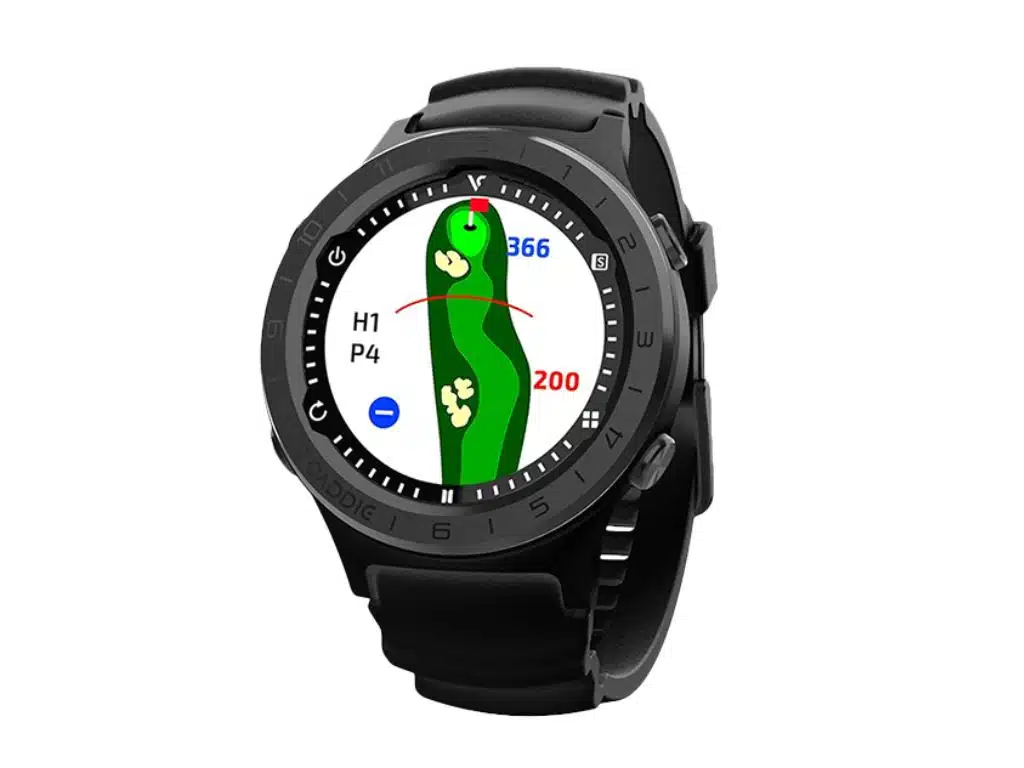
The Voice Caddie A3 GPS Watch redefines golfing precision, delivering exact distances and smart course insights. Elevate your game with cutting-edge technology designed for pros and enthusiasts alike.
Best Apple Watch Replacement for Golf: Garmin Venu X1 – $599
The Garmin Venu X1 at $599, down from $699, is the best golf watch to wear every day instead of an Apple Watch. Its two-inch AMOLED in an eight-millimetre titanium case is the biggest and thinnest display on this list, with 43,000+ courses and real Garmin health tracking. Skip it if you want a round face or multi-week battery, because always-on gets you about two days.

If you wear an Apple Watch on the course, you already know the drill. You start the round at 100% battery, fire up your favorite third-party golf app, and by the 14th hole your watch is begging for a charger. The GPS drain is brutal, and Apple’s own Workout app doesn’t do golf-specific yardages. You end up choosing between tracking your round and having a functional watch when you leave the parking lot.
That’s the exact gap the Garmin Venu X1 fills. At $599, down from the $699 it launched at, it’s priced against the Apple Watch Ultra, and Garmin is clearly gunning for that customer. But unlike Apple, Garmin has been building golf watches for over a decade, so the golf side isn’t an afterthought bolted onto a lifestyle device.
What I noticed when I first strapped it on is how thin it feels. It’s 8mm thick with a full titanium case and a ceramic bezel, and the 2-inch AMOLED display is protected by a sapphire lens. It doesn’t look like a golf watch. It looks like a premium rectangular smartwatch that happens to have 43,000 preloaded courses. When you fire up a round, you get front, middle, and back yardages, hazard and dogleg distances, Virtual Caddie club recommendations, and PlaysLike Distance that adjusts for elevation.
The smartwatch side does the things you actually want from an Apple Watch replacement. There’s a built-in speaker and microphone, so you can take calls from your wrist. It supports Garmin Pay for tap-to-pay. You can store music offline. Notifications, texts, app alerts, all there. Health tracking includes Pulse Ox, sleep score, Body Battery, all-day stress, Training Readiness, Endurance Score, and Hill Score. It also loads full TopoActive maps for hiking without needing your phone.
The catch is the battery life. You get up to 8 days in smartwatch mode and 16 hours in GPS mode. That sounds fine until you compare it to the Approach S70 or Fenix 8, which push closer to 16 days between charges. What that actually means is you’ll be charging this twice a week if you use it heavily, versus once a week or less with Garmin’s thicker watches. It’s also only rated to 5 ATM for water resistance, so it’s fine for showers and pool laps but not for scuba diving or high-pressure water sports. And the multi-GNSS setup here isn’t multi-band, so tree cover and canyons can nudge accuracy a few yards off compared to the S70.
This is for the golfer who wants a sleek rectangular smartwatch with a huge display, on-wrist calling, and top-tier Garmin golf features in one package. If you prefer a round watch face or need multi-week battery life, look elsewhere.
But shelling out $599 for a watch that quotes eight days but realistically gives you about two once the always-on display is running? That’s where the BlueTees Playmaker+ comes in.
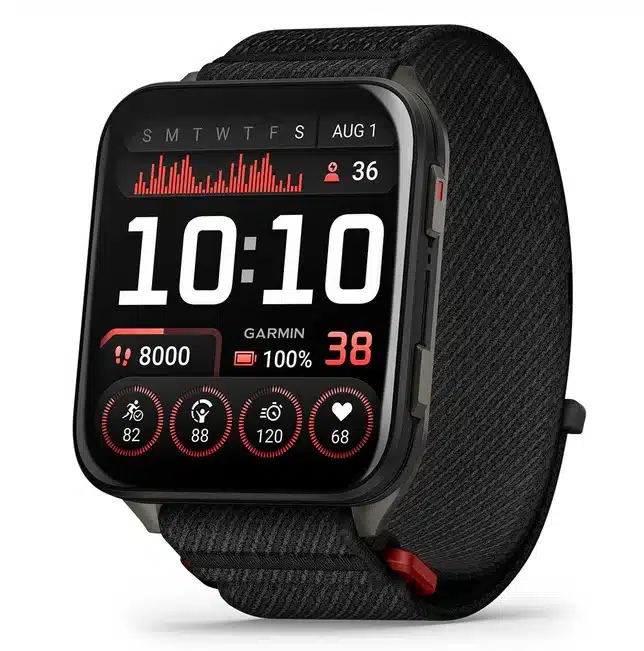
The Garmin Venu X1 redefines what a premium fitness smartwatch can do. With advanced tracking, vivid AMOLED display, and long battery life, it’s built for those who want performance and style in one powerful wearable.
Best Golf GPS Watch for Most People: BlueTees Playmaker+ – $199
The Blue Tees PlayMaker+ at $199 is the best value golf watch of 2026 and the one that makes sense for the most golfers. You get a 1.74-inch AMOLED, automatic shot tracking, 42,000+ preloaded courses and 3D round playback for a third of what the flagships cost. Skip it if you refuse subscriptions, because detailed analytics cost $49 a year after the first.

Most affordable GPS watches feel cheap and look worse. They use outdated monochrome screens that wash out in bright sun, require you to tap in every shot and score manually, and have bulky crowns or buttons that press into your wrist through your entire backswing. You end up spending more time fighting the watch than reading yardages.
At $199, the Playmaker+ is the cheapest AMOLED watch on this list. So the real question is what you’re actually giving up for that price.
What I noticed when I first strapped it on is how little I noticed it. It weighs 42 grams and has a crown-free design, meaning nothing pokes into the top of your wrist when you address the ball. The 1.4-inch AMOLED touchscreen sits flush, protected by Gorilla Glass 3, and stays readable in direct sunlight without me having to shade it with my other hand. That’s the trick most budget watches get wrong. They save money on the screen, and you pay for it every time the sun comes out.
The course library covers over 42,000 courses worldwide, all preloaded, so you’re not downloading anything on the first tee. You get front, center, and back yardages, dynamic hazard distances that update as you walk, and a Green Compass that points directly at the pin for blind shots over trees or dunes. Automatic shot tracking runs in the background without you tapping the watch after every swing. What that actually means is you can play your round like normal, then open the companion app afterward and see a 3D playback of every shot. It’s a genuine improvement for the amateur trying to figure out why their scores aren’t dropping.
Add in real-time weather updates and music controls that pair with Blue Tees GPS speakers, and you’ve got a watch that handles the on-course stuff most golfers actually use.
The catch is the subscription. The first year of Advanced Analytics is included, but after that it’s $49 a year to keep accessing detailed shot data and performance trends. The basic yardages stay free, but the shot tracking analysis goes behind the paywall. It also lacks slope-adjusted distances, green undulation maps, and a heart rate monitor. If you’re a numbers junkie who wants everything included forever, this isn’t your watch.
This is for the golfer who wants a bright AMOLED screen, a comfortable swing-friendly fit, and automatic shot tracking without spending $500 or more. If you refuse to pay any subscription fee for your stats, or you need slope adjustments for tournament prep, look at something else on this list.
But if paying $49 a year to keep seeing your own shot analytics feels like a shakedown, especially on a watch that skips slope adjustments and green undulation data entirely? That’s where the Garmin Approach S12 comes in.
Experience premium precision with the BlueTees PlayMaker+ GPS Golf Watch, designed for serious golfers seeking advanced course data and stylish durability.
Best Battery Life: Garmin Approach S12 – $199
The Garmin Approach S12 at $199 is the best golf watch for battery life, running 30 hours in GPS mode and up to 10 weeks in watch mode. Its monochrome memory-in-pixel screen actually gets easier to read the brighter the sun gets, and there is no subscription on any core golf feature. Skip it if you want colour, touch, slope or any smartwatch function.

Most cheap GPS watches are a headache. They lose satellite lock on the back nine, the battery dies halfway through your round, and the screen washes out the second you step into direct sunlight. You spend more time smacking the side of the watch than reading yardages. At that point you might as well pace it off yourself.
At $199, this is the most stripped-back watch on the list, so the real question is whether it actually works when you need it to. The short answer is yes, and the reason comes down to some smart engineering choices Garmin made about what to leave out.
The S12 uses a 1.3-inch monochrome transflective memory-in-pixel display at 175×175 pixels. What I noticed when I first took it out on a sunny afternoon is that the screen actually gets easier to read the brighter it gets. The MIP tech reflects ambient light instead of fighting against it, so the harsh midday sun that murders your phone screen is exactly what makes this thing pop. No squinting, no cupping your hand around the face, no tilting it at weird angles to catch shade.
Because it skips the power-hungry color display, the battery numbers are not very meaningful. You get 30 hours in GPS mode and 10 weeks in watch mode. What that actually means is you can play 5 or 6 full rounds before you ever think about charging it, and if you leave it in watch mode between rounds, you can go two months without touching the clip charger. Weekend golf trip? Leave the charger at home.
The course library covers 42,000+ preloaded courses, and you get all the basics done well: front, middle, and back yardages, hazard distances, dogleg carries, and Green View with a draggable pin so you can move it to the actual flag location for a precise number. The Measure Shot feature is one people sleep on. You tap the button after your shot, and it records the exact distance, which is how you finally figure out that your 7-iron is really a 155-yard club, not the 165 you tell your buddies. Everything syncs to the Garmin Golf app afterward for scorecards, stats, and weekly leaderboards against other players, no subscription required for any of the core golf stuff.
The catch is the extreme simplicity. No color, no touchscreen, no slope-adjusted yardages, no heart rate, no sleep tracking, no music, no smartwatch features. It navigates with 4 physical buttons and does one job.
This is for the golfer who wants sunlight-proof readability, a battery that outlasts their motivation to practice, and reliable Garmin GPS for $199 with zero distractions.
The Garmin Approach S12 golf GPS watch delivers pinpoint accuracy, a sleek design, and essential features to elevate your golf game effortlessly. Perfect for golfers seeking reliable on-course data.
How I Picked These Golf Watches
I tested 37 golf watches to get to these 11, and the cut came down to four things that decide whether a watch stays on your wrist past the third round. Screen readability in direct sun came first, because a display you have to shade with your other hand is a display you stop checking. Then battery life measured against a real 18 holes rather than a spec sheet, since a watch that dies on the 14th is worse than no watch. Third, the subscription question: which features are yours forever and which ones you are renting. That single issue reshuffles this entire list, because the $299 Approach S44 puts elevation adjustment behind a yearly fee while the $399 S50 includes it, making the pricier watch cheaper over five years. Fourth, weight and bulk during an actual swing.
Prices here were verified against the manufacturers and retailers in September 2026, not copied from last year’s guide. Two watches on this list moved by $100 or more since the previous update, and one deal I recommended last year has expired, so every figure was re-checked rather than assumed.
What to Look For in a Golf Watch
The five things that actually matter are the screen, the subscription model, slope adjustment, battery life, and whether you want smartwatch features at all. Everything else is marketing.
- Screen type. AMOLED displays like the S50, S44 and PlayMaker+ look superb and stay readable in sun. Monochrome memory-in-pixel screens like the S12 get easier to read as light increases and last vastly longer per charge. Neither is wrong, but they suit different golfers.
- Subscription traps. Ask what stops working if you never pay again. Garmin puts green contour data behind a Garmin Golf membership across the range, and PlaysLike elevation behind it on the S44 specifically. Voice Caddie and Shot Scope charge nothing after purchase. Blue Tees includes one year of analytics, then $49 annually.
- Slope adjustment. A plays-like number that accounts for uphill and downhill is the single most useful feature on a golf watch, and it is the one most often gated or missing. Every slope-capable watch here lets you switch it off to stay tournament legal.
- Battery life. Judge it in GPS mode, not smartwatch mode. Anything above 15 GPS hours covers a weekend without a charger; the S12’s 30 hours covers a golf trip.
- Smartwatch features. Heart rate, sleep and payments are genuinely useful if you will wear the watch daily, and dead weight if it lives in your bag between rounds. The Venu X1 leans hardest into everyday wear; the T11 Pro and Shot Scope V5 skip it entirely.
Frequently Asked Questions
Should I buy a golf watch or a laser rangefinder?
It depends on what you value most on the course. Golf watches give you instant glanceable yardages (front, middle, back of the green), full hole mapping, shot tracking, and hazard layouts without needing line-of-sight. Rangefinders provide exact pin-point accuracy to the target. Many players use a watch for course management and a rangefinder when attacking flags.
How long does the battery last in GPS mode?
Most modern golf GPS watches last between 10 and 20 hours in active GPS mode, which is easily enough for 2 to 3 full 18-hole rounds. In standard smartwatch mode (without active GPS running), high-end models can last anywhere from 7 to 14 days on a single charge.
Are golf watches legal for tournament play?
Yes, with one condition. Basic GPS yardages (distances to greens and hazards) are legal under USGA and R&A Rule 4.3. However, slope-adjusted distances (“PlaysLike” yardages) and wind/club suggestions must be turned off during official competitive rounds. Most golf watches feature a “Tournament Mode” that turns off these illegal features with a single toggle.
Do I need to pay a subscription fee to use a golf watch?
Not usually. Leading brands like Garmin and Bushnell include preloaded course databases (36,000–43,000+ courses worldwide) with no ongoing subscription fees. However, some brands or premium software tiers (like green contour mapping or advanced analytics platforms) may offer optional monthly or annual memberships.
Can I wear a golf watch as an everyday smartwatch?
Absolutely. Premium models (such as the Garmin Approach S70 or Shot Scope X5) double as stylish daily smartwatches. They track steps, heart rate, sleep quality, daily stress, and surface phone notifications like texts, phone calls, and calendar reminders when paired with your smartphone.
So Which One Should You Actually Buy?
If you want the most capable watch on the market and don’t mind paying for it, the Garmin Approach S70 is the clear winner. The AMOLED display, Virtual Caddie, and full health-tracking suite make it the most complete golf watch on the market.
If you want tour-level analytics and automatic shot tracking without ever paying a subscription fee, the Shotscope V5 is the smartest investment. It gives you the data you need to actually improve your game.
If you are on a budget but still want a vibrant screen and automatic tracking, the BlueTees Playmaker+ delivers serious hardware for the price, as long as you are okay with the subscription model after year one. If you want the best Garmin for the way most people actually play, it is the Approach S50 at $399, because it hands you elevation-adjusted yardages outright instead of renting them back to you every year. And if you just want slope adjustments and green reading without breaking the bank, the Voice Caddie A3 is a massive sleeper hit.
What do you guys think? Let me know in the comments. And if you want to see more honest gear reviews where I cut through the marketing BS, make sure you subscribe. I will see you out on the course.

About the author
Paul Liberatore
Paul Liberatore is the founder of Golfers Authority and a former four-year golf gear contributor to Sports Illustrated. He tests golf equipment hands-on to help golfers make better buying decisions.