
$2,599. That’s what you can spend on a golf push cart in 2026.
For that money, you get a touchscreen, GPS course maps for 40,000 courses worldwide, and with an add-on, it uses the same laser-scanning technology as a self-driving car to follow you down the fairway without you touching it. I’m going to cover that cart. It earned its spot on this list.
One more place worth a look is Scheels, which stocks carts like the Clicgear Model 4.5: check prices at Scheels.
But here’s what the golf industry has quietly figured out: golfers will pay $2,600 for a cart that follows them around, and most of those golfers will never use half of what they paid for. The industry profits from the assumption that expensive equals better. And for push carts specifically, that assumption is flat wrong.
A push cart is one of the few golf buys where spending more doesn’t get you a better cart. It gets you more automation. The question is whether you actually want that automation and whether you’ll use it enough to justify the price.
After walking dozens of rounds with these carts, I’ve noticed something most reviewers miss: the golfers who are happiest with their cart are rarely the ones who bought the most expensive one. They’re the ones who figured out exactly where their money stopped buying them anything they’d actually use, and stopped there.
And if you’re walking partly for the exercise, I ran the numbers on how many calories golf burns, and pushing a cart burns about 36% more per hour than riding.
That’s what this guide is built on. I’ve split these 12 carts between manual and electric, organized from cheapest to priciest within each category. On the electric side especially, that price ladder is an automation ladder. Every step up buys you something specific. My job is to tell you whether that something is worth it for your game.
Let’s figure out which cart is right for you.
Table of Contents
THE BEST MANUAL PUSH CARTS OF 2026
Here’s the mistake most golfers make when they shop for a manual push cart: they treat it like a commodity. They look at the price, maybe check the weight, and pick the cheapest one that looks decent. Then they spend the next three years annoyed by a cart that tips on every sidehill, folds into a shape that doesn’t fit their trunk, or has a brake they have to bend down to reach.
A manual push cart is a piece of equipment you interact with 40 to 80 times per round, every time you stop, park, fold, unfold, and push. The difference between a great one and a forgettable one comes down to three things: how it rolls, how it folds, and how it holds your bag. The carts in this section nail at least two of those three, and the best ones nail all three.
The key buying mistake in this category is optimizing for price alone. At the low end of this list, you’re spending $300 for a cart you’ll use for five to ten years. The difference between the cheapest and most expensive manual cart here is $100. That’s ten bucks a year. Spend it on the cart that actually fits how you walk.
Here’s what you’ll know by the end of this section: which cart is right for your terrain, your trunk, and your tolerance for setup hassle, and where the price jumps are actually worth it.
BagBoy Quad Pro 4-Wheel

Most push carts tip. That’s the problem nobody talks about in the marketing materials, but it’s the thing that ruins a round faster than a bad swing. You’re on a sidehill lie, you set the cart next to you, and it slowly leans and goes over. Your bag hits the ground, your clubs scatter, and you spend five minutes reorganizing before you’ve even hit the shot.
The Quad Pro exists specifically to solve that problem. It runs on four wheels instead of three, which gives it a rectangular base instead of a triangular one. On a slope, the weight of your bag distributes across four contact points instead of three. The physics are simple: it’s significantly harder to tip. On hilly courses with real elevation changes and uneven fairways, that’s not a minor convenience; it’s the difference between a cart that stays where you put it and one that doesn’t.
The catch is maneuverability. Four fixed wheels can’t pivot the way a three-wheel cart can. On tight cart paths with sharp turns, you’ll need to make wider arcs or lift the front slightly to change direction. On open courses with wide paths, you’ll never notice. On tight, complex courses, it can be a minor frustration.
BagBoy reengineered this cart recently. The frame is more modern, the fold is smaller than the previous generation, and they added a magnetic iron plate on the handle so your rangefinder, towel, or Bluetooth speaker stays stuck right where you can grab it. The storage console is deep, the tires are maintenance-free hard plastic, no inflation, no flats, and it’s Top-Lok compatible, which means BagBoy and Datrek bags click straight onto the cart with no straps. At 16 pounds, it’s the lightest cart in this section.
Who should buy this: Golfers who play hilly courses with significant elevation changes, or anyone who carries a heavy bag and has watched a three-wheel cart tip on them. If your course is flat and your paths are tight, the Nitron is a better fit.
| Spec | Detail |
|---|---|
| Price | $299.95 |
| Weight | 16 lbs |
| Folded | 24″ × 17″ × 15″ |
| Wheels | 4 (fixed) |
But if stability isn’t your primary concern, if what you actually want is to spend less time setting up and more time playing, that’s a different cart entirely.
Tackle any terrain with the BagBoy Quad Pro 4-Wheel Golf Push Cart. Its four-wheel design offers unmatched stability, while the simple one-step fold makes setup a breeze. Compact, durable, and smooth it is the ultimate companion for walking the course.
BagBoy Nitron Auto-Open

The most common complaint I hear from walking golfers isn’t about the cart on the course. It’s about the parking lot. You’re running late, you pop the trunk, and you spend two minutes wrestling with levers and latches trying to get the cart open before you can even get to the first tee. It sounds like a small thing. Over a full season, it adds up.
The Nitron solves this with Nitro-Piston technology, a nitrogen-powered spring system built directly into the frame. You flip one release, lift the handle, and the cart springs open in under two seconds. It’s fully locked and ready to load before you’ve finished the motion. The first time you use it, it feels like a trick. After a few dozen rounds, you can’t imagine going back to a manual fold.
It’s a three-wheeler at 16.7 pounds with a fixed front wheel, so it tracks dead straight and rolls smooth. The one trade-off: on tight turns, you push down on the handle to lift the front wheel and pivot. It’s not difficult, but it’s a step that swivel-wheel carts don’t require.
Here’s what the marketing glosses over about this cart: the Top-Lok bag attachment system is only fully useful if you own a BagBoy or Datrek bag. If you’re using a different brand, you’re using the included bungee straps, which work fine but don’t give you the locked-in, twist-free fit that Top-Lok provides. Worth knowing before you buy.
The build quality is where this cart earns its price. The frame doesn’t flex, the wheels don’t wobble, and the handle doesn’t rattle. At $319, that’s not a given. You also get a full storage console, a handle-mounted brake that you reach without bending down, a magnetic plate, and an included umbrella holder.
Who should buy this: Golfers who walk frequently and want the fastest possible setup. If you play three or more times a week, the time you save on the Nitron’s auto-open adds up to something real. If you play once a month, the $20 premium over the Quad Pro is harder to justify.
| Spec | Detail |
|---|---|
| Price | $299.95–$319.95 |
| Weight | 16.7 lbs |
| Folded | 19″ × 13.5″ × 22″ |
| Wheels | 3 (fixed front) |
The BagBoy carts are built around convenience. The Big Max carts are built around something different: storage.
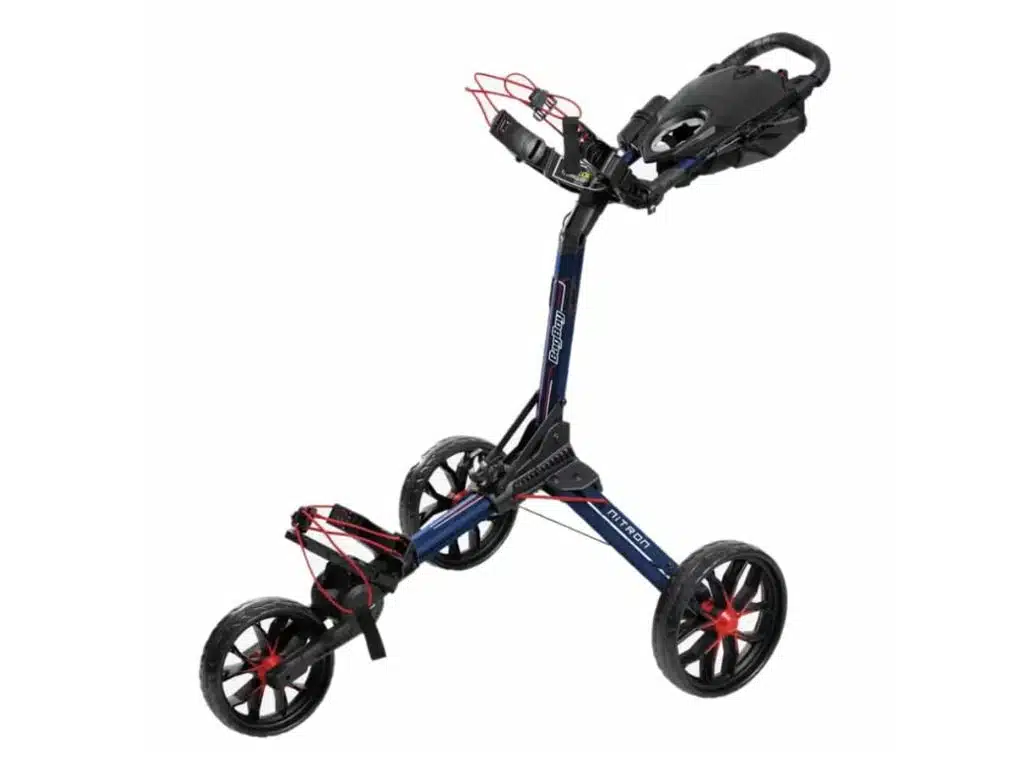
Meet your ultimate golf companion. This premium push cart boasts lightning-fast Nitron piston opening, a full-feature scorecard console, a mobile device holder, and extra-large storage. Lightweight yet incredibly stable on any terrain.
Big Max Blade Trio

The problem with most push carts isn’t on the course. It’s at home. You get back from a round, you pop the trunk, and you’ve got a cart that folds into a cube roughly the size of a small suitcase. It sits in your garage taking up space, it barely fits in a small car trunk, and if you play at a club with a bag room, forget about storing it in a locker.
The Blade Trio is built around one design principle: fold flat. Using a two-lever system, it collapses down to about 8 inches deep. That’s not a typo. Eight inches. A standard push cart folds to 13 to 15 inches at its thinnest. The Blade Trio fits in spaces where other carts simply don’t.
It’s a three-wheeler made from powder-coated aluminum with minimal plastic, so it looks and feels premium. At 14.77 pounds, it’s one of the lighter carts in this section. The custom-molded foam wheels roll smoothly across all terrain, and the XL organizer panel has dedicated slots for your phone, rangefinder, scorecard, and golf balls.
Here’s the catch, and it’s worth being direct about: the Blade Trio doesn’t include a cup holder or umbrella holder out of the box. Those are sold separately. For a cart at this price point, that’s a deliberate trade-off. Big Max made the cart flat-foldable by removing the accessories that would prevent it from collapsing that thin. You’re buying portability first. The accessories are an extra cost.
The other thing to know: it uses a foot brake instead of a hand brake. I prefer a hand brake; it’s easier to reach without looking down. The foot brake on this cart works reliably, but if you’re coming from a hand-brake cart, there’s an adjustment period.
Who should buy this: Golfers with small cars, tight storage spaces, or anyone who wants to store their cart in a club locker. If you’ve ever looked at a folded push cart and thought “there’s no way that fits,” this is the cart that changes that.
| Spec | Detail |
|---|---|
| Price | $349.00 |
| Weight | 14.77 lbs |
| Folded | 27.9″ × 23.2″ × 8.2″ |
| Wheels | 3 |
The Blade Trio folds flat. But if you want the auto-open convenience of the BagBoy system combined with the ability to turn on a dime, there’s a cart that does exactly that.

Experience premium golf convenience with the Big Max Blade Trio Golf Push Cart, ultra-compact, ultra-stable, and engineered for effortless rolling.
BagBoy Nitron Swivel

Here’s the problem the standard Nitron doesn’t solve: tight courses. If you play on a course with narrow cart paths, frequent 90-degree turns, or crowded staging areas near the greens, a fixed front wheel means you’re constantly lifting the front of the cart to pivot. It works, but it’s extra effort, and on a busy course where you’re trying to keep pace, that friction adds up.
The Nitron Swivel adds a 360-degree lockable front wheel to the BagBoy platform. When you need to navigate a tight turn, the wheel swivels freely and the cart follows you around the corner in a single smooth motion. When you’re on a long straight stretch and you want the cart to track dead straight, you lock the wheel and it behaves like a fixed-front cart. You get both modes in one cart.
The upgrades don’t stop at the wheel. BagBoy also added a second magnetic plate on the handle, so you can mount a rangefinder on one side and a speaker or towel on the other simultaneously. The underbar accessory bag now has elastic compartments that keep items from shifting during the round. And the rear brake locks both back wheels at once instead of just one, which means the cart won’t spin around the braked wheel on a steep sidehill.
The trade-off is weight. The Nitron Swivel comes in at 18.5 pounds, 1.8 pounds heavier than the standard Nitron. The swivel mechanism adds hardware, and hardware adds weight. Over 18 holes, 1.8 pounds is noticeable. It’s not a dealbreaker, but it’s real.
The same Nitro-Piston auto-open system is here. One pull and it’s standing ready to load.
Who should buy this: Golfers who play on tight, complex courses where maneuverability matters, or anyone who uses multiple magnetic accessories and wants dedicated mounting space for each. If your course is open with wide paths, the standard Nitron saves you $60 and 1.8 pounds.
| Spec | Detail |
|---|---|
| Price | $359.95 |
| Weight | 18.5 lbs |
| Folded | 18.7″ × 13″ × 22″ |
| Wheels | 3 (360° lockable front) |
The BagBoy carts are all about the mechanism, how they open, how they steer. The Big Max Autofold FF is about something different: how it disappears when you’re done with it.
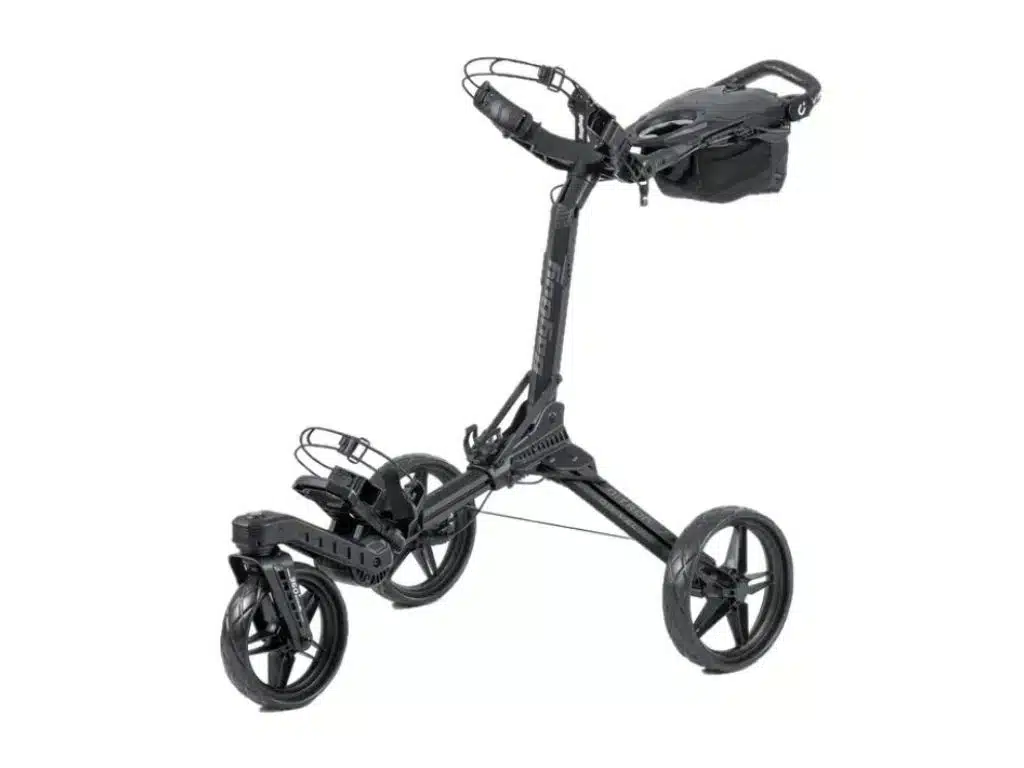
BagBoy Nitron Swivel Golf Push Cart Featuring Nitro Piston technology for an instant, effortless open, this cart combines lightning-fast setup with a 360-degree swivel front wheel for unmatched fairway maneuvering. Perfect for walking golfers.
Big Max Autofold FF

Most four-wheel carts have a problem. They’re stable on the course, but when you fold them up, they’re big. The wide base that gives you stability on a sidehill becomes a wide, awkward rectangle in your trunk. If you’ve ever tried to fit a four-wheel cart into a small car alongside a full bag of clubs, you know what I’m talking about.
The Autofold FF solves this with a flat-fold mechanism that’s genuinely different from what most carts do. You flip a lever, lift the front, and all three wheels tuck up simultaneously while the frame collapses flat. The whole process takes about three seconds. The result is a cart that folds to 10 inches deep, significantly slimmer than most four-wheel designs, and competitive with three-wheel carts.
The four-wheel base gives you the stability advantage on uneven terrain. The two-axle construction keeps the cart planted on sidehills and slopes where a three-wheel cart would want to drift. The aluminum frame runs about 17.6 pounds, the wheelbase is wide and stable, and the organizer console has a hinged cover with a magnetic scorecard clip. The Quick Lok ports on the frame let you snap on the included umbrella and beverage holders.
Here’s what to know before you buy: the Autofold FF does not have swiveling front wheels. The four wheels are fixed, which means tight turns require the same wide-arc technique as the Quad Pro. On open courses, you’ll never notice. On tight courses, it’s a limitation. Also, at roughly $430 USD, this is the most expensive manual cart in this section. You’re paying for the engineering of the flat-fold mechanism on a four-wheel platform; that combination is genuinely rare.
The 5-year warranty (with registration) is the best in this section by a significant margin.
Who should buy this: Golfers who want four-wheel stability but live in a small apartment, drive a small car, or need to store their cart in a club locker. If you want stability without the storage penalty, this is the cart.
| Spec | Detail |
|---|---|
| Price | ~$430 USD |
| Weight | 17.6 lbs |
| Folded | 31″ × 9″ × 24″ (approx.) |
| Wheels | 4 (fixed) |
The Autofold FF folds flat for a four-wheel cart. The Blade IP 2 takes flat-folding to a place that genuinely seems impossible until you see it.
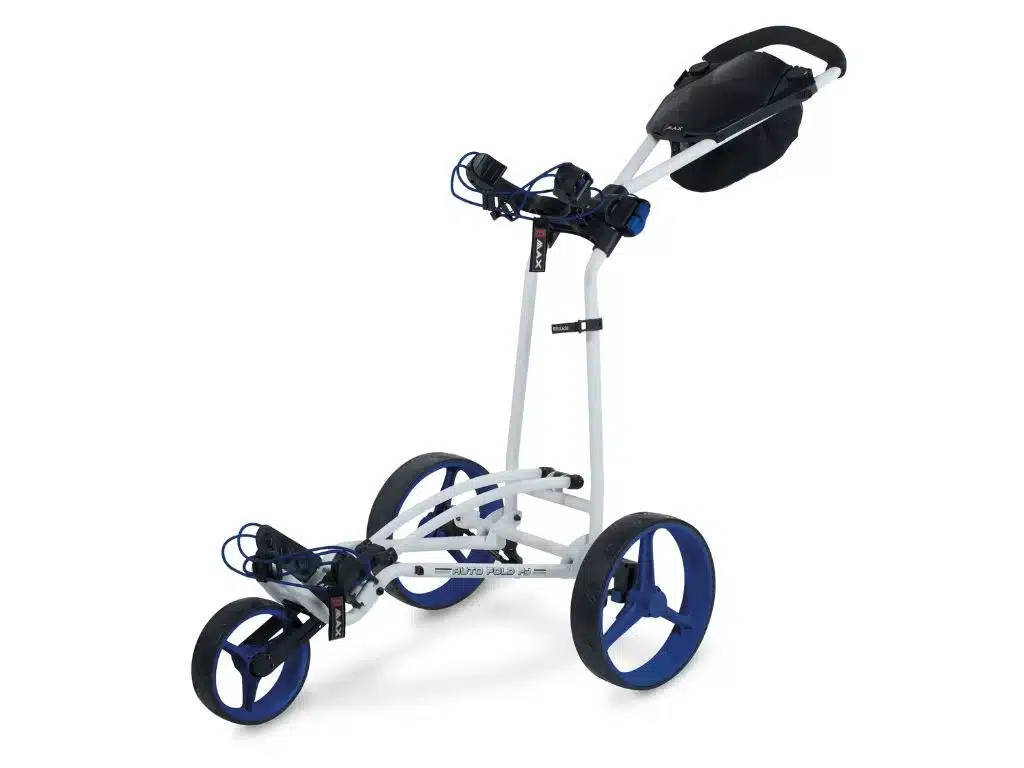
Experience the perfect blend of innovation and convenience with the Big Max Autofold FF golf push cart. Its ultralight design and automatic folding system make it a must-have for golfers seeking hassle-free mobility on the course.
Big Max Blade IP 2

Here’s a number: 4.92 inches. That’s how thin the Blade IP 2 is when folded. Not 4.92 inches at one end and thicker at the other, 4.92 inches across the whole cart. It folds about as flat as a laptop bag. I’ve seen people store this cart under a bed. It fits in lockers that couldn’t possibly accommodate any other push cart on this list.
The way it achieves this is worth understanding. As you fold the cart, the rear wheels automatically tuck inward. They don’t just fold down; they retract into the frame. The result is a folded profile that’s thinner than a standard briefcase. This is the flattest-folding push cart in golf, and it’s not particularly close.
The frame is aerospace-grade aluminum with almost no plastic. At 13.67 pounds, it’s the lightest cart in this section. The XL organizer panel is large, with dedicated slots for your phone, rangefinder, scorecard, and golf balls. The dual foot brakes lock both rear wheels simultaneously.
Now, the catches, and there are two worth knowing. First, like the Blade Trio, the Blade IP 2 doesn’t include a cup holder or umbrella holder. Those are sold separately through Big Max’s Quick Fix and Quick Lok accessory system. You’re buying the cart; the accessories are extra. Second, the foot brake. Same story as the Blade Trio: it works reliably, but if you prefer a hand brake, this cart won’t change your mind.
At $399, this is the most expensive three-wheel manual cart in this section. You’re paying for the engineering of the flat-fold mechanism and the aerospace aluminum construction. If compact storage is your primary concern, the premium is justified. If it’s not, the Blade Trio gives you most of the same flat-fold benefit for $50 less.
Who should buy this: Golfers who need the absolute minimum storage footprint, a small car, a tight locker, limited garage space, and want the lightest possible cart without going electric. This is the cart for golfers who treat portability as the non-negotiable.
| Spec | Detail |
|---|---|
| Price | $399.00 |
| Weight | 13.67 lbs |
| Folded | 34.6″ × 24.4″ × 4.92″ |
| Wheels | 3 |

The Big Max Blade IP 2 push cart stands out as the best choice for golfers seeking unmatched durability and a lightweight design. Engineered for performance and convenience, it enhances every round with smart features and easy handling. Whether navigating hills or tight fairways, this cart delivers pro-level support to elevate your game.
THE BEST ELECTRIC PUSH CARTS OF 2026
Before we get into these carts, I want to be direct about something: the electric category is where the most money gets wasted in golf equipment.
Not because electric carts are bad; several of them are genuinely excellent. But because the marketing in this category is designed to make you feel like you need more automation than you actually do. Every step up the price ladder adds a new feature. Remote control. GPS. Gyroscope tracking. Hazard avoidance. Autonomous follow mode. Each one sounds compelling in a product video. The question is whether you’ll actually use it on the course, in the rain, on a Tuesday morning when you’re just trying to get 18 holes in before work.
What surprised me most when I tested these side by side is how little the automation actually changes the experience for most golfers. A $599 hybrid cart and a $2,599 autonomous caddy both get your bag from the first tee to the 18th green. The difference is in the details, and whether those details are worth the price gap.
Here’s the key buying mistake in this category: buying for the ceiling instead of the floor. Most golfers buy the most impressive cart they can afford, then use 40% of its features. The smarter move is to identify the minimum automation you actually need, buy that cart, and keep the rest of your money.
One practical note before we start: most of these electric caddies work significantly better with cart bags than stand bags. Some smaller stand bags won’t fit at all. If you’re shopping for an electric cart, you may want to think about a cart bag at the same time.
Here’s what you’ll know by the end of this section: exactly where each price jump is justified, and exactly where it stops buying you anything you’ll use.
MGI E-Boost

The problem with fully electric carts for some golfers isn’t the price. It’s the commitment. You’re no longer pushing your cart; you’re managing it. You set a speed, you walk alongside it, and you spend the round monitoring a machine instead of just walking. For golfers who genuinely enjoy the physical act of pushing, that’s a different experience than what they signed up for.
The E-Boost is built for that golfer. It looks and pushes like a normal three-wheel cart. Most of the time, that’s exactly what it is: you push it, it rolls, you walk. But there’s a 240-watt brushless motor hidden inside. When you hit a long climb, or your legs start getting tired on the back nine, you tap a button, and the motor kicks in to take the load. You’re still pushing, but the motor is doing most of the work on the hill.
That’s a fundamentally different idea from every other cart in this section. You’re not committing to full automation. You’re buying a boost for the moments that need it.
Here’s the catch, and it’s the most important thing to know about this cart: the battery is rated for approximately 14 holes of continuous electric use. Not 18. Fourteen. If you use the boost on every hill for a full round, you will run out of power before you finish. The smart move is to push manually on flat terrain and use the boost only on climbs; that’s how you get through 18 holes on one charge. The cart freewheels perfectly when the motor is off, so there’s no drag when you’re pushing manually.
The other thing to know: there’s no battery level indicator on the handle. You can’t see how much charge you have left. You’re managing the battery by feel, not by data. That’s a real limitation for a $599 cart.
At 25 pounds with the battery, it’s heavier than any manual cart in this guide. The compact fold is decent but not the smallest here.
Who should buy this: Golfers who love pushing their cart and just want help on hills. If you walk hilly courses and your back or knees are starting to complain on the climbs, this is the cart that extends your walking career without changing how you experience the round.
| Spec | Detail |
|---|---|
| Price | $599.00 |
| Type | Hybrid push/electric |
| Weight | 25 lbs (with battery) |
| Battery | ~14 holes continuous electric |
| Folded | 30.5″ × 17.4″ × 12.6″ |
But if you want the cart to do all the pushing, not just help on hills, you need to step up to a fully motorized caddy. And the first one worth considering starts here.
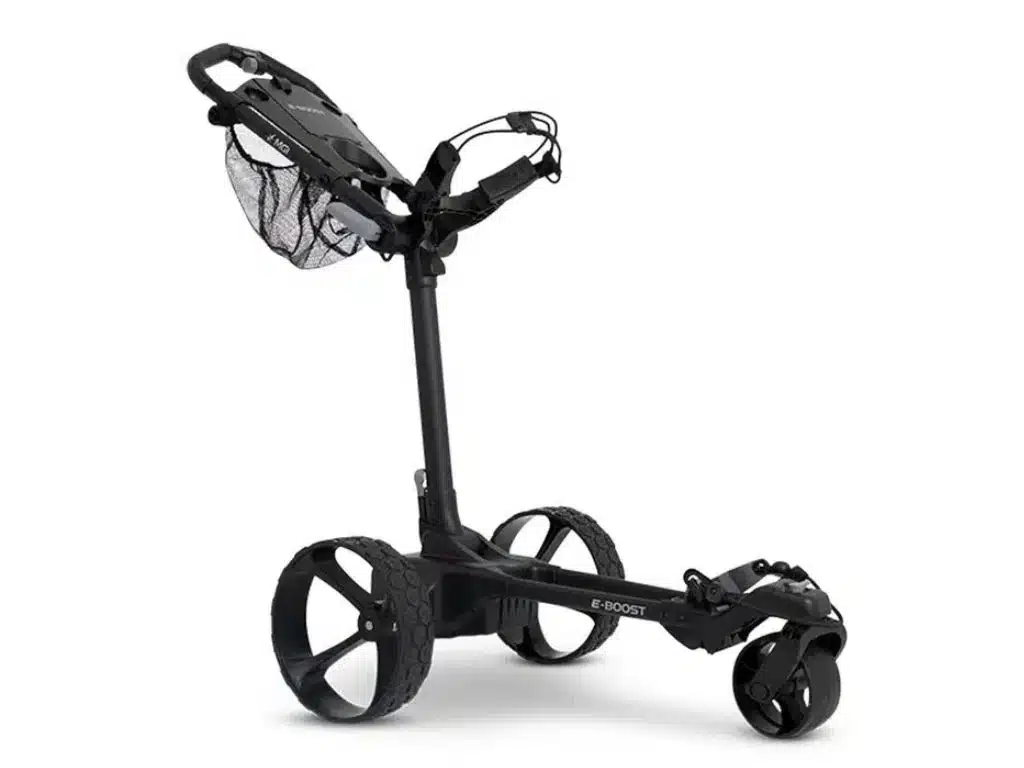
Upgrade your game with the MGI E-Boost Pushcart. Featuring advanced electric power assist, it tackles hills effortlessly while keeping you fresh. Lightweight, durable, and built for performance.
MGI ZIP X5

The step from the E-Boost to the ZIP X5 is the biggest conceptual jump in this entire guide. You’re no longer pushing the cart at all. You set a speed on the handle dial, and the cart rolls along at that speed while you walk beside it. The motor does all the work.
What you’re really paying for at this price is control on hills. The X5 has automatic downhill speed control. When you’re descending a steep hill, the cart regulates its own speed so it doesn’t run away from you. It has an electronic park brake that holds the cart on any incline at the push of a button. And it has a controlled distance function: you program it to travel a specific distance, and it rolls that far and stops. Useful for sending the cart ahead to the next tee while you finish putting out.
The gyroscope keeps it tracking straight across uneven terrain, and the all-terrain rear wheels handle wet grass and rough ground without slipping.
Here’s the catch: this is not a remote-control cart. You walk alongside it and control it from the handle. You cannot send it across the fairway from where you’re standing. If remote control is what you want, this is not the cart. The next step up on this list is where remote control starts.
At 30.57 pounds with the battery, it’s heavier than the E-Boost but still one of the lighter electric caddies here. The 36-hole battery is the real advantage at this price: two full rounds on one charge, no range anxiety.
Who should buy this: Golfers who want the cart to do all the pushing on hilly courses but don’t need remote control. If you walk beside your cart anyway, the X5 gives you full hill management at the lowest price in the fully motorized category.
| Spec | Detail |
|---|---|
| Price | $1,099.00 |
| Type | Motorized, no remote |
| Weight | 30.57 lbs (with battery) |
| Battery | 36 holes |
| Folded | 27.55″ × 18.5″ × 16.5″ |
The ZIP X5 does all the pushing. But you still walk beside it. If you want to walk to your ball while the cart goes to a different spot, that’s remote control, and that’s where the next cart comes in.

The MGI ZIP X5 electric push cart redefines convenience and power for golfers. Lightweight yet robust, it offers unmatched ease and advanced tech to elevate every round.
Alphard Cyber Cart

Here’s the problem remote control solves that most people don’t articulate clearly: you and your bag don’t always need to be in the same place at the same time. You hit your shot from the left side of the fairway. Your bag is on the right side of the cart path. With a push cart, you walk to the cart, push it to your ball, set it down, hit, then push it to the next position. With a remote cart, you hit your shot, then guide the cart to you from where it’s standing. It’s a small thing per hole. Over 18 holes, it changes the rhythm of the round.
The Cyber Cart is the entry point into remote control on this list. Dual 180-watt hub motors drive each rear wheel independently, and a six-axis gyroscope keeps it tracking straight across slopes without constant steering corrections. The remote is an LCD handset with an out-of-range auto-stop; if the cart gets too far from the remote, it stops automatically.
Everything you’d want comes included in the box: phone holder, cup holder, umbrella holder, scorecard holder, USB-C charging port, and sand bottle holder. Most remote caddies at this price charge extra for those accessories. The Alphard bundles them.
Here’s the catch: this cart weighs 40 pounds with the battery. That’s the heaviest cart in this guide. The stability comes from the low center of gravity design, and that design requires mass. Getting it in and out of a car trunk is a workout. On the course it drives itself, so the weight doesn’t matter. In the parking lot, it does.
The other thing to know: the Cyber Cart uses your phone for GPS via the Hole 19 app. There’s no onboard screen. If you want yardage data on the cart itself without pulling out your phone, you need to step up to the MGI carts.
Who should buy this: Golfers who want remote control and a complete accessory bundle without paying for GPS they already have on their watch or rangefinder. If you want remote control at the lowest price on this list, this is the one.
| Spec | Detail |
|---|---|
| Price | $1,379–$1,450 |
| Type | Remote-control electric |
| Weight | 40 lbs (with battery) |
| Battery | 36 holes |
| Folded | 25″ × 20″ × 17.7″ |
The Cyber Cart gives you remote control. But if you play on courses with serious terrain, real hills, wet fairways, and rough ground, you need something built specifically for that.

The Alphard Cyber Push Cart redefines golf convenience with cutting-edge design, unmatched durability, and effortless handling, perfect for serious golfers aiming to elevate their game.
MGI Zip Navigator AT

The AT stands for all-terrain, and MGI means it. Twin 230-watt calibrated motors, one per rear wheel, give this cart real power on steep climbs. The patented Gyroscope Straight Tracker continuously monitors the cart’s orientation and independently adjusts each wheel’s speed to compensate for cross-slopes. On a fairway that falls away to one side, a standard remote caddy will gradually drift downhill. The Navigator AT holds its line.
The full directional remote handles forward, reverse, left, right, and speed from up to about 100 feet away. The all-terrain rear tread wheels dig into wet and rough ground. A foldable fifth wheel at the back acts as an anti-tip stabilizer on steep climbs, preventing the cart from tipping backward when you’re ascending a sharp incline. Downhill speed control keeps it from running away on descents. Electronic park brake holds it on any slope.
Here’s the catch: this cart weighs 37 pounds with the battery. It’s not as heavy as the Alphard, but it’s heavier than the lighter MGI models. The folded size is also larger than the GPS+ model above it on the price ladder, which is counterintuitive but reflects the different engineering priorities of the all-terrain platform.
The other thing to know: there’s no GPS screen on this cart. You get a digital display with 20-level speed control, but no course maps, no yardage data. If you want GPS on the cart, you’re paying for the next model up.
Who should buy this: Golfers who play on genuinely challenging terrain, steep hills, wet courses, rough ground, and who want a remote caddy built to handle it. If your course is hilly and you’ve watched other electric caddies struggle on the climbs, this is the cart that doesn’t.
| Spec | Detail |
|---|---|
| Price | $1,699.00 |
| Type | Remote-control, all-terrain |
| Weight | 37 lbs (with battery) |
| Battery | 36 holes |
| Folded | 28″ × 19″ × 17″ |
The Navigator AT handles any terrain. But if you want your yardage data and your remote caddy in the same machine, so you can leave the GPS watch at home, that’s the next cart.

Master any fairways effortlessly with the high-tech MGI Zip Navigator AT Push Cart. Benefit from smart gyroscope control and 36-hole endurance. Get the guide now!
MGI ZIP AI Navigator GPS+

The GPS+ adds one thing to the Navigator AI platform: a bright four-inch full-color touchscreen with fully integrated GPS, preloaded with hole maps for more than 40,000 courses. Your distances to the front, middle, and back of the green are on the cart screen. Hazard locations are on the cart screen. Your digital scorecard is on the cart screen. You don’t need a separate GPS device, and you don’t need to pull out your phone.
Everything that makes the Navigator AI work carries over: gyroscope straight tracking, downhill speed control, the long-range remote, all-terrain wheels, and the electronic park brake.
Here’s where you need to be honest with yourself about the math. The only thing you’re paying $196 more for over the Navigator AI is that screen. If you already own a rangefinder or a GPS watch you trust, you’re paying $196 for a screen you don’t need. That’s a real cost for a feature you already have.
But if you’ve been wanting to consolidate, to walk with one device instead of two, to have your yardages and your caddy in the same machine, that’s where the GPS+ makes sense. It weighs 38.99 pounds with the battery, slightly heavier than the AI. The folded size is actually more compact than the AT at 24.4″ × 18.1″ × 15.4″.
Who should buy this: Golfers who want to eliminate their separate GPS device and put everything on the cart. If you’re already carrying a GPS watch or rangefinder you trust, save the $196 and buy the Navigator AI.
| Spec | Detail |
|---|---|
| Price | $1,895.00 |
| Type | Remote-control with GPS touchscreen |
| Weight | 38.99 lbs (with battery) |
| Battery | 36 holes |
| Folded | 24.4″ × 18.1″ × 15.4″ |
The GPS+ puts your yardages and your caddy in one machine. The Halo combines your yardages, your caddie, and your course hazard avoidance into one machine and adds the option to make it follow you without touching the remote at all.

Experience next-level golf with the MGI ZIP AI Navigator GPS+ Electric Push Cart, premium design, AI navigation, and effortless performance.
MGI AI Navigator Halo

The Halo is MGI’s 2026 flagship and the most advanced caddy on this entire list. Out of the box, it’s a fully loaded remote caddy: four-inch color GPS touchscreen, dual in-hub brushless motors driving each wheel independently, gyroscope straight tracking, an improved anti-tip fifth wheel, and MGI’s Geo Protect hazard system.
Geo Protect is worth understanding because it’s genuinely different from anything else on this list. Most GPS caddies are passive; they show you course data on a screen, and you use that information to steer the cart manually. Geo Protect feeds GPS course data directly into the cart’s movement logic. As the cart moves, it continuously compares its live GPS position against a database of hazard boundaries, bunkers, water hazards, and out-of-bounds markers. When it detects that it’s approaching a hazard, it slows, stops, or adjusts its path automatically. You don’t have to steer it away from the bunker. It steers itself away.
Over 18 holes, the cumulative attention required to steer a standard remote caddy around hazards is a real cognitive tax. Geo Protect eliminates it.
The headline is what you can add to it. The optional Halo Eye is a 2D LiDAR sensor, the same category of laser-scanning technology used in self-driving cars, and it unlocks true Follow Me mode. The cart tracks your movement, holds a set distance behind you, and actively steers around obstacles in its path. There’s a Point-to-Point mode to send it to an exact spot on the course map, and a Return Home mode to call it back to you. Early users describe the LiDAR tracking as more consistent than older RF-based follow systems, which can lose signal in bright sunlight.
Now, the catches, and I’m going to be straight with you about all of them.
First: the Halo Eye is not included in the $2,599 base price. It’s a separate $396 add-on, or you can buy the Halo Eye bundle for $2,995. The follow mode that makes this cart famous costs extra on top of the base price. The real number for the full autonomous experience is close to $3,000.
Second: the Halo Eye must be removed from the cart before you fold it for transport. MGI designed it this way to protect the sensor, but it adds a step to your post-round routine. If you play 100 rounds a year, that’s 100 times you’re attaching and detaching a sensor. Worth factoring in.
Third: Geo Protect occasionally over-intervenes. On narrow cart paths that run adjacent to mapped hazard zones, the system may stop the cart unnecessarily. You can disable it via the touchscreen, but it’s a real-world limitation that early users flag.
The compact fold is genuinely improved over previous MGI models; the rear wheels retract inward automatically, reducing the folded footprint by 20% compared to the Navigator AT. At 27″ × 15″ × 14″ folded, it fits in most vehicle trunks without wheel removal.
Who should buy this: Golfers who play multiple rounds per week, walk courses with serious terrain, and want the most technologically complete walking caddy available. If you’re a gear person who will use Geo Protect and Follow Me mode every single round, the Halo is worth it. If you just want to walk without pushing, the Alphard at $1,450 already does that.
| Spec | Detail |
|---|---|
| Price | $2,599 (base) / $2,995 (Halo Eye bundle) |
| Type | Remote-control, GPS, optional autonomous follow |
| Weight | 33 lbs (with battery) |
| Battery | 36 holes |
| Folded | 27″ × 15″ × 14″ |
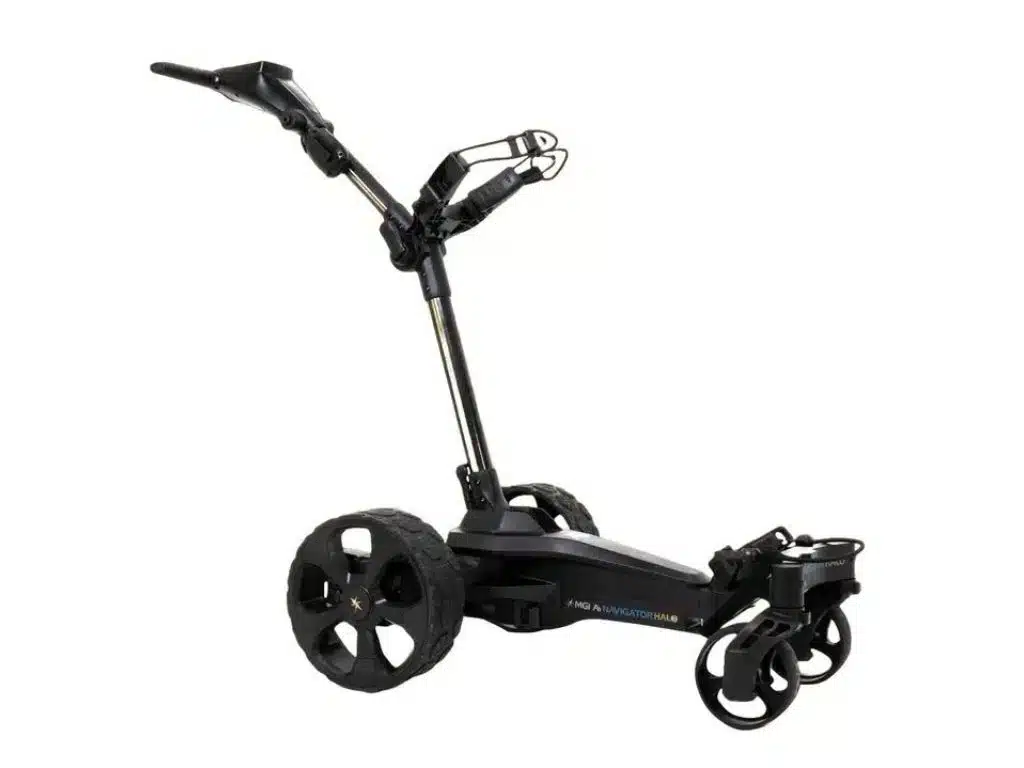
Looking for the absolute best electric golf cart? Our in-depth MGI AI Navigator Halo push cart review details the brushless motor performance, compact folding size, and current pricing.
Frequently Asked Questions
What are the benefits of using a golf push cart?
Golf push carts reduce the physical strain of carrying a golf bag by allowing walking golfers to push their bags instead. They enhance convenience and comfort, often featuring drink holders, umbrella mounts, and storage compartments for an improved on-course experience.
What is the most compact and portable golf push cart available?
The MGI AI Navigator Halo is acclaimed for its ultra-compact flat-fold design, folding to just over 8 inches thick. It weighs under 15 pounds, making it as hassle-free as possible for transport and storage while still being stable and light on the course.
Which golf push cart offers the fastest setup?
The Bag Boy Nitron features patented Nitro-Piston technology, enabling the cart to spring open automatically for rapid setup. It folds compactly and weighs under 17 pounds, combining convenience, quick setup, and solid features like a handle-mounted brake and drink holders.
What features do high-end electric golf caddies offer?
Top-tier electric caddies like the MGI Ai Navigator GPS+ come with full directional remote control, twin motors, gyroscopic tracking, stabilizing wheels, touchscreen GPS with over 40,000 courses, drink and umbrella holders, and intuitive folding mechanisms.
Can I convert my existing push cart into an electric model?
Yes, the BagBoy Nitron Swivel converts traditional carts into remote-controlled electric caddies by replacing rear wheels with motorized ones. It includes features like dual motors, downhill speed control, an automatic parking brake, gyroscopic stabilization, and a battery supporting 18 to 36 holes.
HOW TO PICK THE RIGHT PUSH CART
The pattern I kept seeing across every cart in this guide is this: golfers who are happiest with their cart are the ones who bought for the floor, not the ceiling. They figured out the minimum feature set that actually changes how they experience a round, and they stopped there.
Here’s the decision framework.
Step 1: Manual or electric?
Ask yourself one question: do you want to push your cart, or do you want the cart to push itself?
If pushing is part of the round for you, and you like the physical engagement of walking and pushing, stay in the manual section and save significant money. The best manual cart for most golfers is the BagBoy Nitron Auto-Open at $319. It’s fast to set up, solid to push, and built to last.
If you’d rather let the cart do the work, move to the electric section. But be honest about why. If it’s because your course is hilly and your back is complaining, that’s a real reason. If it’s because the remote control looks cool in a product video, that’s not a reason to spend $1,400.
Step 2: Within electric, where does your money stop paying off?
The automation ladder in this guide looks like this:
- $599 (E-Boost): Motor helps on hills. You still push. Best for golfers who love walking and just need help on climbs.
- $1,099 (ZIP X5): Cart does all the pushing. No remote. Best for golfers who walk beside their cart anyway and want hill management.
- $1,379–$1,450 (Alphard Cyber Cart): Remote control. Cart goes where you point it. Best for golfers who want remote control without paying for GPS they already have.
- $1,699 (Navigator AT): Remote control plus all-terrain engineering. Best for golfers on genuinely challenging courses.
- $1,895 (GPS+): Remote control plus onboard GPS. Best for golfers who want to eliminate their separate GPS device.
- $2,599–$2,995 (Halo): Remote control, GPS, hazard avoidance, and optional autonomous follow. Best for high-frequency walkers who will use every feature every round.
The question at each step is simple: does the next feature up change how I experience a round? If yes, pay for it. If you’re not sure, you probably won’t use it enough to justify it.
Step 3: Three carts for three types of golfers
If you’re still not sure, here’s where I’d put the money:
The budget walker: BagBoy Quad Pro 4-Wheel at $299.95. Four-wheel stability, maintenance-free tires, magnetic plate, Top-Lok compatible. It does everything a walking golfer needs at the lowest price on this list.
The hilly course walker: MGI ZIP X5 at $1,099. Full motorized pushing, automatic downhill speed control, electronic park brake, 36-hole battery. Built for courses with real elevation changes. No remote, which keeps the price down.
The gear enthusiast who walks five days a week: MGI AI Navigator Halo at $2,599 base. Geo Protect, integrated GPS, compact fold, and an upgrade path to full autonomous follow mode. The most complete walking caddy available. Worth every dollar if you’ll actually use it.
The best push cart for you is the cheapest one that does what you actually need. The industry would rather you spend more. That’s exactly why you shouldn’t.
Which one are you rolling with in 2026? Drop it in the comments. If this helped you figure out which cart is right for you, subscribe. I do this for every major gear category. Peace.

About the author
Paul Liberatore
Paul Liberatore is the founder of Golfers Authority and a former four-year golf gear contributor to Sports Illustrated. He tests golf equipment hands-on to help golfers make better buying decisions.