A GW wedge, or gap wedge, fills the loft void between your pitching wedge and sand wedge, typically ranging from 50° to 52°. You'll use it for those frustrating 90-120 yard shots where a PW flies too far and a SW falls short. It's not a specialty club; it's a precision tool designed for consistent distance control on full and partial swings. Understanding how it fits your specific wedge setup makes all the difference.
Understanding the Gap Wedge and Its Role in Your Golf Bag
The gap wedge might be the most misunderstood club in your bag, if you even have one. Here's the reality: there's an 8-10 degree loft gap between your pitching wedge and sand wedge, and that translates to roughly 20-30 yards of no-man's-land on your approach shots.
The gap wedge exists to solve this exact problem. It sits between 48° and 54° of loft, giving you reliable distances in that awkward 90-120 yard range where you'd otherwise be guessing with partial swings.
You need this club for those in-between yardages that force uncomfortable choices. Instead of muscling up a sand wedge or backing off a pitching wedge, you make a confident, committed swing. You can also create multiple yardages by using partial swings at varying speeds between 50-70%. That consistency directly impacts your scoring.

Numbers tell the real story with gap wedges, and understanding loft specifications separates smart club selection from guesswork.
Your GW typically sits between 48 and 52 degrees, with most landing in the 50 to 52 degree sweet spot. Here's where it gets practical: your pitching wedge runs 42 to 48 degrees, while your sand wedge spans 54 to 58 degrees. The GW bridges that gap perfectly. Gap wedges serve as a transition between pitching wedges and sand wedges, which is why they're also known as approach wedges, attack wedges, or A wedges.
Don't overlook the 4 to 6 degree rule. You need consistent spacing between wedges for predictable yardage jumps. A common setup runs PW at 46 degrees, GW at 50, SW at 54, and LW at 58 or 60. The Gap Wedge was specifically created to fill loft gaps that emerged as modern iron lofts became stronger over time. Most golfers should carry 1-2 hybrids to avoid distance gaps in their bag, and the same principle applies to wedge selection.
Check your iron set's pitching wedge loft initially. Stronger modern PWs at 43 degrees demand a 48-degree gap wedge to maintain proper spacing.
While manufacturers love throwing around impressive distance numbers, your real-world gap wedge performance depends entirely on your swing speed and how well you've dialed in this club.
Most golfers land their gap wedge shots between 80 and 110 yards. Faster swingers push that ceiling to 125 yards, while slower swing speeds drop the floor considerably. Your gap wedge fills the scoring zone between your pitching wedge's 100-140 yard range and your sand wedge's 50-90 yard ceiling. The 52-degree club face provides the versatility needed to bridge this distance gap effectively.
You'll reach for this club on approach shots where precision matters more than raw power. It's your go-to for light rough exits, moderate flight paths that need stopping power, and those awkward distances where other wedges just don't fit. The gap wedge emphasizes distance control and accuracy over the specialty turf interaction you'd expect from sand or lob wedges. Command three-quarter swings, and you've got even finer distance control. Using controlled swings like half or three-quarter motions helps you match your desired distances more accurately than relying on full power.
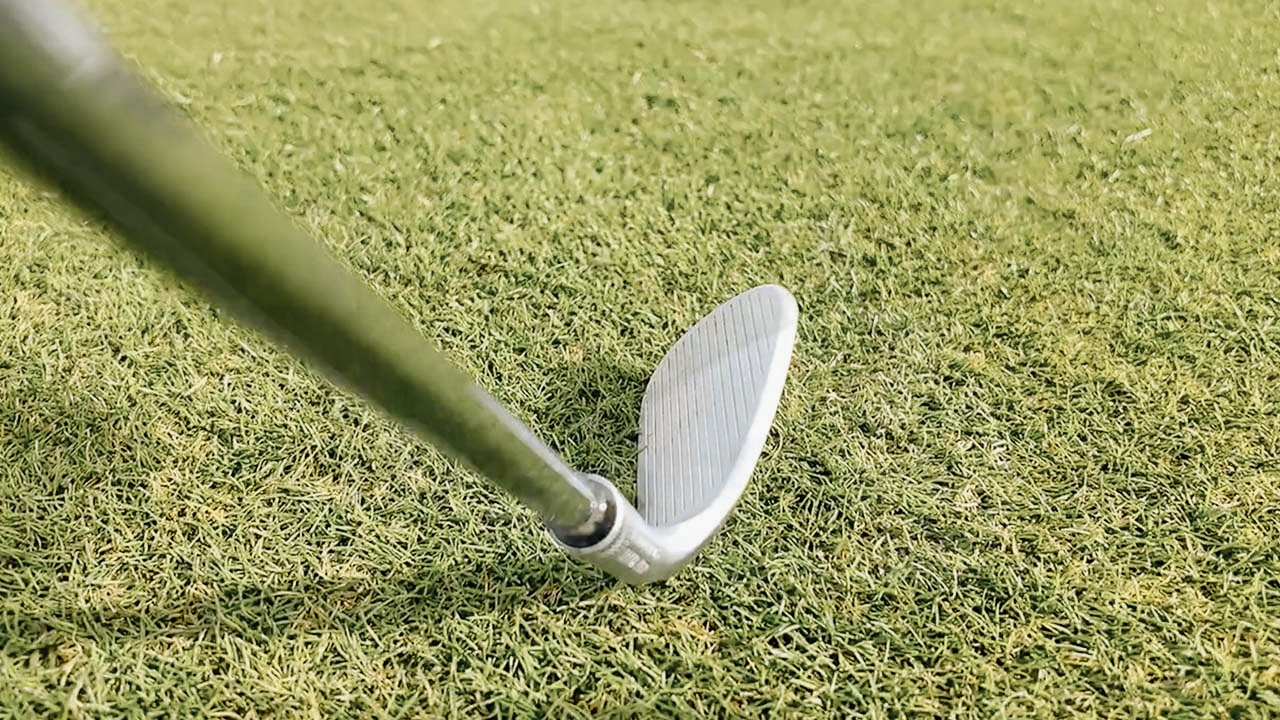
Bounce angle sounds technical, but it's actually the single most misunderstood spec on any wedge you'll buy. Here's the reality: bounce is simply the angle between the leading edge and the sole's lowest point. A GW wedge typically runs 8° to 12° of bounce, which handles most conditions you'll encounter.
Don't fixate on bounce alone. Sole width matters just as much. A wider sole increases effective bounce and prevents digging, even if the stated bounce angle seems moderate. Conversely, a narrow sole reduces effective bounce regardless of what's stamped on the club.
Camber plays a role, too. More rounding on the sole decreases effective bounce, while a flatter profile increases it. You're choosing a system of features, not a single number. The right bounce selection depends on your swing style, course conditions, and the typical shots you play most frequently.
Before you obsess over loft numbers, understand this fundamental truth: your gap wedge anchors the entire short game, not your sand wedge or lob wedge.
Here's why: that 50-54 degree club sits at the mathematical center of your scoring range. You'll hit more full-swing approach shots from 80-110 yards than any other distance inside 150. Building outward from your gap wedge guarantees consistent four-to-six degree spacing throughout your wedge set. The gap wedge features wide soles for better ground contact and grooves specifically designed for spin control.
Start by identifying your pitching wedge loft, typically 44-48 degrees, depending on your iron set. Your gap wedge should sit exactly in the middle between that number and your sand wedge's 54-56 degrees. This eliminates the 15-20 yard distance void that destroys scoring opportunities. Every other wedge selection flows from this central anchor point. Most matched iron sets do not include a gap wedge, requiring golfers to purchase one separately to complete their scoring club lineup. Since golfers are limited to 14 clubs in their bag, strategic wedge selection becomes critical for maximizing short game performance.
Once you've anchored your wedge setup around that gap wedge, the real performance differences come down to specs most golfers never examine, and manufacturers rarely explain clearly.
Bounce angle matters more than loft for turf interaction. Your gap wedge's bounce typically ranges from 8° to 12°, and this determines whether the club glides under the ball on tight fairway lies or digs awkwardly. Lower bounce suits firmer conditions; higher bounce prevents chunking in softer turf.
The clubhead runs slightly heavier than your pitching wedge intentionally. That extra weight stabilizes partial swings and delivers consistent contact on delicate approach shots between 80 and 115 yards. With its 48 to 52 degrees of loft, the gap wedge fills the distance void between your pitching wedge and sand wedge perfectly. Just as proper fitting can reduce shot dispersion significantly with your driver, matching wedge specs to your swing produces more consistent scoring club performance.
Dual-bounce sole grinds let you manipulate performance by opening the face, changing how the club interacts with turf without switching clubs. The compact clubhead profile with minimal offset is built for workability rather than forgiveness, allowing skilled players to shape shots with precision.
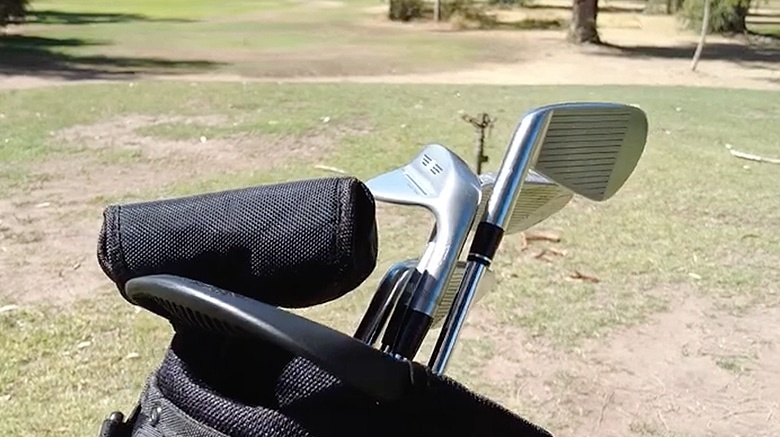
You don't need a gap wedge yet. Perfect your pitching wedge and sand wedge initially; they'll handle most situations you'll face. The real question isn't about buying another club; it's whether you actually have a distance gap that's costing you strokes. Track your current yardages. If you're consistently leaving 20+ yard holes between your PW and SW, then a gap wedge makes sense. Until then, focus on technique.
You'll hear the "75 rounds" rule tossed around, and it's actually solid advice, not just marketing fluff. For weekend players, that translates to replacing your gap wedge every 12 to 36 months. If you're grinding out range sessions or playing sandy courses, shorten that timeline. The real test? When your shots start rolling out instead of checking up, those grooves are done.
Yes, you can, but let's be real, it's situational. Your gap wedge works best from bunkers with low lips where you need the ball to run out. Open the face slightly, keep your hands neutral, and make a shallow swing that skims the sand. For high-lipped bunkers or tight pins requiring a soft landing, you're fighting physics. Stick with your sand wedge there.
Match your gap wedge shaft to your irons; it's that simple. You'll get a consistent feel and predictable ball flight across your set. The marketing around "wedge flex" shafts creates unnecessary confusion; most are just stiff flex by another name. Don't overthink this. If you're playing regular flex irons, stick with regular in your gap wedge. Mismatched shafts only introduce variables you don't need in scoring situations.
The honest answer? The performance gap has shrunk dramatically. You'll notice forged wedges deliver slightly softer feedback and more immediate shot-shaping feel, while cast wedges offer better forgiveness on mishits. For most golfers, modern casting technology has closed this gap enough that it shouldn't drive your decision. Focus instead on grind, bounce, and loft; those factors affect your short game far more than manufacturing method ever will.
You don't need a gap wedge because some equipment guide told you so; you need one because that 15-yard distance hole between your pitching wedge and sand wedge is costing you strokes. A properly fitted GW with the right loft and bounce for your swing fills that gap and gives you a full-swing option where you'd otherwise be manipulating other clubs. That's not marketing; that's just smart course management.