To hit a wedge consistently, you'll need to nail the setup initially: position the ball center or slightly back, load 55-60% of your weight on your front foot, and keep your hands ahead of the ball at address. Your grip pressure should stay moderate, about a 5 or 6 out of 10. The real secret is tempo, moving your arms and body as one unit while maintaining your sternum over the ball throughout the swing, and perfecting these fundamentals reveals distance control that'll change your short game.
Before you obsess over fancy swing mechanics, let's address the elephant on the range: most golfers sabotage their wedge shots before they even start the backswing.
Your grip needs to be neutral, with the "V" formed by your thumb and index finger pointing toward your trail shoulder. Hold the club in your fingers, not your palm, and keep pressure at a moderate 5-6 on a scale of 1-10. Death-gripping the club kills your wrist hinge and destroys feel. Maintaining a slightly firm grip without excessive tightness allows for better club control throughout the swing.
For stance, go narrower than you think. Position your feet about an inch inside shoulder width and load approximately 60% of your weight onto your front foot. Place your hands slightly ahead of the ball with a subtle forward press. This setup promotes the descending strike that crisp wedge shots demand. Position the ball just back of center for standard shots, moving it further back when you need more control. Remember that wedges generate the most backspin of any club in your bag, so this setup helps you maximize that spin for higher trajectories and better stopping power on the green.
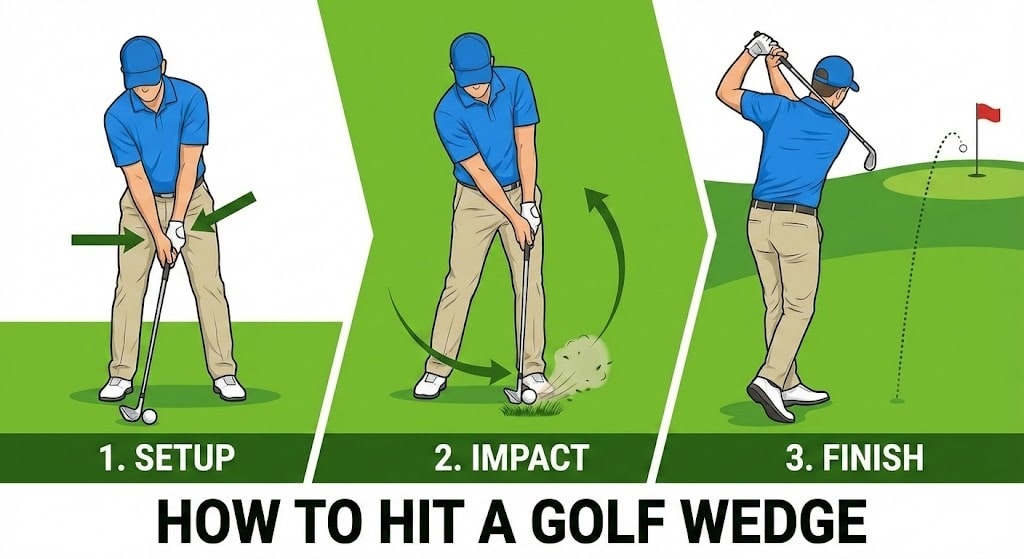
Ball position might seem like the simplest variable in your wedge game, yet it's the one that trips up golfers more than any other setup fundamental.
Here's the truth: center your ball position for virtually every wedge shot you hit. That's it. No complicated formulas or shot-specific adjustments needed for standard play. The center of your stance aligns perfectly with the bottom of your swing arc, promoting that slightly descending blow you need for crisp contact. If you need to work the ball lower for specific situations, moving the ball slightly back of center can effectively deloft the club.
Where golfers mess up is overthinking this. Ball too far forward? You'll catch it fat or launch it too high. Too far back? You'll dig and lose spin control. Use your shirt logo as a reference point; it should point directly at the ball. Simple, repeatable, effective. Once you've established proper ball position, move your hands forward slightly in front of the ball to create a shaft lean towards the target for optimal contact. Remember to maintain proper posture with your arms hanging naturally beneath your shoulders for the most consistent contact across all your wedge shots.
Getting your ball position nailed down means nothing if your swing turns into a choppy, handsy mess the moment you take the club back.
Here's the truth: wedge control lives and dies in your tempo. Your club reaches belt height at the halfway back position with the shaft horizontal—that's your checkpoint. From there, speed enters the scene only at the halfway point of your downswing when the club begins its release phase.
The real key? Your arms and body move as one synchronized unit. You're not hitting the ball; you're collecting it on your way through. The ball simply gets in the way of a predetermined swing path. Keep that sternum forward over the ball, maintain consistent tempo regardless of swing length, and watch your distance control evolve completely. Striking the ball dead center on the clubface can add as much distance as swinging faster, which is why tempo matters more than raw power. When your hips and hands engage together through impact, you'll achieve the clean contact that separates solid wedge players from those who struggle with inconsistent strikes. Your weight distribution should favor your lead side at around 55-60% for full swings, providing the stability needed for consistent ball-first contact.

Controlling your tempo means absolutely nothing if you can't translate that smooth swing into predictable yardages—and this is where most weekend golfers completely fall apart.
You need a distance matrix. Grab a launch monitor, hit five balls at half, three-quarter, and full swings with each wedge, and record the averages. Write those numbers directly on your shafts. This isn't obsessive, it's basic preparation. Remember that consistent ball position directly affects your loft at impact, which changes your launch angle and ultimately determines how far the ball travels.
Your divots tell the truth about impact quality. The divot should start just before the ball position, not behind it. Shallow divots indicate you're sweeping; deeper ones mean a steeper attack angle. Neither is wrong, but you must know which you produce because it affects spin and roll. Understanding your attack angle and tempo helps you select equipment that complements your natural swing characteristics.
Choke down an inch for instant distance reduction without changing mechanics. Simple adjustments beat complicated swing thoughts every time. Choking up on the club provides better distance control and lets you fine-tune yardages without overhauling your entire approach.
Your divot depth reveals more than impact quality; it's the single most crucial data point for selecting wedge bounce, and ignoring it explains why so many golfers' blade shots off tight lies or chunk the ball in soft sand.
If you're excavating deep craters, you need a high bounce (10°–14°) to prevent the club from burying. Sweepers who barely brush the turf thrive with low bounce (4°–6°). Most golfers fall somewhere in between and should grab mid bounce (7°–10°). For diggers, wedges with cambered soles help the club glide through turf rather than getting stuck.
Course conditions matter similarly. Soft turf and fluffy bunkers demand high bounce. Firm fairways and hard-packed sand require low bounce for clean contact. Remember that course elevation also affects how your wedges perform, as altitude changes can impact ball flight and landing angle.
Here's the real test: match your attack angle to your typical playing surfaces. Steep swing on soft courses? High bounce. Shallow swing on firm tracks? Low bounce. Players with more wrist hinge in their swing typically need higher bounce to accommodate their steeper angle of attack. Stop guessing.

You need three wedges: a pitching wedge (46°), a gap wedge (52°), and a sand wedge (56°). That's it. Forget the lob wedge for now, it's a specialty club you don't need yet. This setup gives you consistent 6-degree gaps between clubs, which translates to predictable distance control. Don't let anyone upsell you on a fourth wedge until you're consistently striking these three.
Weather wreaks havoc on your wedge game more than you'd think. A wet clubface slashes your spin dramatically; you'll lose nearly 1,000 rpm compared to dry conditions. Cold temperatures cut carry by 2–3 yards for every 10-degree drop. Wind demands you hit lower, controlled shots since higher trajectories become unpredictable. Your best defense? Wipe that clubface dry between shots and adjust your distance expectations accordingly.
You should grab your wedge when obstacles stand between you and the pin. Bunkers, thick rough, or ridges demand the higher path a wedge delivers. Firm, fast greens also call for a wedge because you'll need that spin to stop the ball quickly. If you've got a tight pin position with little room for rollout, don't gamble with a chip; pitch it and let the loft do the work.
You've probably heard you need new wedges constantly; that's partly marketing hype. Here's the reality: replace your wedges every 75 rounds or 12–36 months, depending on how much you play and practice. You'll notice grooves losing their bite when shots fly higher with less spin and control suffers around greens. Inspect them every 60–70 rounds. Don't wait until performance tanks; swap them before groove wear becomes obvious.
You don't need a range to sharpen your wedge game. Grab a mirror and rehearse your setup, check your posture, ball position, and alignment until it's automatic. Practice different backswing lengths to build feel for distance control. The impact drag drill, using an alignment rod behind the ball, trains proper hand position at contact. These simple drills build the muscle memory that translates directly to consistent shots on course.
You've now got the complete structure: grip pressure that stays consistent, ball position that matches your intent, tempo that doesn't rush, and bounce selection that fits your conditions. Stop overcomplicating this. The golfers who struggle with wedges aren't lacking talent; they're lacking a systematic approach. Pick one element, drill it until it's automatic, then stack the next. Your short game change starts with your very next range session.