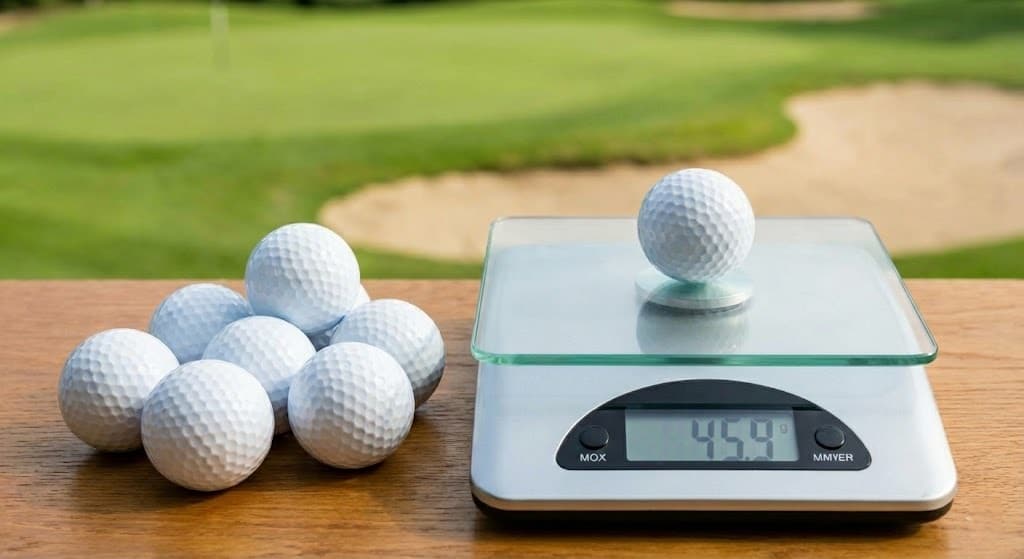
You've probably heard different numbers thrown around, but here's the truth: golf balls weigh a maximum of 1.62 ounces (45.93 grams) under USGA and R&A rules. There's no minimum weight, but that's irrelevant; every premium ball from Titleist to Callaway is engineered right at that ceiling because heavier means more stability and distance. Understanding why manufacturers obsess over those final fractions of a gram reveals how weight directly impacts your game.
The maximum weight of a golf ball is exactly 1.62 ounces (45.93 grams), not a fraction more. This isn't arbitrary; the USGA and R&A established this ceiling back in 1920, and it hasn't budged since. You might assume there's also a minimum weight requirement, but there isn't one. Manufacturers can technically make balls as light as they want.
Here's why that doesn't matter: lighter balls perform terribly. They lose momentum and spin, making them completely impractical for serious play. Heavier balls provide more stability in windy conditions, while lighter options might offer more carry but significantly less control. That's natural self-regulation at work. This is why most manufacturers produce balls near the maximum allowable weight to optimize performance. The testing process is rigorous; balls sit at 75°F for three hours before officials measure a 24-ball sample. If four or more exceed the limit, the entire batch gets ruled non-conforming. These strict regulations ensure consistency and fairness across all levels of competitive play.

When you're shopping for golf balls, manufacturers love throwing around terms like "maximum distance" and "tour-level performance", but they rarely mention weight, and that's a problem.
Here's what actually matters: heavier golf balls resist drag more effectively, maintaining velocity through your entire ball flight. Drag is the invisible thief stealing your distance, and lighter balls surrender to it faster than their heavier counterparts. Premium balls with multi-layer construction optimize this weight distribution across three to five layers for enhanced performance.
Your swing speed determines everything here. If you're generating high clubhead speeds, heavier balls deliver maximum distance because they punch through air resistance. The compression-release effect transfers more energy from your clubface, launching the ball with greater spring-back velocity. Research shows a moderate correlation between clubhead speed and body mass, meaning golfers with greater physical size often generate the swing speeds needed to maximize heavier ball performance.
But weight alone doesn't tell the whole story. Solid construction outperforms hollow designs regardless of weight classification, and dimple patterns create turbulence that reduces drag independently.
Five major golf ball manufacturers dominate the market, yet not one of them advertises the actual weight of their products, and that should make you suspicious.
Here's the truth: Titleist, Callaway, TaylorMade, Srixon, and PXG all engineer their premium balls to hover near the USGA maximum of 1.62 ounces. The differences between brands are measured in fractions of grams, variations you'll never detect on the course. This maximum weight equals 45.93 grams, which serves as the universal ceiling for all manufacturers.
That "heavier feel" you sense with certain Callaway balls compared to a Pro V1? That's material density and compression playing tricks on your hands, not actual weight differences. Two-piece balls with denser cores might weigh slightly more than multi-layer tour balls, but both fall within identical legal limits. Titleist achieves this precision because its Pro V1 and Pro V1x balls are manufactured at Ball Plant 3 in Fairhaven, Massachusetts, where rigorous quality standards govern every aspect of production.
Don't chase weight specifications. Chase performance characteristics that match your swing. Testing of new Pro V1 balls revealed weights ranging from 45.54g to 45.74g, earning an A+ score for consistency from quality assessments.

Behind every golf ball sitting on a pro shop shelf lies a testing process most golfers never think about, and manufacturers rarely discuss.
Here's what actually happens: Labs condition balls at exactly 75°F for three hours minimum before touching a scale. They're using Ohaus electronic scales calibrated to 0.0001 ounces; that's precision you won't find in your kitchen.
The sampling method matters too. Twenty-four balls get randomly pulled from each production lot, and every single one gets weighed individually. If four or more balls exceed 1.620 ounces, the entire lot fails. Three failures? You're still conforming.
This isn't arbitrary bureaucracy. Non-conforming lots can't enter tournament play, period. So when you're buying from reputable brands, you're getting balls that survived serious scrutiny. Beyond weight compliance, manufacturers also conduct compression set testing to verify that core materials maintain their elasticity after repeated impacts and storage conditions. These rigorous testing protocols exist because the USGA and R&A equipment standards require manufacturers to meet strict compliance requirements before their products reach consumers. Independent testing through launch monitor analysis has shown that balls meeting these standards perform remarkably similarly across different price points, from premium tour balls to direct-to-consumer alternatives.
Although manufacturers obsess over hitting that 1.620-ounce ceiling, weight alone doesn't determine how a golf ball performs; it's the relationship between weight, size, and internal design that actually matters.
Here's what you need to understand: that a 1.680-inch minimum diameter creates a fixed surface area for aerodynamic interaction. When engineers pack weight strategically within those boundaries, they're manipulating energy transfer, spin characteristics, and flight path stability simultaneously.
Multi-layer constructions let designers redistribute mass through dense cores and lighter covers, or vice versa. This isn't random tinkering. Dense inner materials enhance momentum for distance, while weight distribution patterns affect how the ball rotates off your clubface. Modern balls classified as two-piece, three-piece, or four-piece designs demonstrate how layered components allow precise customization of weight distribution to match player strengths. The specific compression ratings ranging from 30 to 120 work in tandem with this weight distribution to optimize energy transfer based on swing speed.
The dimples, cover composition, and core hardness all dance in unison within these weight and size constraints. You're not buying grams; you're buying engineered physics. This precision engineering explains why a sample of 28 golf balls revealed a bell curve distribution around the 46-gram maximum, with manufacturers carefully targeting that upper limit.

You're looking at roughly 10 pounds for 100 golf balls when calculating shipping weight. Here's the math: each ball maxes out at 1.62 ounces under USGA rules, multiply by 100, and you get 162 ounces, which is 10.125 pounds. Don't forget your packaging adds a bit more, but you'll stay well under standard carrier limits. Plan your shipping costs around that 10-pound baseline.
Yes, you can absolutely find golf balls manufactured lighter than the 1.620-ounce maximum. Here's what most people get wrong: there's no minimum weight requirement in the rules. Manufacturers have complete freedom to go lighter. That said, I'd be skeptical of why you'd want one. Lighter balls sacrifice distance because they can't fight air resistance as effectively. Most competitive players stick close to that maximum for good reason.
Manufacturers push golf balls to the 1.62-ounce limit because physics rewards it. You'll get more distance from a heavier ball; it punches through air resistance more effectively and maintains velocity longer. There's no marketing trick here; it's straightforward aerodynamics. Lighter balls lose energy to drag faster, so they fall short. When you're competing, that weight consistency also guarantees you're testing skill, not equipment lottery.
You need a controlled environment: 75±3°F (23.9°C) for the testing room itself. But here's the detail most people miss: the balls must sit at 75.0±1.0°F for at least three hours before anyone touches a scale. This conditioning secures uniform temperature throughout the ball. Deviate from these standards, and your measurements mean nothing. Temperature doesn't change the ball's actual mass, but it guarantees consistent, repeatable results.
You can fit approximately 5,760 to 6,400 golf balls on a standard 48x40-inch shipping pallet. I know that sounds like a wide range, but here's the deal: spheres don't pack perfectly, you're dealing with about 74% packing efficiency due to air gaps. Stack them 60 inches high across roughly 10 layers, and you've got your number. Packaging adds bulk, so expect the lower end in real-world scenarios.
You don't need to obsess over golf ball weight; manufacturers have already done that work for you. Every legal ball maxes out at 1.620 ounces, and reputable brands consistently hit that mark. Your energy's better spent matching a ball to your swing speed and short game preferences. Weight compliance is a solved problem. Focus on what actually moves the needle: compression, spin, and feel.