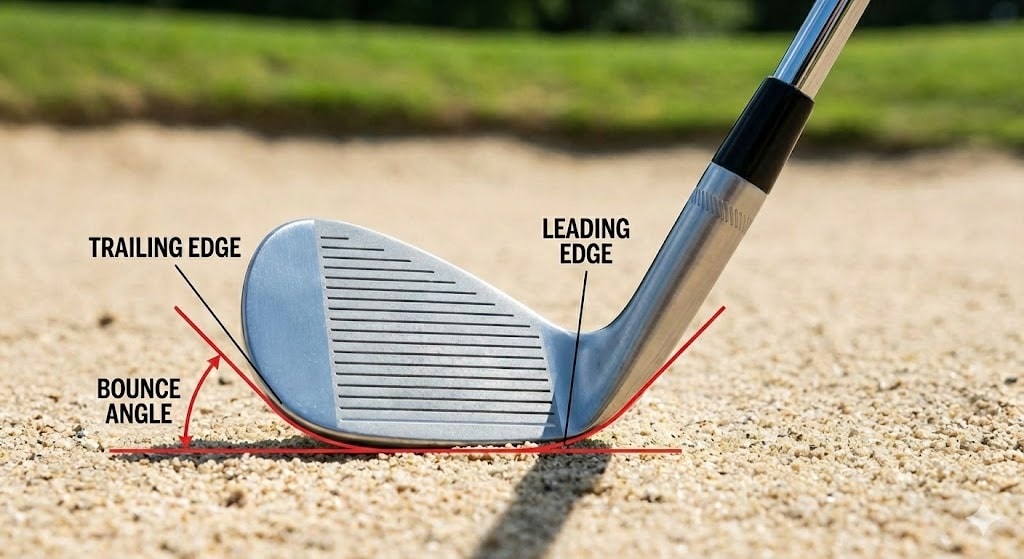
Bounce is the angle between your wedge's leading edge and the lowest point of the sole, measured in degrees. It's what prevents your club from digging into turf or sand like a shovel. Low bounce (4-6°) works on tight lies, mid bounce (7-10°) handles most conditions, and high bounce (10-14°) saves you in soft sand and fluffy rough. Your swing style and course conditions determine which category actually works for you.
Bounce is the most misunderstood spec on your wedges, and it's costing you strokes around the green. Here's what you actually need to know: bounce is simply the angle between your club's leading edge and the lowest point of the sole. When you set your wedge flat on the ground, what gap do you see between the turf and the leading edge? That's your bounce angle at work. This angle is measured in degrees and typically ranges from 4 to 14 degrees depending on the wedge model.
Think of it like the turned-up nose of a surfboard or the curved tips on skis. It prevents the front edge from digging into the turf or sand. Without adequate bounce, your club becomes a shovel. With too much, it skips off the surface. The right amount keeps you striking clean. The camber of your wedge also plays a crucial role, as it determines how the sole interacts with the ground through impact. The higher the bounce angle, the more gradual the leading edge becomes, which is why choosing the right bounce depends on your swing style, course conditions, and the types of shots you typically play.

When your wedge contacts the ground, the bounce angle determines whether the sole glides through or the leading edge digs in like a garden trowel. This isn't abstract theory; it's the difference between crisp contact and chunked shots that travel half the intended distance.
In soft turf or fluffy bunker sand, higher bounce prevents your club from burying itself. The sole skips across the surface, letting you make that explosive sand shot without leaving the ball in the bunker. Lower bounce does the opposite; it lets the leading edge slice under the ball on firm, tight lies where you don't want the sole bouncing off hardpan. Course conditions play a significant role in wedge selection, as soft turf requires higher bounce angles between 10-16 degrees to avoid digging.
Your swing matters here, too. Steep swingers who take deep divots need a higher bounce to prevent excavation. Shallow sweepers benefit from lower bounce that doesn't catch and skip. Because most golfers have a neutral angle of attack, mid-bounce wedges in the 7-10° range tend to be the most popular and versatile choice.
Opening the clubface on higher bounce wedges creates additional loft, which is why high-bounce wedges allow for easier shot manipulation around the greens when you need to hit soft, floating shots over obstacles.
Understanding which bounce category suits your game requires cutting through the oversimplified advice that floods golf forums and retail floors.
Low bounce wedges (4°-6°) position the leading edge closer to the ground, demanding precision. You'll find these in the bags of players who sweep the ball cleanly off tight lies and firm turf. They're unforgiving but devastatingly effective in the right hands.
Mid bounce wedges (7°-10°) dominate the market for good reason. They handle standard conditions without punishing inconsistent contact. If you're uncertain, start here. This category serves as a versatile option that adapts to varying course conditions and swing types.
High bounce wedges (10°-14°+) prevent digging in soft sand and fluffy lies. That extra sole angle keeps you from burying the club face when conditions turn mushy. Steep swingers and bunker warriors swear by them. Since professional fitting can improve performance by 22%, consulting an expert helps determine which bounce category matches your swing characteristics.
Your divot tells a story about which wedges belong in your bag, and most golfers never bother to read it.
If you're carving trenches that look like you're aerating the green, you need high bounce (10-14 degrees). That extra sole angle prevents the leading edge from burying itself and converts potential skulls into playable shots. Steep swingers who ignore this end up fighting their equipment every round. High bounce wedges feature a wider flange and lower trailing edge that creates a smoother gliding response along the ground.
Sweepers who barely brush the turf need the opposite approach. Low bounce (4-6 degrees) keeps the leading edge tight to the ground, eliminating the blade-style thin shots that plague shallow swingers on firm lies. This setup works particularly well on hard ground and firm sand, where you need the club to slide rather than dig.
Most players fall somewhere in between. Mid bounce (7-10 degrees) gives you margin for error while you're still figuring out your tendencies. Just like proper fitting requires consideration of individual swing characteristics rather than relying on a single factor, finding your ideal bounce means understanding your unique attack angle and tempo.
Course conditions matter more than your swing when you're standing over a shot from wet sand or baked fairways. I've watched golfers struggle with perfectly fitted wedges simply because they ignored what the course was telling them.
Here's the breakdown: firm turf and compacted sand demand low bounce wedges in the 4-6 degree range. You need that leading edge to contact the ball initially without skipping. Soft, fluffy conditions flip the script entirely; high bounce exceeding 10 degrees prevents your club from digging like a shovel. This higher bounce angle means the leading edge sits higher at address, allowing the sole to glide through soft conditions rather than cut into them. Players who take deep divots with a steeper attack angle benefit most from these high-bounce options in softer conditions.
Most courses fall somewhere in between, which is where mid bounce wedges between 7-10 degrees earn their keep. They handle variable lies without specialized requirements. Getting properly fitted clubs ensures your wedge bounce matches both your swing characteristics and the conditions you typically play. Match your bounce to the ground, not the marketing, and you'll see cleaner contact immediately.
While bounce angle gets all the attention on spec sheets, it's only half the story; sole grind determines how that bounce actually performs when your club hits the turf.
Here's what manufacturers don't emphasize enough: a wedge's effective bounce depends on five factors working together: bounce angle, sole width, sole radius, leading edge shape, and lie angle. Sole grind directly manipulates several of these elements. Different grind types are designated with letters by manufacturers, with options like F, S, M, D, K, L, U, C, and Y each catering to specific turf conditions or swing styles.
A full sole grind enhances turf contact, providing every degree of that stamped bounce number. But add heel and toe relief, and you've fundamentally changed the equation. That 12-degree wedge now plays like an 8-degree when you open the face for a flop shot.
This is why two wedges with identical bounce specs can feel completely different. The grind is doing the real work. Just as proper grip size affects your swing mechanics and shot accuracy, sole grind selection should match your individual playing style and course conditions.

You can change the bounce angle on your existing wedges, but it's not a DIY project. A skilled club fitter grinds material from the sole to adjust the effective bounce; it's precise work that can go wrong fast. Honestly, you're better off getting properly fitted for wedges with the right bounce from the start. Improper grinding weakens the club and creates inconsistent performance you'll hate.
Bounce has minimal direct impact on your distance. The real issue is consistency. If you're playing the wrong bounce for your swing or turf conditions, you'll chunk or blade shots, creating wild distance dispersion. When bounce matches your attack angle and course firmness, you strike the ball cleaner, and your carry numbers become predictable. Don't expect yards gained, expect tighter distance control when you're properly fitted.
Professional golfers typically use 10°–14° bounce on sand wedges for bunker versatility and drop to 4°–8° on lob wedges for cleaner contact on tight lies. You'll find most tour players follow a decreasing bounce pattern as loft increases, around 10° on their gap wedge, then progressively lower through the bag. Don't overthink it: medium bounce (8°–10°) covers most situations you'll actually face.
The user wants me to explain how bounce differs between pitching wedges and lob wedges in 70 words, using second person POV, active voice, contractions, and following the expert golf writer persona. I need to start by immediately answering the question without reciting information about what bounce is.
Let me think about the actual differences:
Let me write a direct, authoritative 70-word answer in the specified voice
Your pitching wedge typically carries less bounce, usually 4° to 6°, because you're hitting it from fairway lies with a shallower swing. Lob wedges span a wider range, from 4° to 14°, giving you options based on your technique and course conditions. Don't assume you need matching bounce across your wedges. You'll want lower bounce on your lob wedge for tight lies and higher bounce for fluffy sand and soft turf.
Yes, you should carry wedges with different bounce angles. Here's the reality: no single bounce works everywhere. You need low bounce for firm turf and tight lies, high bounce for soft sand and fluffy conditions, and mid bounce for everything in between. Your swing type matters too; steep swingers need more bounce, shallow swingers need less. Carrying variety gives you options when conditions change.
Bounce isn't some mysterious spec you should ignore; it's the difference between clean contact and chunked shots. Match low bounce to tight lies and steep swings, high bounce to soft conditions, and shallow sweepers. Don't overthink this: grab a mid-bounce wedge if you're unsure, then adjust once you've identified your tendencies. Your short game will thank you for paying attention to this often-overlooked number.