
Guys, the launch monitor market has officially gotten out of hand. And I mean that in the best possible way.
Ten years ago, if you wanted real numbers on your golf swing, you needed to buy a machine that cost about as much as a car.
Today, there are 16 legitimate options on this list alone, and the cheapest one costs less than a new driver shaft.
But here’s the problem nobody talks about. Everyone tells you to get a launch monitor. Your buddy has one. Your teaching pro has one. The guy at the range has one. But with so many different choices at so many different price points and with so many different features, how in the hell are you supposed to know which one is the right one for you?
That’s what I’m going to help you with. Yes, this is a long list. And yes, I can’t deny that 16 options is still a lot.
But here’s the thing. I’m going to give you the quick down-and-dirty on each one of these products. And I’m even going to tell you exactly which type of golfer I think each launch monitor is best for.
Almost everything on this list falls into one of two camps. Radar units sit behind the ball, track the flight with Doppler radar, and generally love open outdoor space. Camera units sit beside the ball, photograph the moment of impact, and require a lot less indoor room. Radar got cheap first. Cameras are getting cheap fast. And the line between “practice tool” and “full golf simulator” is blurrier than it’s ever been.
So that’s how we’re doing this. Every monitor worth your money in 2026, from $199 to $4,999, cheapest to most expensive, with the honest case for who each one actually fits. Some of these I’d recommend to almost anybody. A couple I’d only recommend to a very specific golfer. I’ll explain it all as we go.
So, guys, if you’ve been overwhelmed by the golf launch monitor options in 2026, you’re in the right place.
Let’s get into it.
Table of Contents
Shot Scope LM1 ($199) Makes Real Data Almost an Impulse Buy

Alright, let’s kick this off with one of the hottest products of 2026. This thing actually blows my mind because of how good it is for as little as it costs.
The LM1 matters because of what it represents. This is the floor for legitimate shot data, and the floor is now $199.
It’s a compact radar unit that gives you the core numbers: ball speed, clubhead speed, smash factor, carry distance, and total distance. You’re not getting spin. You’re not getting simulation. You’re getting the fundamentals. And let’s face it, for most golfers who’ve never owned a launch monitor, the fundamentals are exactly where you should start.
Here’s what I mean. Most amateurs don’t know their actual carry distances. They’re basing their club selections on how far they think they hit each club, but they’re usually delusional.
The LM1 fixes that for two hundred bucks, and that alone changes how you play.
The honest knocks are that the amount of data is limited, and like every radar unit, it wants some room to watch the ball fly, so a tight indoor space may not work.
But if you’re the golfer who’s been curious about launch monitors and scared off by the prices, this is the cheapest legitimate answer on the market.
Best for: The first-timer who wants real numbers without a real investment.
Elevate your game with the ShotScope LM1 Launch Monitor. Get precision data, ultra-portable design, and full swing analysis to lower your handicap. Shop the ultimate golf tech today! (191 characters)
- No Ongoing Subscription Fees
- Highly Portable & Quick Setup
- Comprehensive Data Set
- Doppler Limitations Indoors
- App-Dependency
- Outdoor Sunlight Visibility
Swing Caddie SC200 Plus ($249) Is the No-Phone, No-Fuss Practice Tool

The SC200 Plus is a simple device, and that’s the whole point.
It’s a Doppler radar unit that shows you carry distance, swing speed, ball speed, and smash factor on a bright LCD. A voice calls out your carry after every shot. A little remote lets you change clubs and modes. And you can get all of that without pairing it to a phone or app. You turn it on, drop it behind the ball, and hit.
One of the separator features is the swing speed mode, which measures your clubhead speed without a ball. Basically, if you’re doing speed training, this thing is built for you. You swing, you get a number, you swing harder, and you get a bigger number.
It’s also a great practice companion for a simple setup. When you’re hitting into a net, you can’t see the ball flight, so the quality of your feedback is everything. Carry distance, ball speed, and smash factor tell you exactly how good that strike was even though the ball only traveled eight feet.
What you’re giving up are things like launch angle, apex, spin, and shot history storage. This is more of a session tool than an analysis platform. is real: no launch angle, no apex, no spin, and no shot history since there’s no app to store it.
Best for: The net hitter and the speed trainer who want quick, simple feedback.
Experience precision golf training with the Swing Caddie SC200 Plus, advanced Doppler radar, voice output, and swing speed mode for ultimate practice.
- Accurate shot data
- Portable and lightweight
- Affordable price
- Fewer advanced metrics
- No app integration
- Limited battery life
Swing Caddie SC300i ($329) Is Where Launch Data Actually Starts

This is the first unit on the list that measures what happens in the air, not just off the face.
The SC300i is a Doppler radar unit that adds launch angle and apex height to the usual carry, ball speed, swing speed, and smash factor lineup, all shown on a big standalone screen. Connect it to the free app and you also get spin rate plus shot history and video overlay so you can watch your swing with the numbers stamped right on the clip.
I’ve tested this thing against professional-grade units, and the accuracy holds up shockingly well for the price. Carry distances within a few yards, ball speed within a couple miles per hour. For club gapping and practice, that’s everything you need.
The standalone screen matters more than it sounds. Plenty of budget monitors are useless without your phone. The SC300i works completely on its own, with a remote and voice output, and the battery runs about 20 hours, so it lives in your bag and just works.
The honest limitations are that the spin numbers are calculated estimates, not directly measured. There’s also no shot shape data. And there’s no simulation, which matters at this price because of what’s coming two spots down this list.
Best for: The golfer trying to improve who wants real launch data and a screen they can read from their hitting with no phone required.
The Voice Caddie SC300i offers pro-level launch data with Doppler radar technology, voice output, Bluetooth, and a 20-hour battery in a sleek, portable design.
- Portable and lightweight
- Accurate swing data
- Easy setup
- Limited features
- Short battery life
- Small display
Garmin Approach R10 ($499) Is Still the Gateway Drug to Simulation

Alright, next on our list is a product that at this point could be considered a classic. The R10 has been around a few years now, and there’s a reason it refuses to go away. No unit has introduced more golfers to home simulation.
It’s a tiny radar unit on a tripod that tracks a genuinely deep list of metrics, including club path and face angle numbers. And it pairs with the Garmin Golf app for simulation. Home Tee Hero gives you virtual courses through your phone or tablet, and the R10 also connects to bigger sim platforms if you want to grow into a projector setup later.
That’s the R10’s real argument. It’s not just a practice tool, it’s a starter kit for an entire hobby. Plenty of full garage simulator builds started life as one of these and a net.
Now the honest part. The R10 is phone-dependent, so you’re living in the app. The club data is radar-calculated and gets debatable with short irons and wedges, where it can read more like an educated guess than a measurement. Indoors, it needs real ball flight to read accurately, so tight spaces hurt it. And the full simulation experience sits behind a subscription.
But at $499, nothing else gets you this much capability in a box this small.
Best for: The golfer who suspects, correctly, that this launch monitor thing might turn into a simulator thing.
Experience advanced golf tracking with the Garmin Approach R10, a premium launch monitor delivering precise data and improving your game effortlessly.
- Compact and portable.
- Provides 14 key ball and club metrics.
- Long battery life (10 hours).
- Occasional shot direction errors.
- Backspin readings less reliable.
- Indoor accuracy can vary.
Swing Caddie SC4 Pro ($499) Is the Built-In Screen Option at the Same Price

Same $499 as the R10, but the experience couldn’t be more different, and it starts with the screen.
The SC4 Pro puts everything on a big, bright built-in display you can read from your your hitting position. Carry and total distance, ball speed, swing speed, smash factor, launch angle, apex, and spin. No phone propped against your bag, no app required to see your numbers, no pairing before you can hit your first ball. You set it down, you swing, and the data is just there. The remote and voice output keep the whole session moving without ever breaking your rhythm.
That’s the practical difference at this price point. The R10 makes you live in Garmin’s app. The SC4 Pro hands you the numbers on the quick, every shot, on its own hardware.
But choosing the screen doesn’t mean giving up on simulation. The SC4 Pro has simulator compatibility options waiting for you, so when you’re ready to dive into a deeper experience with virtual courses on a bigger setup, the path is there. It’s just not a toll you pay on day one.
For pure practice, it’s the most complete sub-$500 experience on this list. But like every radar unit in this stretch, it wants some room to watch the ball fly.
Best for: The golfer who wants instant numbers today and a simulator door left open for tomorrow.
Voice Caddie SC4 Pro Launch Monitor offers pro-grade precision with Doppler Radar for exact ball and club data, perfect for indoor and outdoor golf practice.
- Accurate shot data
- Portable and easy to use
- Long battery life
- Lacks advanced metrics
- Less accurate in wind
- Higher price point
Blue Tees Rainmaker ($599) Is Playing a Completely Different Game Than the Other Radar Units

Every other radar unit in this price range is a standalone tool. The Rainmaker is something else entirely. It’s the engine of a connected ecosystem, and at $599, nobody else is even attempting that.
Blue Tees already makes rangefinders and GPS speakers. The Rainmaker is what ties them together. Your real launch monitor distances feed club recommendations right into their Captain rangefinders. Dynamic bag mapping keeps your actual yardages current, and automatic shot syncing moves your practice data across the whole platform without you having to do anything.
That’s technology that costs serious money through the premium brands, sitting in a $599 box. The full ecosystem experience runs through a $79-a-year membership.
The hardware holds up its end. Doppler radar, 21 metrics, a big 4.3-inch color display, a carry handle that flips down and becomes the stand, a detachable magnetic remote, IPX4 weather resistance, plus E6 Connect and GSPro support for sim play.
The downside is that the lag between impact and seeing your numbers is the longest of any launch monitor on the market. So if you’re impatient, this isn’t the right product.
But if you’re judging the Rainmaker as just a launch monitor, you’re missing what Blue Tees is building.
Best for: The golfer ready to buy into a connected ecosystem where the launch monitor makes every other device smarter.

Stay dry on the course with the Blue Tees Rainmaker. Featuring a 68" double-canopy design, wind-ready tech, and a sleek look for ultimate foul-weather protection.
- Top-Tier Waterproofing
- Magnetic Quick-Access Pocket
- Modern Aesthetics
- Price Point
- Zipper Stiffness
- Weight & Bulk
Garmin Approach G82 ($599) Is a Category of One

There’s a very short list of golf tech products that invented their own category. The Garmin G80 is on it. Back in 2019, it combined a full on-course GPS handheld with a built-in radar launch monitor. And in the seven years since, no other company has even attempted the combination. The G82 is the long-awaited successor, and it upgrades the concept in just about every direction.
The GPS side is full-strength Garmin. Big 5-inch color touchscreen, more than 40,000 preloaded courses, slope-adjusted yardages, green view with manual pin placement, the works. Then you press one button and it becomes a radar launch monitor for the range.
The G82’s new tricks make the package meaningfully better than the G80. Putting data for the first time. A virtual caddie. And a built-in magnetic mount that snaps to a cart post, replacing the old rubber-band setup that always felt beneath a device this well made. The build quality is excellent, by the way.
Now, let’s be real. The data on the launch monitor side is limited to the basics. You’re not buying a Trackman here. If you need advanced club data, this isn’t the right pick.
But guys, this is the only device in golf that’s a true GPS and a launch monitor in one body, and there’s simply nothing to compare it to.
Best for: The golfer who wants one premium device that they can use both on the course and at the range.

Master the course with the Garmin Approach G82. This handheld launch monitor tracks club head speed, smash factor, and distance, integrated with full-color mapping for over 41,000 global courses.
- All-in-One Convenience
- Integrated Practice Modes
- No Extra Hardware Required
- Limited Data Points
- Screen Size and Visibility
- Radar Placement Sensitivity
Square Golf ($699) Is the Only Camera Launch Monitor Under $1K

When the Square showed up, it changed the rules for indoor golf.
Before then, if you wanted a camera-based unit that saved on room depth, you had to spend up to at least a few grand. If you wanted something affordable, you were pretty much stuck with radar devices, which take up a lot of room.
But the original Square, for only 700 bucks, sits beside the ball, photographs the moment of impact with high-speed cameras, and measures most of what you’d want to know about your golf shots. Club data requires shaft stickers. And the included dotted balls sharpen the spin numbers. It even tracks chipping and putting, which almost nothing near this price attempts, so full simulator rounds actually feel complete.
Speaking of simulators, this is where the Square earns its cult following. It connects natively to GSPro, E6 Connect, and Awesome Golf without charging you a gatekeeper fee, and its own course library runs on a token system instead of a subscription, with a thousand tokens in the box covering dozens of rounds.
The limitations are that it’s indoor-only and it’s missing some key data metrics like clubhead speed and smash factor. But for the price, there’s nothing else like this.
Best for: The budget sim builder working with a small room who wants an easy connection to GSPro.
Upgrade your indoor golf setup with the Square Golf Launch Monitor. This camera-based simulator delivers highly accurate ball and club data for under $1,000. Enjoy realistic gameplay with no expensive subscriptions. Perfect for compact home spaces!
- Small and easy to carry.
- Accurate shot data.
- Simple to use.
- Fewer advanced features.
- Short battery life.
- Less accurate in windy conditions.
Rapsodo MLM2PRO ($599.99) Packs More Features Per Dollar Than Anything Here

The MLM2PRO is a radar unit with two cameras built in, and that combination is what makes it different.
The radar tracks your shots from behind the ball. The cameras handle video. Impact Vision gives you slow-motion replay of the strike itself, and Shot Vision records your swing from the down-the-line angle. So after every shot, you get the numbers and the footage.
It tracks 15 metrics, 8 of them directly measured. That includes real spin rate and spin axis when you use RPT balls, which have special markings the cameras can read. A sleeve of Callaway RPT balls comes in the box along with a tripod and carrying case.
The simulation side is strong too. Rapsodo’s own software runs entirely on your phone or tablet, no gaming PC required, and gives you simulated rounds on more than 30,000 courses. There’s also a Target Range mode with 72 target distances for working on distance control. And if you outgrow all that, the MLM2PRO officially connects to GSPro, E6 Connect, and Awesome Golf.
The catch is the membership. You get a 45-day Premium trial with purchase, but after that, most of the good stuff, including the courses, the measured spin, and the third-party connections, requires a Premium Membership at $199 a year. There’s a lifetime option at $599 if you’d rather pay once.
So the real cost of ownership is higher than the sticker. Know that going in.
Best for: The golfer who wants video, measured spin, and simulation in one unit and is willing to pay the yearly fee to keep it all unlocked.
Improve your golf swing with the Rapsodo MLM2PRO Launch Monitor and Golf Simulator. Featuring dual cameras, precise metrics, and realistic simulation, practice anytime, anywhere. Get actionable insights to lower your handicap and play better golf.
- Accurate shot tracking with video.
- Works indoors and outdoors.
- Portable and easy to use.
- Subscription needed for all features.
- Spin data limited outdoors.
- Indoor setup requires space.
FlightScope Mevo Gen2 ($1,299) Is Entryway to the Big-Time

Cross the $1,000 line and this is the first thing you should look at. The Mevo Gen2 is FlightScope’s flagship portable launch monitor, and it replaced the long-running Mevo+.
It’s a radar unit, but it pairs Doppler radar with a built-in camera in a system FlightScope calls Fusion Tracking. Out of the box it measures 18 ball and club parameters, tracks full swings, chipping, and putting, and includes a shot tracer with video overlay.
Here’s the part that sets FlightScope apart from a lot of this list: no subscription, ever. You buy it, you own it. The box even includes lifetime access to a 12-course E6 Connect bundle, and it connects to GSPro and Awesome Golf.
If you want to go deeper on club data, the optional Pro Package unlocks the advanced stuff like club path, face-to-path, and dynamic loft, and a Face Impact Location add-on shows exactly where on the face you made contact. Those are one-time purchases, not a rented feature.
Two things I will say that you should definitely know going in. It takes a few extra minutes to set up correctly. Get the alignment right and the data is excellent; rush it and your numbers can drift. And as a radar unit, it needs space, at least eight feet behind the ball and eight more to your net or screen.
Best for: The committed golfer building a real practice setup who wants pro-level data without ever paying a subscription.

Use Code GAMevo to get 5% off
Improve your golf game with the FlightScope Mevo Gen2 Launch Monitor. This portable 3D Doppler radar provides accurate data on carry distance, club head speed, smash factor, and spin rate. Practice anywhere with real-time feedback.
- Accurate ball and club data
- Compact and portable
- Easy app integration
- Needs a smartphone for display
- Shorter battery life
- Relatively expensive
Square Omni ($1,599) Is the Original Square With Every Limitation Removed

The original Square gave you camera accuracy in a small room for $699. The Omni costs $900 more, and the whole question is whether it’s worth the jump. It is, and here’s exactly what that extra money buys.
First, it works outdoors. The original was indoor-only, which meant it never went to the range. The Omni reads accurately on real grass in sunlight, so it’s both your garage unit and your range unit. That alone closes the biggest gap in the first one.
Second, you get all the data. Where the original was missing key numbers like clubhead speed and smash factor, the Omni delivers the full set, 21 metrics covering complete ball data, full club data, and face impact location. That last one, knowing exactly where on the face you struck it, is a real game-improvement tool, and at this price it’s the cheapest way to get it by a wide margin.
Third, the hardware grew up. It steps from two cameras to four, the build is far more robust with the cameras and screen recessed so a shanked ball can’t kill them, and the built-in screen shows six core metrics after every shot without touching your phone. You also no longer need marked balls for accurate spin. Any ball works.
Also, just like with the original Square, you don’t have to pay a Square subscription to connect to GSPro.
Best for: The golfer who wants one camera unit for both the garage and the range, with full data and no subscription, at the lowest price that combination has ever existed.

Elevate your game with the Square Golf Omni. Experience professional-grade swing analysis, high-speed camera tracking, and ultra-accurate data for indoor and outdoor use.
- Comprehensive Club Data
- No Special Balls Required
- Compact "All-In-One" Design
- Light Sensitivity
- Software Ecosystem
- Limited Lateral Range
SkyTrak+ ($1,995) and SkyTrak ST MAX ($1,995) Are the Same Proven Unit at One Price
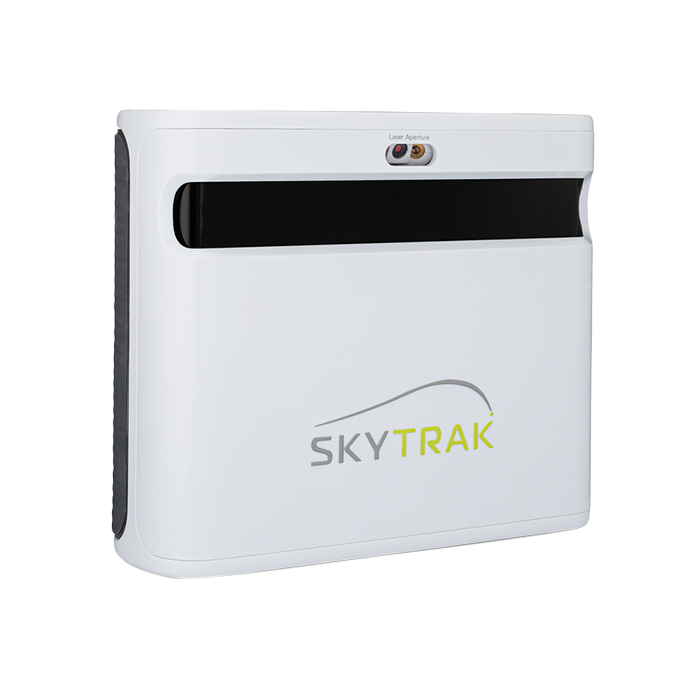
These two launch monitors share a section because they share the same hardware. Same dual-Doppler radar and photometric camera system, same ball and club data, same software ecosystem, same accuracy.
It’s a camera-assisted unit that sits beside the ball, so it fits in a room far shallower than radar units need, which is a big part of why it became a go-to for garage and basement builds. For sim golf, SkyTrak has their own native Course Play software that includes course packages from Foresight Sports and Trackman.
So what’s the difference between these two launch monitors? The ST MAX adds a few things on top of the identical core. You get a built-in speed training mode, dual USB-C ports, a faster processor, and a new charcoal finish. Those are the differences.
With both units now listed at $1,995, the old $500 choice is gone. The ST MAX adds speed training, dual USB ports, and newer internal architecture at no extra cost, so it is the better full-price buy. The SkyTrak+ still makes sense certified pre-owned at $1,495, where it saves $100 versus a $1,595 certified pre-owned ST MAX.
The honest knock for both is that neither measures angle of attack, which stings a little when units a third of the price include it.
Best for: ST MAX for anyone buying new at $1,995. SkyTrak+ still makes sense certified pre-owned at $1,495 if saving $100 matters more than speed training and the newer internal design.
Experience pro-level precision with the SkyTrak+ Plus Golf Launch Monitor, delivering unmatched accuracy and real-time shot data.
- Accurate shot data
- Portable and easy setup
- Compatible with simulators
- Expensive
- Needs good lighting
- Limited club info
Bushnell Launch Pro Circle B ($2,999.99) Is Pro-Grade Foresight Accuracy at the Lowest Entry Price

Now we’re starting to get into serious professional-grade hardware. The Launch Pro Circle B runs the exact same three-camera photometric system as the Foresight GC3, the unit that teaching pros, club fitters, and serious players have trusted for years. Bushnell took that proven GC3 platform, put their own badge and signature orange on it, and priced the entry point well below what that camera tech normally costs.
The accuracy is the whole point. Three high-speed cameras reading impact directly is about as good as consumer-accessible launch monitor data gets, and it’s why this hardware shows up in fitting bays. It works indoors and outdoors, the build is tank-like, and as a camera unit it doesn’t need much room behind the ball.
Now, the honest part, and it’s important. The Circle B’s low entry price gets you the hardware and ball data. The deeper stuff lives behind a subscription, and Bushnell actually made that friendlier with the return of a Silver tier. Silver runs $199 a year and unlocks full ball and club data plus five FSX Play simulator courses. Gold runs $499 a year and adds 25 courses plus third-party software support like GSPro. So if you mainly practice and dabble in sim golf, Silver covers you without paying for courses you’ll never play. If you’re a serious sim golfer who wants GSPro and maximum variety, you’re in Gold territory.
That subscription is the tradeoff versus a buy-once unit, but the flip side is real choice: you pay for the tier you’ll actually use instead of one locked-in price.
Best for: The accuracy-obsessed golfer who wants true fitting-bay camera data at the most attainable entry price and will pick a subscription tier to match how they actually play.

Step up your golf game with the Bushnell Launch Pro Circle B, a cutting-edge launch monitor and simulator offering unmatched precision and immersive practice. Whether perfecting your swing or analyzing ball flight, this pro-level tool transforms training into performance gains.
- Accurate data
- Realistic simulator
- Portable design
- Expensive
- Needs space
- Complex setup
Full Swing KIT ($4,999) Is the Launch Monitor Used on ESPN’s TGL

At the top of the radar side of this list we’ve got the Full Swing KIT, and it carries a credential nothing else here can match. This is the technology powering TGL, the primetime indoor golf league that Tiger Woods and Rory McIlroy invested in and play in. In fact, Tiger uses this for his own practice.
The KIT pairs dual-mode 24GHz radar with a high-resolution camera, and it gives you 16 data metrics with no unlock fees and no subscription tiers. Everything from attack angle to spin axis comes standard, which matters at this price because plenty of premium units still nickel-and-dime you for club data.
The 5.3-inch OLED screen is bright enough to read in direct sunlight and puts your numbers right in front of you the instant you hit. A built-in 4K camera records your swing automatically, and the whole thing charges over USB-C and travels in a tank of a protective case.
The accuracy is outstanding. And it’s simple to set up and align, which makes it an actual pleasure to use instead of a pain.
The honest cons are real, though. It’s iOS only, so Android users are simply out. As a radar unit it wants at least eight feet of ball flight to read accurately, and it gets shaky on shots under 40 yards indoors. And five grand, while fair for what it is, is still five grand.
Best for: The iPhone golfer who wants tour-proven radar, a full data set with zero subscriptions, and the same tech the best players in the world rely on.

Unlock your golf potential with the Full Swing KIT Launch Monitor, trusted by pros for pinpoint accuracy in swing analytics. This advanced device delivers real-time data on ball speed, spin, and launch angle, helping you optimize every shot. Whether you're a serious golfer or coach, Full Swing KIT provides the insights needed to elevate your game and lower your scores.
- Accurate real-time swing data
- Portable and easy to use
- User-friendly interface
- Expensive
- Limited battery life
- Initial setup needed
Garmin Approach R50 ($4,999) Is the All-in-One That Needs Nothing Else

Let’s close this list with the unit that rewrote the rulebook on what a launch monitor includes in the box. Every other premium option here, even the great ones, still leans on something external for the full experience: a phone, a tablet, a computer, a separate piece of software. The R50 needs none of it.
This is a camera unit, three high-speed cameras sitting beside the ball, delivering directly measured spin and a full data set, clubhead speed, path, face angle, launch numbers, and more, all included with no unlock fees.
But the cameras aren’t the headline. The screen is. The R50 has a gorgeous 10-inch built-in touchscreen, and it does things no other launch monitor does. You play simulator golf right on the device. Set it down, start hitting, and you’re playing courses on the unit itself with no phone and no PC anywhere in sight. Home Tee Hero gives you 43,000-plus courses through a $99-a-year membership, the graphics got a real upgrade for the R50, and you get automatic slow-motion replay of every shot right there on the screen.
When you want to go big, a single HDMI cable runs the whole show to your projector or TV, no computer in the chain. And if you’d rather use GSPro or E6, the R50 connects to third-party platforms too.
The honest caveats. Five thousand dollars is serious money. Also, it’s a big unit and not something you toss in your bag.
Best for: The golfer who wants a complete launch monitor and simulator in a single box with no phone, computer, or extra software needed.
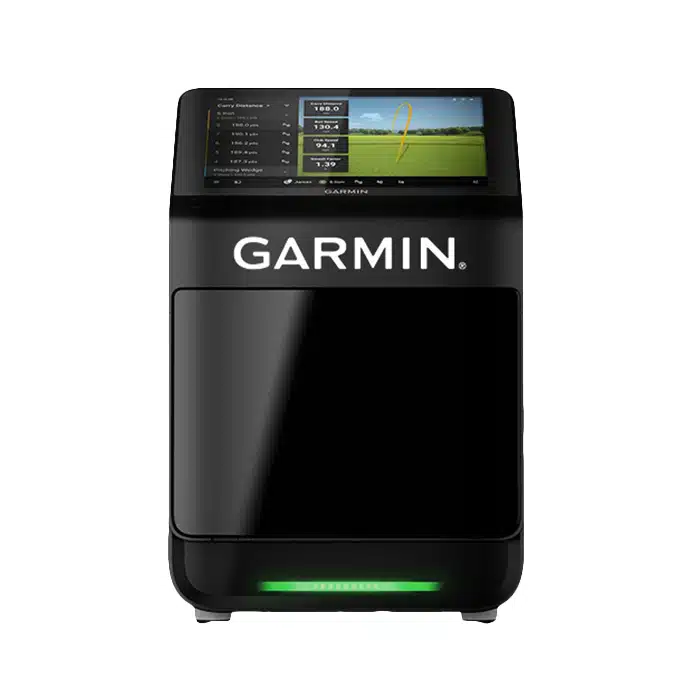
Experience top-tier golf precision and tracking with the Garmin Approach R50, designed for serious golfers seeking advanced performance.
- Lightweight and portable
- Accurate shot data
- Easy setup
- Limited advanced stats
- Short battery life
- Small screen
Frequently Asked Questions
What is a golf launch monitor, and why should I use one?
A golf launch monitor is a device that measures key performance metrics of a golf shot, such as ball speed, launch angle, spin rate, and carry distance. It helps golfers improve their game by providing accurate, repeatable data on ball flight and club performance for practice and fitting purposes.
What are the main types of golf launch monitors?
There are radar-based monitors (positioned behind the ball, tracking full ball flight outdoors), camera-based monitors (optical tracking from beside the ball, ideal for indoors), and overhead systems (installed above for simulator setups). Each type suits different environments and usage scenarios.
Which golf launch monitor offers the best balance of accuracy and portability?
The FlightScope Mevo+ is popular for its compact size, outdoor and indoor usability, and detailed data tracking. It is widely regarded as a great value for serious amateurs and coaches needing portability alongside accuracy.
Are indoor launch monitors less accurate than outdoor ones?
Indoor launch monitors, especially camera-based units like the Garmin Approach R50, have been found to be very accurate indoors and are sometimes preferred for home golf simulators due to ease of use in confined spaces. Some radar-based models excel outdoors, while certain hybrid monitors offer versatility.
Which Launch Monitor Should You Buy?
Something from this list is going to be the right fit for you. It’s that simple. Every single one of these products is a killer. Otherwise, I wouldn’t have included it.
Read each section carefully and consider how you intend to use a launch monitor.
If you mostly practice outdoors and want real numbers without a huge investment, a radar unit is probably going to be your best bet. The Shot Scope LM1 gets you in the door for $199. The Swing Caddies, the Garmin R10, and the Rapsodo MLM2PRO take you up the ladder from there. And if you want serious radar data, the FlightScope Mevo Gen2 and the Full Swing KIT are waiting at the top.
If you’re building something indoors, in a garage or a spare room where depth is tight, cameras are your answer. The original Square cracked that door open at $699. The Square Omni kicks it wide open with indoor and outdoor play. The original SkyTrak+ is sitting there at a sweetheart of a price. And when you want the same accuracy level that the pros trust, the Bushnell Launch Pro Circle B brings Foresight’s camera tech down to its most attainable price ever.
And if you want it all and don’t want to worry about having anything else to buy, the Garmin R50 is the only device on this list that pulls that off.
So stop worrying about one launch monitor being the best for every golfer. That’s not how this works. There’s only the best launch monitor for you, your space, your budget, and the way you actually play golf. Figure out your specific situation and then pick the unit here that is best addressing your needs. If you do that, I promise you that you’re going to have a winner on your hands.
What do you guys think? Any launch monitors that aren’t on this list that you think should have been? Anything on this list that you’ve personally used? If so, what are your thoughts? Let me know in the comments. And please be sure to like and subscribe. Thank you very much for watching. And until next time, I’ll see you out on the course.

About the author
Paul Liberatore
Paul Liberatore is the founder of Golfers Authority and a former four-year golf gear contributor to Sports Illustrated. He tests golf equipment hands-on to help golfers make better buying decisions.