Carrying your golf bag is great until the back nine of a hilly course. By hole 14, your legs feel heavy, your swing gets sloppy, and you start making lazy decisions just to get the round over with. Most golfers try to fix this by buying a cheap push cart, but pushing 40 pounds of gear up a 15-degree incline isn't much better than carrying it. You still arrive at your ball out of breath.
I've tested dozens of electric golf carts, from basic motorized push models to autonomous robots that follow you down the fairway. The problem is that the market is flooded with overpriced carts that tip over on side slopes, have remotes that lose signal, or use batteries that die on the 16th hole.
To figure out which ones are actually worth the money, you have to look past the marketing. You need to know how they handle steep hills, whether the remote is actually responsive, how much space they take up in your trunk, and if the battery can survive a 36-hole weekend. Here is how the best electric golf carts break down.

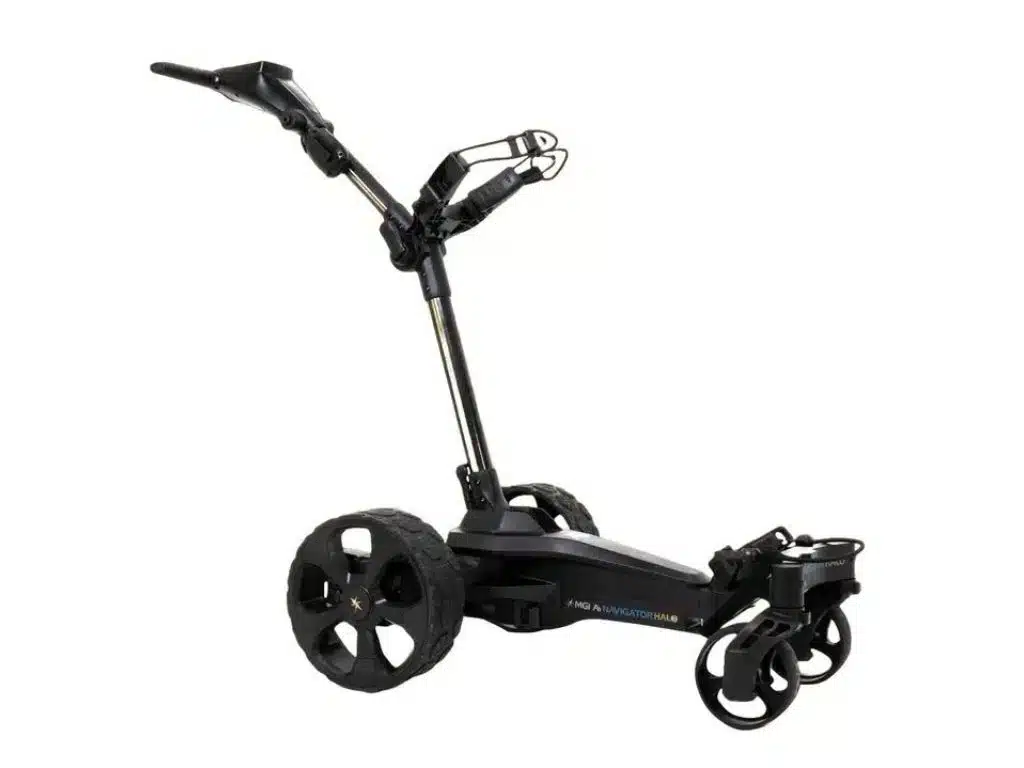
Most remote-control caddies are dumb machines. You press forward, and they go forward until you tell them to stop. If there is a bunker in the way, they will drive straight into it unless you intervene. That means you spend half your round babysitting your cart instead of focusing on your next shot.
So when an electric cart costs $2,599, I immediately start looking for the catch. Let me show you what I found.
What I noticed when I first put this on the course is that it actually reads the terrain in real time. If the cart is heading toward a mapped water hazard or bunker, it automatically slows down and stops before it goes in. That happens because of a system called Geo Protect, which is tied to an integrated 4-inch touchscreen GPS loaded with over 40,000 courses. What that means is you can send the cart down the fairway and walk to your ball without constantly checking over your shoulder to make sure it hasn't driven into a lake.
The stability on this thing is aggressive. It uses a patented Gyroscope Straight Tracker and dual in-hub brushless motors. The first time I sent it across a steep side-slope, I expected it to drift downhill like every other cart. It didn't. The gyroscope constantly adjusts the power to each wheel, keeping it on a dead-straight line. The battery is a 24V 299Wh lithium unit housed in a fire-resistant metal casing, and it easily handles 36 holes on a single charge.
The other thing that matters is how it folds. The rear wheels automatically retract inward during the folding process, which reduces the footprint to 27 by 15 by 14 inches. That is 20 percent smaller than the previous generation. You don't have to take the wheels off to fit it in your trunk, which saves a massive headache in the parking lot.
The catch is the price and the optional upgrades. The base cart is $2,599, but if you want the Halo Eye LiDAR sensor that allows the cart to autonomously follow you, you have to buy the $2,995 bundle. If you do get the Halo Eye, you have to remove the sensor every time you fold the cart, which adds a step to your post-round routine. Also, the Geo Protect system can be overly cautious on narrow paths near hazards, forcing you to temporarily disable it on the screen.
This is for the high-frequency walking golfer who plays on courses with severe elevation changes and hazards, and who wants a cart that actively prevents accidents. If you just want a basic motorized push cart and don't care about GPS or hazard avoidance, look at something else on this list.
But what if $2,599 is more than you want to spend on a cart? That's where the MGI ZIP AI Navigator GPS+ comes in.
Looking for the absolute best electric golf cart? Our in-depth MGI AI Navigator Halo push cart review details the brushless motor performance, compact folding size, and current pricing.

Most golfers who use an electric caddy still carry a separate GPS device or a laser rangefinder. You end up juggling a remote control in one hand and a GPS in the other, which completely defeats the purpose of a hands-free walking experience.
So when a cart costs $1,895 and claims to fix that, the question is whether the integration actually holds up.
The ZIP AI Navigator GPS+ builds a 4-inch full-color all-weather touchscreen directly into the handle. What I noticed when I first used it is how bright the screen is in direct sunlight. It comes pre-loaded with 40,000 courses and gives you front, middle, and back yardages, plus hazard distances. What that means is you have all your course data right in front of you without having to dig into your pockets or pull out your phone.
The remote control on this model gives you full directional command from up to 110 yards away. You can send it to the next tee box while you finish putting. Like the Halo, it uses MGI's Gyroscope Straight Tracker to maintain a straight line on side-slopes. It also features a five-wheel design with quick-release all-terrain rear wheels. The cart weighs 38.99 pounds with the 36-hole 24V lithium battery installed, which makes it the heaviest cart in this guide.
The MGI App connects to the cart via Bluetooth. It adds interactive course maps, digital scoring, and the ability to see your smartphone notifications right on the cart's display. There is also an on-board USB charging port, so your phone won't die on the 14th hole while you are running the app.
The catch is the weight and the learning curve. At nearly 39 pounds fully loaded, lifting this into the back of an SUV takes some effort. There is no follow mode available for this model, and getting used to the remote control steering takes a few holes to master. You also need to rely on your smartphone and the app to get the absolute most out of the digital features.
This is for the serious walker who wants a high-end remote-control cart with built-in GPS distances so they can ditch their handheld device. If you struggle lifting heavy objects or you demand an autonomous follow mode, this is not the right fit.
But what if you don't care about GPS screens at all, and you just want the most capable all-terrain remote cart possible? That's where the MGI Zip Navigator AT comes in.

Experience next-level golf with the MGI ZIP AI Navigator GPS+ Electric Push Cart, premium design, AI navigation, and effortless performance.

Most electric carts handle flat fairways just fine, but the second you take them into the rough or up a steep, uneven hill, they struggle. The front wheel catches, the cart tips backward, and you end up wrestling a heavy machine instead of letting it do the work.
At $1,699, this cart is built specifically to solve the terrain problem, so the construction either justifies the price or it doesn't.
The first thing I noticed when I drove this into thick rough is that it doesn't get bogged down. It just keeps moving. That is because of the dual swiveling independent front wheels and twin 230W calibrated motors working together. The independent front wheels allow it to pivot and turn tightly, while the twin motors provide aggressive power to the all-terrain tread rear wheels. What that means is you can navigate through tight trees or heavy grass without the cart fighting you.
The stability on steep inclines is where this cart earns its name. It has a fully foldable rear fifth wheel that acts as an anti-tip bar. When you send it up a massive hill, that fifth wheel keeps it planted. It also has automatic downhill speed control. You don't have to ride the brake on the remote; the cart senses the decline and governs its own speed so it doesn't run away from you.
It runs on a 24V 36-hole lithium battery and weighs 37 pounds with the battery attached. The folded dimensions are 28 by 19 by 17 inches. It does not have an integrated GPS screen, which is why it costs less than the GPS+ model. The remote is full directional, with left, right, forward, reverse, and speed control. The Gyroscope Straight Tracker is the feature that separates this cart from a basic remote model. On a fairway that falls away hard to the left, a standard cart will drift downhill and require constant steering corrections. The gyroscope monitors the cart's orientation and adjusts the power to each wheel independently to keep it tracking straight. After a few holes, you stop thinking about it entirely.
The catch is the bulk and the bag compatibility. While it folds down, it is still a large, 37-pound piece of equipment. Also, if you use a smaller, lightweight stand bag, you might need to buy an adapter to get it to sit securely on the cart's brackets without twisting during the round.
This is for the golfer who plays hilly, rugged courses and needs a powerful remote-control cart that will not tip over on steep inclines. If you want a built-in GPS screen or a lightweight cart that is easy to throw in the trunk, look elsewhere.
But what if you play on severe side slopes and need a cart with an even lower center of gravity? That's where the Alphard Cyber Cart comes in.

Master any fairways effortlessly with the high-tech MGI Zip Navigator AT Push Cart. Benefit from smart gyroscope control and 36-hole endurance. Get the guide now!

Most remote carts have a high center of gravity because the battery and motors sit high on the frame. When you drive them across a steep side-slope, they feel top-heavy and prone to tipping over, which forces you to walk right next to them just in case.
An $1,450 cart needs to solve that anxiety completely, so here is what the engineering actually looks like.
Run this across a severe side-slope, and it stays completely glued to the turf. It does not drift. It does not wobble. That is because the Cyber Cart is built with a drastically low center of gravity, dual hub 180W motors, a 6-axis gyroscope, and physical anti-tip bars built into the back. You can send this cart across the side of a hill from 50 yards away and trust that it won't end up on its side.
The remote is an LCD unit with an out-of-range auto-stop feature, so if you accidentally send it too far, it shuts itself down instead of driving into the woods. The cart comes with a 37V 236.8Wh lithium battery that lasts up to 36 holes and recharges in about four hours. It also includes a massive accessory bundle right out of the box: a phone holder, cup holder, umbrella holder, scorecard holder, sand bottle holder, and a USB-C port.
It does not have a built-in GPS screen, but it does come with six months of paid Hole 19 GPS app access, which you run on your smartphone. The front wheel swivels 360 degrees and can be locked for long, straight walks. The one-click folding system gets the cart down to 25 by 20 by 17.7 inches. The automatic parking brake engages the moment the cart stops, so it won't roll back on you if you stop it on a hill to take a shot. The downhill speed control works in tandem with the gyroscope to keep the cart moving at a consistent pace on descents, which means you don't have to sprint to keep up with it.
The catch is the massive weight and the wet-weather performance. At 40 pounds with the battery, this is the heaviest cart on the list. Lifting it into a car is a chore. Also, the wheels can struggle for traction in very wet conditions, and the warranty is only two years compared to the three years you get with the MGI models.
This is for the golfer who prioritizes absolute stability on severe side-slopes and wants a highly responsive remote control experience. If you want a lightweight cart or an onboard GPS screen, this is not the right call.
But what if you don't want a remote control at all, and you just want the cart to push itself? That's where the MGI ZIP X5 comes in.

The Alphard Cyber Push Cart redefines golf convenience with cutting-edge design, unmatched durability, and effortless handling, perfect for serious golfers aiming to elevate their game.

Most golfers who buy electric carts think they need a remote control, but managing a remote can actually be distracting. You end up constantly adjusting the speed and direction instead of just walking and enjoying the round.
At $1,099, this is the cheapest fully motorized cart on the list, so the real question is what you're actually giving up for that price, and the answer is less obvious than you'd expect.
The ZIP X5 is a non-remote electric push cart. You walk behind it, set the speed, and it pulls itself along. Take it out for the first time and you immediately notice how much more relaxing it is than a remote cart. You don't have to steer it from afar; you just keep a hand on the ergonomic T-bar handle and let the whisper-quiet 230W motor do the heavy lifting.
The terrain management is what separates this cart from a basic motorized push cart. It has an electronic park brake that automatically engages the second you stop on an incline. It also has automatic downhill speed control. You never have to fight gravity. When you walk down a steep hill, the cart holds its pace so you don't have to pull back on a 40-pound rig.
It weighs 30.57 pounds with the 24V 250Wh lithium battery, making it the lightest fully motorized cart here. It also has a Controlled Distance Function, which lets you program the cart to drive a specific distance and stop. You can point it at the next tee box, hit the button, and let it go.
The catch is the lack of a remote and the limited storage. You have to walk with the cart, which means you can't send it to the other side of the fairway to look for a ball. It also lacks a storage net or extra pockets for balls and tees, and like the Navigator AT, it can struggle to hold certain lightweight stand bags securely.
This is for the avid walker who wants to eliminate the fatigue of pushing a cart up hills but doesn't want the complexity or cost of a remote control. If you want to walk hands-free or need a cart that follows you, it's not the right fit.
But what if $1,099 is still too much, and you really just want a manual push cart that gives you a boost when you need it? That's where the MGI E-Boost comes in.

The MGI ZIP X5 electric push cart redefines convenience and power for golfers. Lightweight yet robust, it offers unmatched ease and advanced tech to elevate every round.

Most electric carts have a massive flaw: if the battery dies, they are nearly impossible to push manually. The motors create drag, turning a dead electric cart into an anchor that ruins the rest of your round.
So when a cart costs $599 and claims to solve that, the engineering has to be completely different.
The E-Boost is a hybrid. It is a manual push cart with a built-in 240W brushless motor. Push it with the motor off, and there is zero drag. It freewheels perfectly, just like a standard push cart. When you hit a steep hill, you press a button on the handle, and the motor kicks in to give you an electric boost. You push it manually on the flat fairways and use the motor only when you actually need it. That is the whole point.
It weighs just 25 pounds with the 225Wh 24V lithium battery attached, which makes it the lightest cart in this entire guide. I picked it up with one hand and loaded it into my trunk without thinking about it. The handle has variable speed control and is loaded with practical storage: a scorecard holder, two ball compartments, a storage net, and a built-in cup holder. There is also an on-board USB charging port. The folded dimensions are 30.5 by 17.4 by 12.6 inches, which is compact enough to fit in most car trunks alongside your bag without a fight. The swivelling and lockable front wheel gives you the same maneuverability you get on a standard push cart, and the four accessory stations on the frame mean you can add MGI accessories like a phone holder or umbrella holder without any drilling or adapters. The brushless motor is the key engineering detail. I noticed on a long uphill stretch that I barely had to lean into the handle at all. Brushless motors run quieter, last longer, and require less maintenance than brushed ones, and the 240W output is enough to handle a serious hill without you having to fight it.
The catch is the battery capacity and the folding mechanism. The battery is only rated for about 14 holes of continuous electric use. You have to use it as a manual push cart for part of the round if you want the battery to last all 18 holes. There is also no battery level indicator on the handle, so you have to guess how much juice is left, and the front folding mechanism can be stiff and hard to open.
This is for the golfer who still wants the physical engagement of a manual push cart but needs a motorized bailout option for steep hills. If you want a cart that does all the work for all 18 holes, look at the fully electric models above.
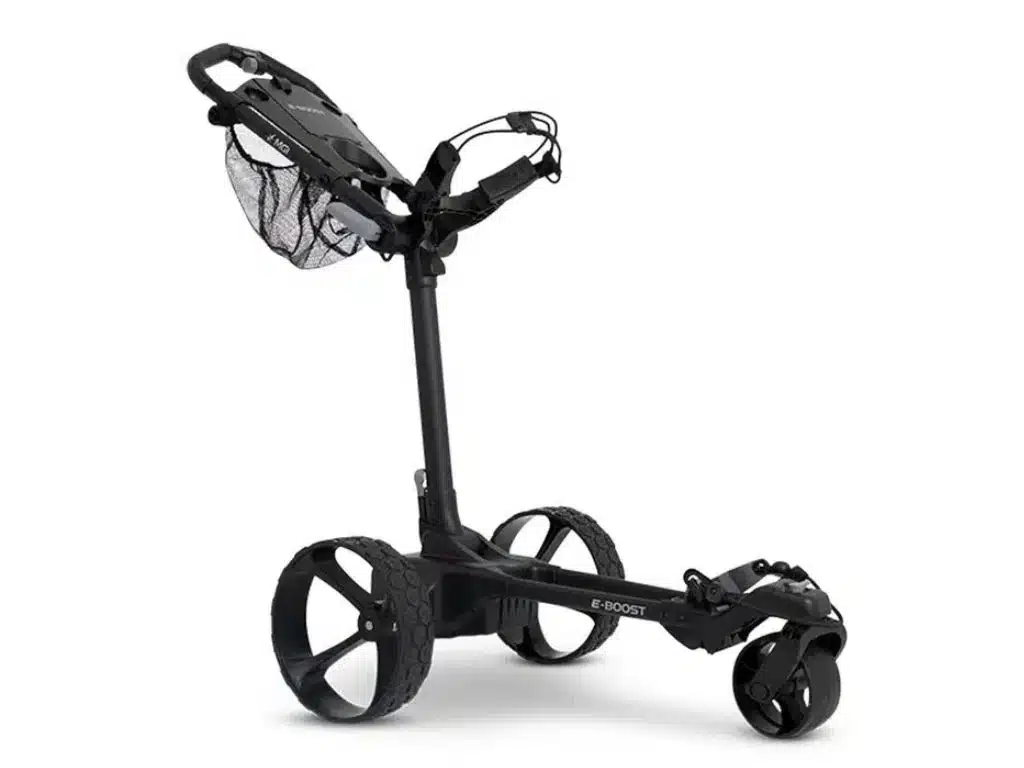
Upgrade your game with the MGI E-Boost Pushcart. Featuring advanced electric power assist, it tackles hills effortlessly while keeping you fresh. Lightweight, durable, and built for performance.
Most standard electric golf carts powered by lithium-ion batteries cover 30 to 50 miles on a single full charge. Actual range varies based on terrain, speed, total weight load, and battery capacity.
Lithium-ion batteries are lighter, charge much faster (3–5 hours vs. 8–10 hours), require zero maintenance, and last 3 to 5 times longer than traditional lead-acid batteries. While lithium has a higher upfront cost, it saves money over time through longevity and efficiency.
Yes, in many municipalities. To qualify as a Low-Speed Vehicle (LSV) for public roads with posted speeds of 35 mph or less, a cart typically needs standard safety features: seatbelts, headlights, taillights, turn signals, mirrors, a horn, a windshield, and a VIN.
Lithium-ion batteries typically last 7 to 10 years (or ~3,000 to 5,000 charge cycles) with proper care. Lead-acid batteries generally require replacement every 3 to 5 years.
Electric carts require minimal upkeep compared to gas models; no oil changes, spark plugs, or air filters are needed. Basic maintenance involves checking tire pressure, inspecting brakes, keeping the frame clean, and maintaining battery charge health.
If you want the absolute best technology on the market and you play courses with a lot of hazards, the MGI AI Navigator Halo is the answer. The Geo Protect system works, and the optional Halo Eye LiDAR sensor turns it into a fully autonomous follow caddy if you want to go that route.
If you want a remote-control cart with an integrated GPS screen but you don't want to spend $2,500, the MGI ZIP AI Navigator GPS+ gives you all the course data you need right on the handle.
If you play on rugged, hilly courses and need maximum power and stability, the MGI Zip Navigator AT and the Alphard Cyber Cart are the two best options. The MGI gives you better maneuverability with the dual front wheels, while the Alphard gives you a lower center of gravity for extreme side slopes.
If you just want to stop pushing a heavy cart up hills and don't care about remotes or screens, the MGI ZIP X5 is the smartest value on the board. And if you want a manual push cart that can bail you out on steep inclines, the MGI E-Boost is the only hybrid that gets it right.
Let me know in the comments which one you're going with.