
Fitting golf clubs isn't just picking a shaft stiffness off a chart; it's a data-driven process where a trained fitter analyzes your actual swing metrics using launch monitors to determine the exact specifications you need. You'll get matched to the right shaft weight, flex, lie angle, loft, and grip size based on your clubhead speed, attack angle, and strike patterns. The result? Clubs built for how you swing, not some factory average, and understanding each step reveals why it works.
Walking into a club, fitting unprepared is like showing up to a job interview without your resume; you're wasting everyone's time, including your own.
Bring your current clubs. Every single one. Your fitter needs baseline data, and those beat-up irons tell a story about your swing that words can't capture. Wear your golf shoes and glove; stance and grip affect everything. Skip the jeans; restrictive clothing corrupts your natural movement.
You'll also need to arrive with information ready: your handicap, budget limits, injury history, and honest assessment of which clubs you love versus which ones betray you on the course. Note specific problems, that the 7-iron that always flies right, the driver you can't keep in the fairway. Your fitter will use your existing clubs to gather vital information for determining future club sizes and specifications. Being honest about your struggles helps the fitter address issues that may have caused ingrained bad habits from using ill-fitted equipment.
Warm up before arriving. You're about to hit hundreds of balls. Full bag fittings can take up to 4 hours, so block out your entire morning or afternoon and eat beforehand.

The moment you step onto that launch monitor mat, your fitter already knows more about your game than you've told them. Now, they're about to confirm it with data. Your first shots establish baseline metrics: clubhead speed, ball speed, launch angle, and spin rate. The monitor captures everything in real-time.
But raw numbers don't tell the whole story. Your fitter analyzes angle of attack, tempo, and release timing to understand why your ball flies the way it does. They'll document shot shape tendencies and strike location patterns using impact tape. That heel-heavy dispersion you've been ignoring? It's now quantified.
This data-driven approach strips away assumptions. You'll see exactly where energy leaks from your swing and which misses repeat most often. Professional fitters rely on systems like TrackMan 4 because radar-based monitors deliver carry distance data within 5% of real-life measurements. That's your starting point.
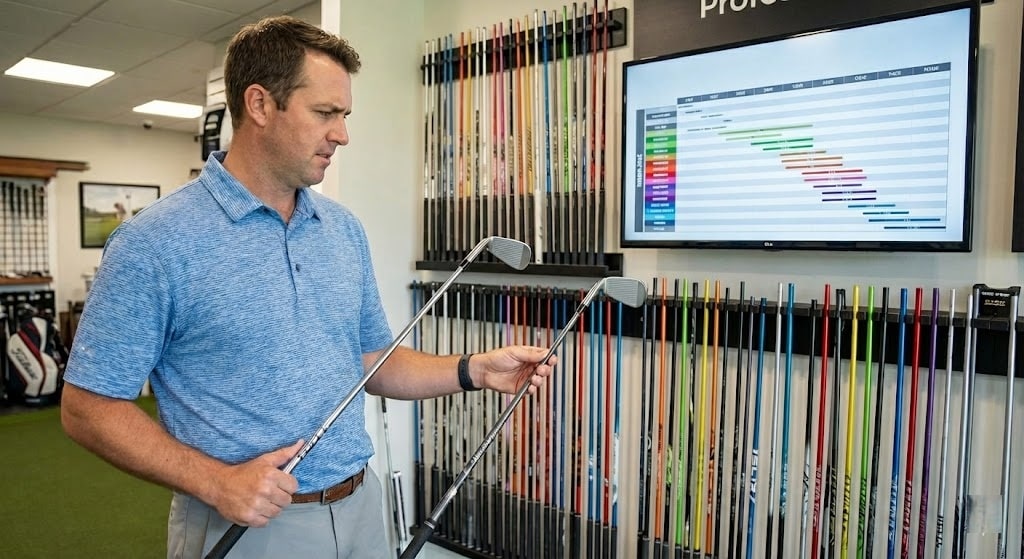
Every component in a custom-fit club represents a deliberate choice, not a factory default. You're selecting shaft material, weight, and flex based on your actual swing speed and tempo, not some generic "regular" or "stiff" label that means different things to every manufacturer. For most amateur golfers, Regular flex shafts represent the most common choice, while graphite driver shafts are preferred over steel due to their lighter weight and greater distance potential.
Your grip choice affects feel and control more than most golfers realize. Material, texture, and size all factor into how confidently you deliver the clubface at impact. A wide range of color combinations available through customization also lets you match your personal style while optimizing performance.
Loft and lie adjustments might sound minor, but they're transformative. A lie angle off by just two degrees sends your ball consistently offline, and you'll blame your swing instead of the equipment. Club Champion's Master Builders hand-build each custom club with precision and attention to detail, ensuring these critical specifications are executed exactly to your fitting recommendations.
The real power here? Paint fills, ferrule colors, and finish options let you customize aesthetics without sacrificing performance. Your clubs should look like yours.
Once you've zeroed in on the right components, the real work begins, turning all that testing into a final decision you'll actually commit to.
Your fitter presents a detailed spec sheet comparing your "before" and "after" numbers. You'll see exactly how the recommended clubhead, shaft, and grip combinations improved your dispersion, distance, and consistency. Price quotes are laid out clearly, with no hidden surprises.
Here's what matters: you're not locked in. You can buy everything, cherry-pick specific clubs, or simply adjust your existing equipment based on the fitting data. The fitter follows up after delivery to confirm the clubs perform as expected on actual courses. If something feels off, tweaks happen. This isn't a one-and-done transaction; it's an ongoing relationship designed to enhance your investment. Clients consistently report dramatic improvements post-fitting, including increased ball speed, distance, and accuracy, owing to their tailored equipment. Studies show that 80% of custom-fit golfers hit the ball more accurately based on launch monitor data, validating the investment you're about to make. Throughout this process, you maintain complete control since fitter recommendations serve as guidance rather than high-pressure sales tactics.
Behind every set of fitted clubs lies a precision assembly process that most golfers never see, and honestly, it's where the real magic happens.
Your fitter's recommendations mean nothing if the build fails. Shafts get cut from the butt end, never the tip, to preserve that essential stiffness profile you paid for. Graphite demands a saw, not a tubing cutter, or you'll crack the fibers. Two-part epoxy bonds everything, but excess creates problems.
Here's what separates good builders from great ones: weight matching. Every head gets weighed before assembly. Lighter heads might need tungsten in the hosel; heavier ones require lead tape adjustments. Shafts get sorted by weight, too; lighter shafts pair with longer clubs, heavier with shorter. Before final assembly, builders test-fit club heads and mark shaft insertion depth with tape to ensure consistent positioning across the entire set. Professional fitting ensures proper impact distribution across the clubface, which can significantly extend how long your clubs remain in peak condition.
Final swingweight and frequency testing confirms consistency across your set. The GolfWorks assembly team brings over 150 years of combined experience to every custom build, ensuring the precision that professional and recreational golfers demand.
You'll typically spend between $100 and $300 for a solid professional fitting, though prices swing wildly from $25 to $500+. Don't get suckered by the idea that expensive always means better. A full bag fitting at Club Champion or True Spec runs $100–$400, while single-club sessions cost considerably less. Many shops credit your fitting fee toward equipment purchases, so factor that into your decision.
You don't need annual refittings; that's often marketing talk. Most golfers should get a full fitting every 2–3 years, with simple loft and lie checks annually. However, your situation dictates the timeline. If you've made significant swing changes, recovered from injury, or notice consistent distance loss, get refitted sooner. Juniors need checks every 6–12 months due to growth, while seniors should reassess every 1–2 years as flexibility changes.
You'll often hear that beginners should "develop a swing initially" before getting fitted. I disagree. Starting with properly fitted clubs prevents you from building compensatory habits that become ingrained for years. Data shows custom-fit golfers are 56% more likely to see improvements of 5+ strokes per round. You don't need a full bag fitting; even adjusting lie angles on your current set helps you find center contact more consistently from day one.
You've got solid options. Major retailers like Golf Galaxy and PGA TOUR Superstore employ certified fitters using TrackMan, and their non-commission structure removes sales pressure. For brand-specific knowledge, Titleist and TaylorMade operate dedicated fitting centers with tour-level equipment. Don't overlook local independent shops either; places like P45 Knuckle Down Golf often bring decades of hands-on experience. Call ahead, book an appointment, and bring your current clubs.
Custom-fitted golf clubs typically take 2 to 4 weeks to arrive; don't let anyone tell you it's faster without specifics. You're looking at 3 to 5 business days for the actual build, plus shipping time. Component availability and order backlogs during peak season can stretch that timeline. Express shipping speeds delivery but won't accelerate production. Contact your fitter directly if you're past the 3-week mark.
You've now got the complete roadmap for what happens during a professional club fitting. Don't let anyone convince you it's unnecessary or that off-the-rack clubs work just as well; they don't. Your swing is unique, and your equipment should reflect that. Book a fitting with an independent fitter, bring your current clubs and an open mind, and trust the data over brand loyalty. Your scores will thank you.


