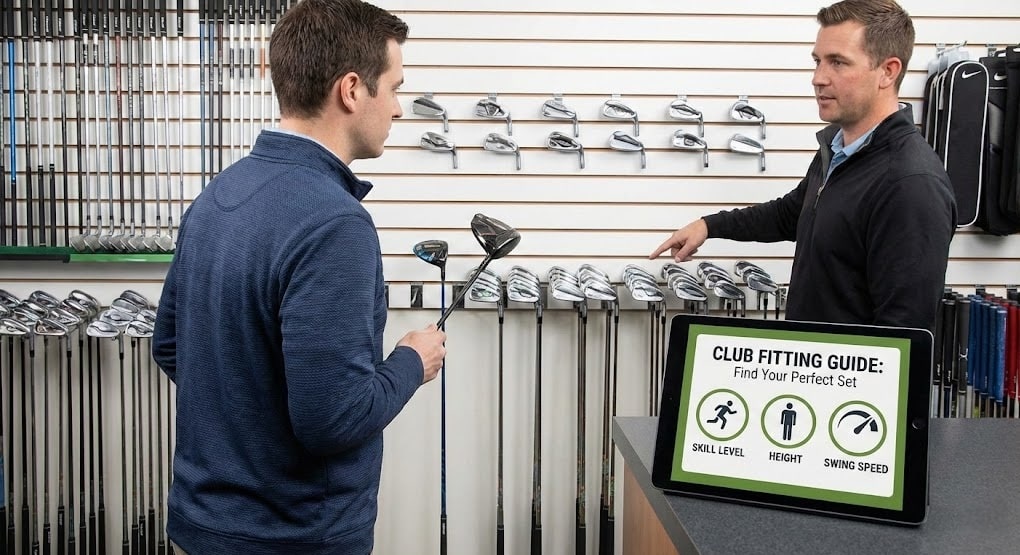
Forget the marketing hype about "game-improvement technology", choosing golf clubs comes down to three factors: your swing speed, your skill level, and honest distance data from actual rounds, not inflated range sessions. Start by getting fitted, since 87% of fitted golfers drop their handicap by at least 10%. Consider hybrids over hard-to-hit long irons, and don't overlook quality used clubs that save 30-60%. Below, you'll find everything you need to build your ideal set. When it comes to selecting the ideal golf clubs for specific distances, it's essential to understand the importance of each club's design and performance characteristics. Testing different models on the course will give you real insight into which clubs can consistently help you reach your target distances. Remember, the right combination of clubs will enhance your game, making every hole a new opportunity for improvement.
Every golfer faces the same bewildering moment: standing in a pro shop surrounded by dozens of clubs, each promising to change your game, while sales staff push whatever inventory they need to move that month. Here's the truth: you only need to understand five club categories.
Woods deliver maximum distance with their large clubheads and long shafts. Your driver handles tee shots; fairway woods work from the grass. Irons (3-9) cover approach shots and recovery situations, with mid-irons offering the best balance between distance and control. Hybrids bridge the gap, replacing those notoriously difficult long irons. Wedges handle precision work around greens with their high loft angles. Your putter finishes the job on the green.
That's it. Five categories. Everything else is marketing noise. Some brands like Takomo cut through the retail markup nonsense by shipping forged clubs from Finland directly to you, proving you don't need to overpay for quality equipment.

Knowing your club categories means nothing if you can't answer the most basic question on every approach shot: how far do you actually hit each one?
Here's the uncomfortable truth: range distances lie. You're relaxed, hitting off perfect mats, and there's zero pressure. Your on-course numbers tell the real story.
I recommend tracking shots during actual rounds using GPS devices or smart sensors like Arccos. These tools capture data under genuine playing conditions, when it actually matters. Advanced systems provide detailed analytics for improvement that help you understand patterns in your game over time.
If you're testing at the range, use the same ball type throughout and note where you're striking the face. A toe hit and a center hit produce wildly different distances, and averaging them together creates useless data. For the most accurate measurements, consider using a launch monitor that provides real-time feedback on metrics like ball speed and carry distance.
Update these numbers seasonally. Temperature swings alone change your distances by several yards. For drivers specifically, you can expect approximately 1.5 yards difference for every 10°F temperature change.
Why do manufacturers push 14-club sets on players who can barely make solid contact with one? Here's the truth: you need a driver, a 3-wood, a few irons (3, 5, 7, 9), a pitching wedge, and a putter. That's it.
When you're commencing, look for clubs with larger clubheads and wider sweet spots. These forgiving designs minimize the damage from your inevitable mishits. Shorter shafts give you better control and help get the ball airborne consistently.
Don't buy a bundle without testing individual clubs initially. Your body type and natural swing style matter more than any marketing promise. Wilson, TaylorMade, and Callaway all make solid beginner-friendly options. Consider hybrids instead of long irons—they're simply easier to hit. Test before you buy. Understanding how loft affects trajectory and distance will help you make smarter decisions when selecting each club for your bag. A professional club fitting can match equipment to your unique swing characteristics, helping you get the most out of every club in your bag. Matching your driver shaft to your swing speed category is essential, as the right flex and weight combination can reduce shot dispersion by 50% while adding extra distance.

Before you write off professional club fitting as an overpriced gimmick, look at what the data shows: 87% of fitted golfers reduce their handicap by at least 10%. That's not marketing fluff; it's launch monitor data proving that matching equipment to your swing mechanics enhances your game.
Here's what fitting actually delivers: 80% of fitted golfers hit more accurately and consistently. You'll tighten shot dispersion, improve carry distance, and often correct that nagging slice without overhauling your swing.
High-handicappers see the most dramatic gains, but single-digit players benefit from the confidence enhancement alone. The $200-$400 session fee covers lie angle analysis, shaft flex improvement, and grip sizing, all calibrated to your body and swing. For beginners, properly fitted clubs help prevent ingrained bad habits that develop when learning with ill-matched equipment.
Fitted clubs also reduce injury risk by eliminating strain from ill-matched equipment. That's performance and longevity in one investment. The fitting process includes follow-up sessions to fine-tune adjustments after you've had time to play with your new equipment on the course. Many golfers wonder about the best time to get fitted, but experts agree that, regardless of skill level, the answer is now rather than waiting until you've developed your swing further.
Once you've dialed in your fitted equipment, the next challenge becomes knowing which club to pull for every situation the course throws at you, and this is where most golfers sabotage their own scorecards.
You're standing 150 yards out, ball sitting down in thick rough, and you grab your usual 7-iron. Wrong move. That buried lie demands more loft; grab your 8-iron and swing with authority. The rough's density dictates your options, not your ego.
Wet conditions? Add one club. Headwind punishing your approach? Add another. These aren't suggestions, they're non-negotiable adjustments that separate smart players from frustrated ones. In cold temperatures, reach for lower-lofted clubs since the ball won't travel as far in chilly air.
Stop aiming at pins tucked behind bunkers. Play to green centers, clear hazards with appropriate loft, and watch your greens-in-regulation climb without changing your swing. When you find yourself in thick rough near the green, a sand wedge or lob wedge provides extra loft to escape while delivering the stopping power you need.
For those long approach shots beyond 180 yards, consider swapping your difficult-to-hit long irons for hybrids, which combine wood and iron features to deliver more consistent contact and better results from challenging lies.
While your equipment choices deserve careful thought, where you play those clubs can quietly become your biggest golf expense, and most players stumble into memberships without ever seeing the full price tag.
Private club initiation fees range from $80,000 to $400,000, with annual dues adding $6,768 to $33,000 on top. Then come the hidden costs: food minimums ($1,000 annually), locker fees, capital assessments, and guest charges. Southwest clubs hit hardest, with maintenance costs exceeding $15,000 per acre.
Here's the uncomfortable truth: 81% of golfers expect fees to rise again in 2026. Clubs routinely push 8% annual increases without losing members.
Your alternative? Public courses average $45 per round, and semi-private memberships run around $900 annually. Before signing anything, calculate your true cost-per-round; that number determines whether exclusivity actually serves your game. Smart budget allocation means considering buying used golf clubs at 30-60% less than new prices, freeing up funds for course access and practice time.

Replace your grips every 12–18 months or roughly 30–40 rounds, whichever comes first. Don't wait until they're falling apart. If your grips feel slick, show shiny spots, or have visible cracks, you've already waited too long. Live in a hot, humid climate or store clubs in your car trunk? You'll need fresh grips every 6–9 months. This isn't marketing fluff; worn grips genuinely sabotage your swing.
The ideal golf bag size depends on how you play, not what manufacturers push. For most golfers, a standard bag measuring 35-36 inches tall with 10-inch diameter handles a full 14-club set without overcrowding. Don't fall for oversized tour bags; they're overkill unless you're a pro. You'll want 14 full-length dividers to protect your clubs and lightweight materials if you're walking courses regularly.
No, left-handed golf clubs don't cost more than right-handed options. This is a persistent myth I love busting. Major brands like Callaway, TaylorMade, and MacGregor price their left-handed sets similarly to right-handed versions. You'll find the same $399.99 MacGregor DCT 3000 or $699.99 Callaway Strata best regardless of handedness. Price differences come down to materials, technology, and brand, not which hand you swing with.
Altitude genuinely affects your distances, though many golfers overcomplicate this. You'll gain roughly 1% distance for every 1,000 feet of elevation—that's real physics, not marketing fluff. At 5,000 feet, your 150-yard 7-iron becomes a 157-yard shot. The fix? Club down. Thinner air also flattens your path, so expect more roll. Update your distance chart before playing mountain courses.
Yes, you should clean your clubs after every round; it's not overkill. Dirty grooves kill spin, and that directly impacts your shot control. Use warm water, mild soap, and a soft brush to scrub the clubface. Dry them immediately with a towel. You don't need a deep clean every time, but wiping down clubheads removes the gunk that accumulates and keeps performance consistent round after round.
Choosing golf clubs isn't about buying what the pros use or what's trending on YouTube. It's about understanding your game, measuring your actual distances, and investing in a proper fitting when you're ready. Start simple, resist the urge to overcomplicate your bag, and keep in mind that the best clubs are the ones you'll actually hit well, not the ones with the flashiest marketing. Finding the right equipment can significantly improve your performance on the course. To ensure you're well-equipped, consider visiting the best golf club fitters in California who can guide you based on your individual swing and style. Their expertise will help you select the perfect clubs tailored to your needs, enhancing both your comfort and confidence as you play.