The blade vs. mallet debate isn't about which putter is superior; it's about matching engineering to your stroke. If you've got an arcing stroke, a toe-weighted blade gives you the rotation you need. Straight-back-straight-through? A face-balanced mallet resists twisting and forgives mishits. Mallets statistically help mid-handicappers hole 7% more putts inside six feet, while blades offer better feel on fast greens. Understanding your stroke type reveals the right choice.
When you're staring at a wall of putters at your local golf shop, the initial thing that hits you is how dramatically different blade and mallet putters look, and that visual difference isn't just cosmetic.
Blade putters sport that classic, sleek rectangular profile that hasn't changed much in decades. They're compact, minimalist, and favored by purists who appreciate clean lines. Their heavy toe-weighting places the sweet spot closer to the heel, which influences how the club responds during your stroke. Mallet putters? They've gone wild with design, half-moons, squares, wings, and geometric shapes that look like spacecraft. These larger heads often include alignment aids that help golfers aim more accurately at their target.
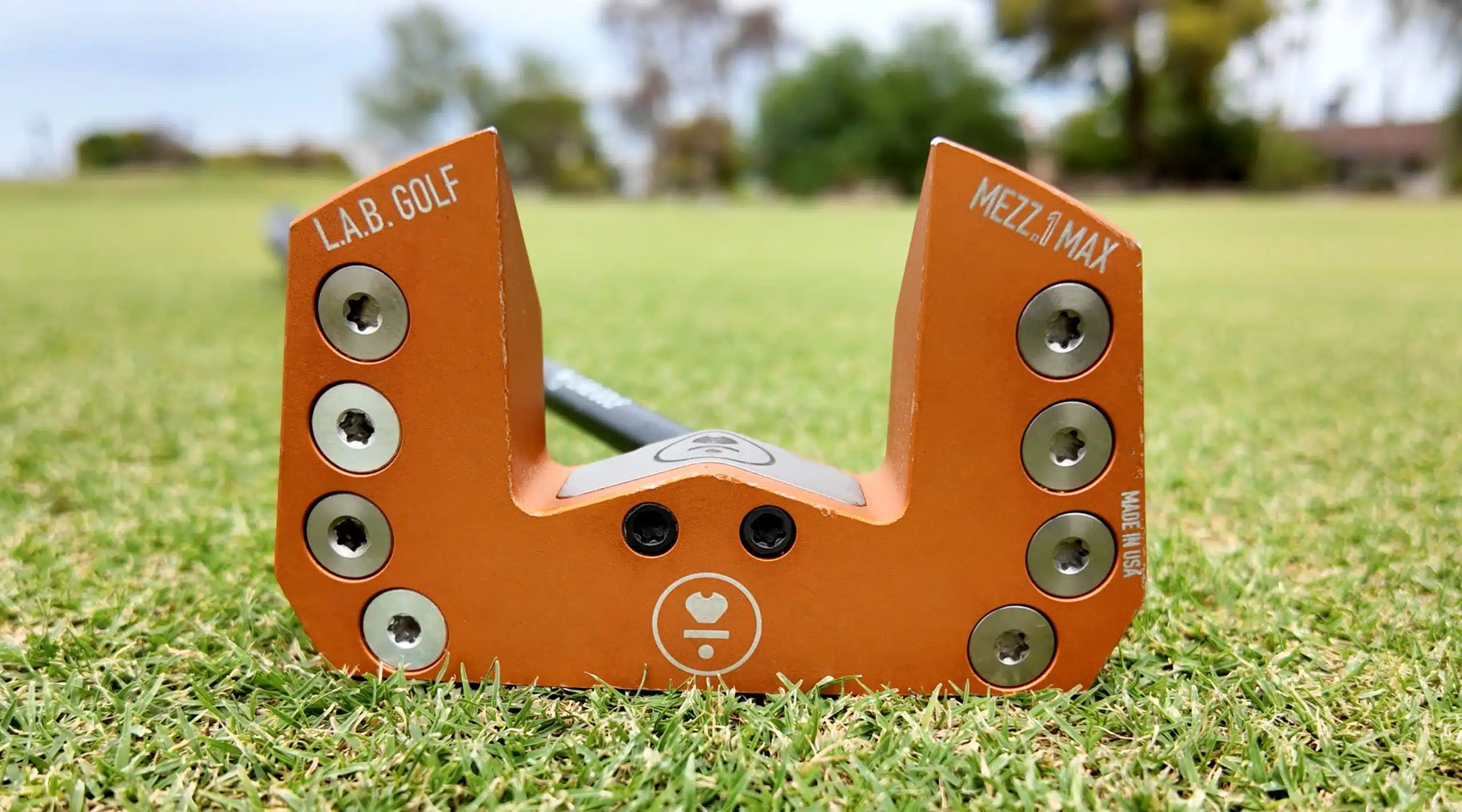
Here's what matters: mallet heads are larger, giving manufacturers room to play with multi-material constructions. You'll find aluminum bodies with tungsten weights strategically placed for balance. This perimeter-weighted design creates higher forgiveness and stability compared to traditional blade styles. Blade putters stick to simpler, single-metal construction. That size difference directly impacts everything from alignment aids to weight distribution, features we'll dig into next.
Two factors separate a putter that bails you out from one that punishes your mistakes: weight distribution and moment of inertia (MOI).
Blade putters concentrate mass in the heel and toe, keeping weight centralized near the face. This design delivers precise feedback but creates a lower MOI, meaning the head twists more on mishits. This makes blades best suited for arc-type putting strokes, where golfers naturally open and close the face through impact.
Mallet putters spread weight around the perimeter and toward the back of the head. This perimeter weighting, often achieved through multi-material construction with tungsten weights, pushes MOI considerably higher. The result? A larger effective sweet spot that's roughly twice as forgiving as traditional blades. Many mallet designs also incorporate enhanced alignment aids that help golfers line up their putts with greater accuracy. The mallet's lower center of gravity also enhances stability throughout the entire putting stroke.
Here's what matters: higher MOI resists twisting during your stroke, keeping the face square through impact. Lower MOI rewards clean strikes but magnifies errors when you miss center.
Finding your natural stroke arc matters more than any marketing promise about game-changing technology, yet most golfers skip this step entirely and wonder why their new $400 putter feels wrong.
Your stroke falls into one of three categories: straight-back-straight-through, slight arc, or strong arc. Each demands a specific putter configuration. Strong arc strokes need high toe-hang putters, typically blades with short slant or inline hosels, that rotate naturally through impact. Straight strokes require face-balanced mallets that resist twisting. The SBST technique keeps the putter face square to the target throughout the entire motion, minimizing misalignment risk. For optimal SBST performance, position your eyes directly over the ball during setup to maintain that straight path.
Here's the critical match: pair your arc with appropriate toe hang. A strong arc player using a face-balanced mallet fights the club's design every stroke. Conversely, an SBST player wielding a high-toe-hang blade introduces unnecessary rotation. Match these elements correctly, and consistency follows immediately. Just as professional fitting ensures the right wedge specifications for your swing, a proper putter fitting analyzes your stroke pattern to determine the ideal toe hang and head style.

Although manufacturers love touting forgiveness as a magic fix, the real question isn't whether mallets are more forgiving; they objectively are, but whether that forgiveness actually translates to lower scores on your scorecard.
The data says yes. Mid-handicap golfers using mallets average 2.3 three-putts per round compared to 2.6 with blades. That's one saved stroke every three rounds from three-putt avoidance alone.
Here's where it gets interesting: 15-handicap players hole 82% of putts inside six feet with mallets versus 75% with blades. That's roughly one extra make per round on the putts that actually matter for scoring. That 7% difference in make percentage demonstrates why mallets are statistically advantageous for average golfers looking to improve.
Blades do edge out mallets on lag putt proximity,7.3 feet versus 7.7 feet from 20+ feet. But you'll hole that shorter second putt more consistently with a mallet's higher MOI design. Testing reveals that a Scotty Cameron blade produces a smash factor of just 1.37 on toe strikes compared to 1.5 on center strikes, showing how strike location dramatically affects energy transfer and explains the performance gap between putter styles. This same attention to precision is why companies like TaylorMade maintain state-of-the-art manufacturing facilities to ensure their equipment meets tour-level quality standards.
When you pick up a blade putter, you're holding a tool that talks back to you; every mishit, every pure strike registers instantly through your hands. That concentrated heel-toe weighting delivers feedback that experienced players crave for gauging stroke quality and distance. This superior feedback mirrors what skilled golfers appreciate in blade irons, where precise contact information helps refine technique and control. Mallets, by contrast, often feel "duller" on impact; their perimeter weighting dampens sensation, particularly on off-center strikes.
Here's where conditions matter: blade putters dominate on fast greens. Their compact design lets you create that delicate, repeatable stroke crucial for quick surfaces. You'll find precise distance control comes naturally when the putter responds honestly to your touch. Blade putters are particularly well-suited for golfers who use an arc-style putting stroke.
Flip to slow, bumpy greens, and mallets earn their keep. That higher MOI maintains speed and direction through inconsistent surfaces, while alignment aids compensate for less predictable rolls. Mallets also offer more real estate on top for visual alignment features, including true path lines that help you aim the ball more effectively.

Most PGA Tour professionals now prefer mallet putters, and it's not even close. You'll find all 10 players in the Official World Golf Ranking rolling mallets as of late 2025. The TaylorMade Spider Tour X dominates among the game's best. While a few holdouts like Ludvig Åberg stick with blades, they're the exception. The shift happened fast, and forgiveness won.
You'll find solid blade and mallet putters in the $150-$250 range, which is the sweet spot for quality without overpaying. Premium models from Scotty Cameron or Bettinardi jump to $400-$500+, but here's the truth: testing shows those extra hundreds don't guarantee better performance. Budget options exist under $100, though feel and consistency suffer. Skip the prestige tax unless you genuinely love the craftsmanship.
Switching putters won't magically slash your handicap overnight; that's marketing fantasy. However, if you're struggling with short putts, a mallet's forgiveness could save you one to two strokes per round by converting those nerve-wracking six-footers. That's a meaningful improvement. But here's the catch: your stroke type matters more than the putter itself. Match the head to your mechanics initially, then expect gradual gains, not instant change.
You'll need 100 to 300 practice putts across 3 to 5 sessions before that new putter stops feeling foreign. Most golfers acclimate within two weeks with consistent practice, but here's the catch: switching from a blade to a mallet demands more adjustment time than swapping between similar designs. Don't judge your new flatstick after one frustrating round. Your muscle memory needs time to rewire itself.
Yes, but the difference isn't dramatic. You'll spend more time cleaning a mallet putter; those intricate designs and inserts trap dirt in crevices that demand a soft brush. Blade putters? A damp cloth handles most jobs. Both need regular grip checks and proper storage, but don't overthink this. Your playing conditions matter more than putter type. Sandy courses mean more cleaning regardless of what's in your bag.
Here's what matters: there's no universally superior putter design. Blade putters reward skilled players with a consistent arc stroke who crave feedback. Mallet putters offer forgiveness and stability for those with straighter strokes or less practice time. Don't let marketing buzzwords or tour player endorsements drive your decision. Get fitted, test both styles on real greens, and trust what actually drops more putts for you.