

You'll need three wedges to cover all your short game situations: a pitching wedge (45-48°), a gap wedge (50-52°), and a sand wedge (54-56°). This setup creates perfect 10-15 yard distance gaps between clubs, so you're never stuck between shots. Your pitching wedge handles those 100-130 yard approaches, the gap wedge fills that tricky 85-100 yard range, and your sand wedge saves you from bunkers and thick rough. There's more to matching these wedges to your specific swing style, though.
When you're standing over your golf bag trying to decide which wedge to pull, you need to understand what each one actually does for your game. Your pitching wedge, lofted between 44 and 49 degrees, handles those longer approach shots from about 100 to 130 yards out. Next up, you've got the gap wedge at 48 to 54 degrees. It fills that distance void between your pitching and sand wedges, perfect for those tricky 85 to 115-yard shots. The sand wedge, sitting at 54 to 58 degrees, isn't just for bunkers! It's your go-to for quick-stopping shots around the green. The wide sole design helps it glide smoothly through sand and soft lies without digging in. Ultimately, there's the lob wedge at 58 to 64 degrees, which sends balls sky-high for those short, obstacle-clearing shots. The lob wedge's maximum backspin capability makes it essential for delicate shots where you need the ball to stop quickly after landing. With a quality bag featuring 14-way dividers, you'll protect your wedges from damage while keeping them organized and easily accessible during your round.

The three-wedge system is your ticket to simplifying your short game while still covering all your bases. You'll typically carry a pitching wedge at 45-48°, a gap wedge at 50-52°, and a sand wedge at 54-56°. This setup gives you perfect 10-15 yard gaps between clubs, which means no more guessing games when you're 100 yards out!
Here's what makes this system work: your PW handles those 100-130 yard approach shots, your gap wedge covers 85-115 yards, and your sand wedge takes care of everything from 75-105 yards. Modern iron designs often create distance discrepancies between your pitching wedge and traditional wedges, making proper gap wedge selection even more critical. Plus, each club pulls double duty; your sand wedge isn't just for bunkers, it's also your go-to for flop shots and short pitches around the green. When facing thick rough, your sand wedge's higher loft will help you escape with a shot that lands softly on the green. Organizing your wedges properly in a quality stand bag with full-length dividers will protect your club faces and make selection quick during play.
Four to six degrees might not sound like much, but that's the magic number that'll make or break your wedge game. When you're spacing your wedges properly, you'll avoid those awkward in-between distances that force half-swings and guesswork.
Start by checking your pitching wedge loft; it's probably around 45 degrees. From there, add wedges in 4-6 degree increments. You might go with a 50-degree gap wedge, 56-degree sand wedge, and maybe a 60-degree lob wedge if you need it. The Wedge Selector Tool recommends this 4-6 degree separation between wedges to create optimal distance gaps for consistent scoring.
Here's the thing: those small loft differences translate to roughly 10-15 yard gaps between clubs. That means you'll have a comfortable full swing for most approach shots instead of trying to "take something off" your swing. It's way easier to control distance when you're making your normal motion! Premium bags feature full-length dividers that keep your wedges organized and prevent them from clanging together during transport. Remember that a higher loft produces more backspin and a higher launch angle, which helps your ball stop quickly on the green rather than rolling off the back.
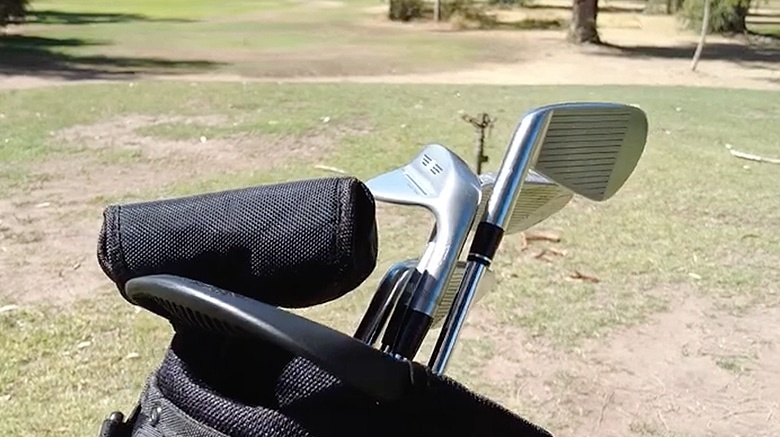
Three key design features separate a wedge that'll frustrate you from one that'll actually improve your short game—and they all depend on how you swing the club.
First, there's the bounce angle, basically how much the sole sticks out below the leading edge. If you're someone who takes divots like you're digging for valuables, you'll want high bounce (10° or more). Got a sweeping swing? Low bounce (under 8°) is your friend. Sand wedges typically feature 10-16 degrees of bounce to help prevent the club from digging too deep in bunkers.
Second, the grind shapes how the sole interacts with turf. Steep swingers need wider grinds to prevent digging, while shallow swingers prefer narrower ones for versatility. The M Grind offers maximum versatility for players who vary their technique, while specialized options like the K Grind work best for heavy-handed players.
Finally, shaft flex matters more than you'd think! Slower swing speeds need flexible shafts for accuracy, while faster swingers benefit from stiffer shafts for distance control. Proper club organization in your bag ensures easy access to the right wedge for each shot, preventing damage to your shafts and speeding up play.
Most golfers carry just two wedges and wonder why their short game suffers; you need at least three, and probably four, to handle everything the course throws at you.
Here's the thing: your pitching wedge covers 100-130 yards, but what happens at 85 yards? That's where a gap wedge saves the day. Add a 56-degree sand wedge for bunkers and most chips, and you've got the basics covered. Want more versatility? Throw in a 60-degree lob wedge for those tight spots around the green.
The key is keeping 4-to-6-degree gaps between each wedge, so if your pitching wedge is 44 degrees, go with 50, 56, and 60. This setup gives you a shot for every distance without any awkward gaps where you're stuck between clubs. Each wedge offers a specific combination of bounce, loft, and grind that works together to help you execute different shots around the green. Remember to clean grooves after each round to maintain the spin and control that makes your wedges perform at their best. Consider how your wedges fit with the rest of your bag setup, just like Tour pros choose their equipment based on specific course demands and playing style.
You'll want to replace your wedges every 60-75 rounds or about once a year if you're playing weekly. The fact is, worn grooves mean less spin control, and that's when your short game suffers! Check for visible groove wear or if shots are flying higher with less bite. Serious players might swap them every 12-18 months, while weekend warriors can stretch it to 2-3 years.
Yes, you can absolutely mix wedge brands in your bag! Many golfers, including tour pros, combine different manufacturers to get the perfect setup. The fact of the matter is, each brand offers unique bounce options and grinds that might suit specific shots better. You might love TaylorMade's 56-degree for bunkers but prefer Cleveland's 60-degree for tight lies. What matters isn't matching logos, it's finding wedges that give you confidence and fill your distance gaps properly.
You'll want to clean your wedges after every round using warm, soapy water and a soft-bristled brush. Soak the clubhead for 2-3 minutes, then scrub the grooves in circular motions to remove debris. For rust on raw wedges, use fine steel wool (grade 000) with white vinegar. Rinse thoroughly, dry completely with a microfiber towel, and let them air dry overnight. Store them in a dry place to prevent corrosion!
No, you shouldn't choose different wedge configurations just because you're left-handed. You'll follow the same loft gapping principles—keeping 4-6 degrees between wedges for consistent distance control. Your main challenge is finding models, since manufacturers produce fewer left-handed options. Focus on getting proper lofts like 52°, 56°, and 60° that match your pitching wedge. Custom fitting becomes extra crucial for you, helping you overcome the limited off-the-rack selections available.
For beginners, expensive wedges aren't worth it. You'll do just fine with $30-80 entry-level wedges while you're learning the basics. The point is - premium wedges offer advanced spin technology and grooves, but you won't consistently use these features yet. Save your money, hone your fundamentals with budget-friendly options, then upgrade when you're breaking 90 regularly. Think of it like learning guitar - you don't need a Gibson Les Paul on day one!
You've got this! Start with three wedges: your pitching wedge, gap wedge, and sand wedge, and you'll handle 90% of shots inside 120 yards. Remember, proper loft gaps matter more than fancy features, so aim for that 4-6 degree spacing between clubs. As you improve, consider adding a lob wedge for those tricky short-sided shots. Test different combinations in the range, trust your instincts, and build a short game arsenal that matches your swing. Your scores will thank you!

