Forget the generic distance charts manufacturers print; your actual yardages are what matter. You'll use your driver for shots beyond 200 yards, irons to cover the 100-220 yard range, and wedges for anything inside 120 yards. But here's the catch: these numbers shift dramatically based on your swing speed, maturity, and skill level. The real breakthrough is mapping your personal distances with each club, which we'll break down below.
If you've ever pulled your 3-wood from the bag on a tight hole thinking you're making the smart play, I need to challenge that assumption right now. The data destroys this conventional wisdom completely.
Your driver averages 224.7 yards compared to your 3-wood's 210 yards; that's roughly 15 yards you're surrendering for virtually nothing. Here's the kicker: fairway accuracy between these clubs differs by a mere 0.9%. You're sacrificing distance for an accuracy advantage that doesn't exist. Even when looking at shots landing inside 30 yards from the centerline, the 3-wood only shows a 3.1% accuracy improvement over the driver.
Modern drivers pack 2-3 times the moment of inertia of 3-woods, meaning your mishits travel farther and straighter than you'd expect. When you leave that driver in the bag, you're losing approximately one-third of a stroke per hole. That's real scoring damage. Keep in mind that women should subtract 50 yards from these driver and wood averages when calculating their expected distances. To maximize your distance potential, ensure you're maintaining a secure grip by keeping your hands dry throughout your round.
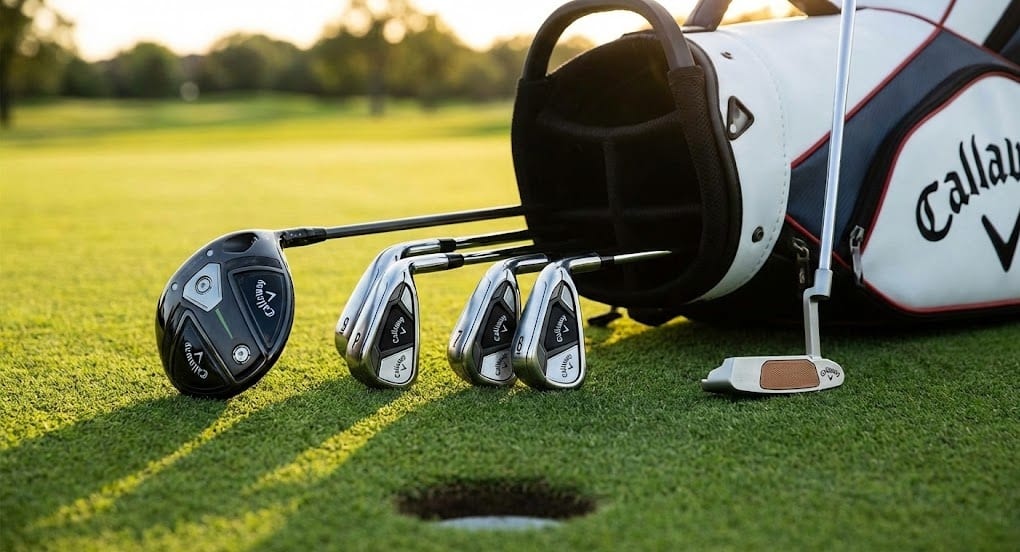
Because most golfers obsess over their driver distance while completely ignoring their iron game, they're hemorrhaging strokes where it actually matters, on approach shots.
Here's the truth: your irons aren't interchangeable. Each club exists for a specific distance window. Long irons (2-4) cover 170-220 yards. Mid irons (5-6) handle 130-185 yards. Short irons (7-9) dial in 100-160 yards. Wedges own everything inside 120.
The magic number you need to memorize is 10-15 yards, that's your gap between each iron. If you're hitting your 7-iron and 8-iron the same distance, something's broken in your technique. Understanding your smash factor helps identify whether you're transferring energy efficiently from club to ball on each iron.
Don't guess at these numbers. Get on a launch monitor and map your actual distances. To find your true average with each club, hit about 50 balls and eliminate the longest and shortest five shots before calculating. Getting properly fitted clubs ensures your equipment matches your unique swing and physical attributes, making these distance gaps more consistent. Your scorecard depends on knowing exactly which iron matches each yardage you face.
Most golfers treat their wedges as afterthoughts, generic clubs they grab when they're "close enough" to the green. That's backwards thinking. Your wedges are precision instruments, and understanding their exact distances separates scramblers from scorers.
Here's the breakdown: your pitching wedge covers 100-140 yards, your gap wedge handles 80-110 yards, your sand wedge manages 50-90 yards, and your lob wedge controls 40-75 yards. But full swings aren't the whole story. These distances vary based on swing speed, technique, and equipment, so personal calibration is essential. Keep in mind that wedge grinds affect how your club interacts with the turf, making proper selection crucial for consistent contact.
You need partial swing expertise. Practice half and three-quarter swings with each wedge, then build a personal distance chart. Use the clock method, 7:30, 9:00, 10:30 arm positions, to create reliable yardage increments. A higher loft means a shorter distance with more stopping power. Match your wedge selection to both distance and flight path requirements. The sand wedge excels in bunkers and thick grass near the green due to its thicker club design that performs better in tricky spots.

While swing speed charts and distance benchmarks flood the internet, they're creating a problem: golfers obsess over matching "average" numbers that don't apply to their bodies or their games.
Here's the truth: a 55-year-old woman swinging at 74 mph shouldn't compare herself to a 25-year-old man cranking 113 mph. Your club selection must reflect your actual swing speed, not some aspirational target.
Men typically hit drivers 30 yards farther than women, and that gap holds across every club in the bag. Maturity compounds this; swing speeds drop steadily after 30 for both genders. A male golfer over 60 averages 93 mph, down from 113 mph in his twenties. For women, swing speeds decline significantly as well, with those aged 51-60 averaging 73 mph compared to 90 mph for women aged 30-40. Understanding that driver distance increases roughly 2.84 yards for every 1 mph of swing speed gained helps explain why these age-related declines matter so much for club selection.
For junior golfers, height rather than age determines proper club length, which directly impacts their ability to generate consistent distances with each club. Stop chasing someone else's numbers. Measure your distances, build your own chart, and select clubs accordingly.
Knowing your actual distances means nothing if you can't turn those numbers into smart decisions on the course.
Here's the structure I use: before every shot, identify your required carry distance, not just the pin yardage. That water hazard guarding the green doesn't care about your theoretical 7-iron distance.
Stop reaching for the club that gets you there with a perfect strike. Instead, grab the one that delivers consistent results. For in-between yardages, choke down on a longer club rather than swinging harder with a shorter one. This technique of choking up on the club provides better precision and keeps your swing under control.
Build three distances for each club in your bag: stock yardage, punch shot distance, and maximum effort. This gives you genuine options when conditions change. Wind, elevation, and lie quality demand flexibility, and your decision-making structure needs to account for all of it. The best way to establish these numbers is by mapping your distances through hitting multiple shots per club and averaging the results. Proper club selection combined with correct shaft flex for your swing speed can reduce shot dispersion by 50% while adding meaningful distance to your game. When you consider choosing the right golf club, understanding your own strengths and weaknesses can greatly influence your performance. Experimenting with different clubs on the driving range allows you to develop a feel for each option, ensuring you are prepared for any situation on the course. Additionally, taking the time to personalize your selection based on your individual swing mechanics can lead to impressive improvements in accuracy and distance.
Altitude adds serious yards to your game. At elevation, thinner air means less resistance, so your ball flies farther, expect 5-8% more distance. Your 250-yard drive suddenly becomes 262-270 yards. Longer clubs benefit most; your wedges won't change much. The catch? Flatter trajectories mean more roll and less stopping power on greens. You'll need to club down, especially on approach shots, to avoid sailing past your target.
Yes, you'll want to adjust your club selection when conditions get soggy. Wet golf balls lose significant spin, sometimes over 55 percent, which changes how shots behave in the air and on landing. You should club up because you're losing ball speed and roll. I'd also recommend switching to clubs with stiffer shafts and heavier clubheads for added stability when moisture wreaks havoc on your contact.
Wind changes everything about your club selection. For headwinds, add the mph directly to your yardage; a 20 mph headwind means you're hitting 20 yards more club. Tailwinds work differently: take half the wind speed and subtract it. A 20 mph tailwind only saves you 10 yards because the ball lands hot and rolls. Crosswinds demand 13–18 yards of adjustment at 16–20 mph.
Yes, but probably not as much as you've been told. The biggest factor isn't brand or price, it's matching compression to your swing speed. If you're swinging under 85 mph with a high-compression tour ball, you're leaving 15-25 yards on the table. A properly fitted low-compression ball will fly farther than a premium ball that's wrong for your game.
You should reassess your club distances at least once a year, but here's the real answer: do it whenever something changes. New swing mechanics? Reassess. Lost 10 yards off your driver? Reassess. Bought new clubs? Reassess. Don't wait for an arbitrary timeline; your game evolves constantly. Grab a launch monitor session and get actual data, not guesses based on your best shots from three summers ago.
Look, knowing your actual distances, not what the marketing says you should hit, changes everything about your game. You've now got the structure to match clubs to yardages based on your swing, not someone else's. Track your real numbers on the range, build your personal distance chart, and stop guessing. That's how you'll start hitting more greens and shaving strokes off your scorecard.