
You'll play better golf by honing your skills with 7-10 crucial clubs rather than stuffing your bag with all 14 allowed. Start with a driver for distance, a putter (which you'll use for 41-47% of your strokes), a versatile 7-iron, and cavity back mid-irons for forgiveness on mishits. Add a hybrid instead of hard-to-hit long irons, plus a pitching wedge and sand wedge for scoring around the greens. The key point is that focusing on fewer clubs helps you build consistency and confidence faster, and there's plenty more to reflect on when building your perfect setup.
When you're initially starting out in golf, you don't need to show up with a bag crammed full of every club imaginable. The important point is, while the USGA allows up to 14 clubs, you'll do just fine with 7 to 10 clubs as a beginner. Most starter sets include 6-9 clubs, which cover all the necessities you need.
Focus on getting a fairway wood (like a 3-wood or 5-wood), a hybrid with 18-21 degrees of loft, mid-irons (6-iron through pitching wedge), and a sand wedge for bunkers. Look for cavity back irons with wider soles and oversized heads; they're way more forgiving when you mishit the ball. You'll want clubs with flexible regular shafts that match your slower swing speed, making it easier to launch shots consistently. Wider clubfaces help beginners make better contact and elevate the ball more easily.
Don't forget to add a putter to your bag, as it's essential for scoring on the greens and represents a unique club type that every golfer needs.
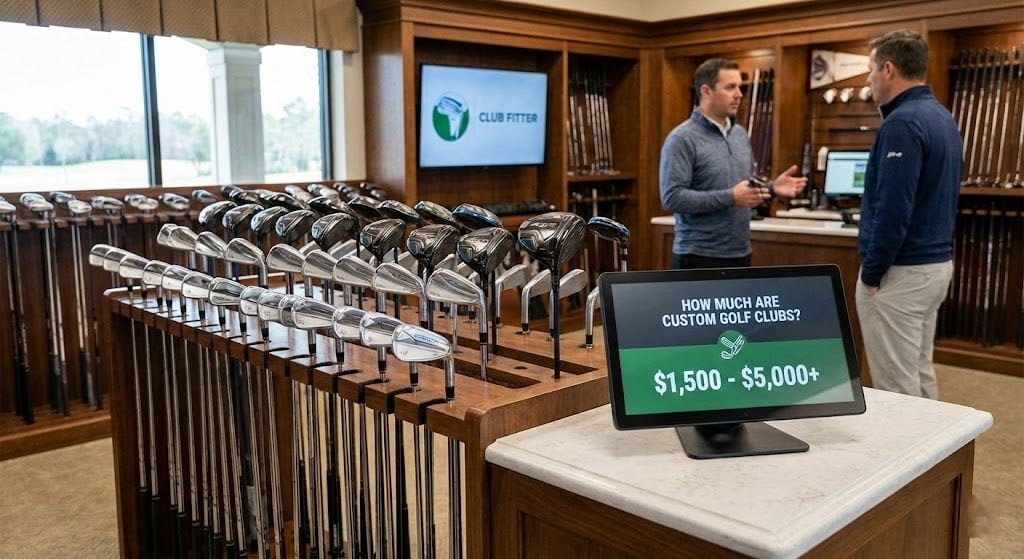
Every serious golfer eventually reveals that three clubs dominate their entire game: the driver, putter, and irons. The key point: your putter accounts for 41-47% of your strokes during a typical round, with weekend golfers putting 35-40 times per 85 shots. That's nearly half your score! The driver ranks third nationally in usage surveys, giving you essential distance control off the tee. Ben Hogan actually identified it as the top significant club for setting up approach shots. Then there's the trusty 7-iron, which over 40% of Northern Michigan golfers named their most indispensable club. It handles par-3s, chip-and-runs, and those tricky mid-range distances. Unlike online golf reviews, which often suffer from brand sponsorships and paid promotions, these insights come from actual golfers at courses sharing their authentic experiences. These three clubs form your scoring foundation, master them, and you'll avoid those round-killing double bogeys! Remember, even PGA Tour pros average 0.3 doubles per round, so focusing on eliminating big numbers rather than chasing perfect shots will transform your scoring.
Your iron and wedge selection can make or break your scoring potential, especially when you consider that these clubs handle nearly every shot from 150 yards in. Here's what you'll want: carry irons 4 through 9 for gapped distance control on approaches. If you're struggling with those long irons, swap your 3-5 irons for hybrids; they're way easier to hit from rough or fairway.
For wedges, you'll need three: a pitching wedge for shots under 100 yards, a 52-degree gap wedge for those tricky 100-110 yard distances, and a 56-degree sand wedge for bunkers and tight lies. Some golfers add a 60-degree lob wedge for flop shots over hazards. Since wedges are your second-most-used clubs after your putter, they're critical for saving strokes around the green! The angled faces of irons help grip the ball and impart spin, giving you the control you need to stick your approach shots close to the pin. Higher-numbered irons offer more accuracy for precision shots, while lower-numbered irons deliver greater distance when you need it.

How do you pick between fairway woods and hybrids when both promise to improve your game? The situation is this: fairway woods deliver maximum distance with their lower lofts, a 3-wood launches the ball about 215 yards with its 15-degree face, perfect for reaching long par-5s. But hybrids offer something different. Their higher lofts (16-20 degrees for a 3-hybrid) and smaller clubheads excel from nasty lies, thick rough, tight fairways, and even slopes where woods struggle. If you're a beginner or high handicapper, hybrids provide easier launches and forgiveness. Experienced players often prefer woods for pure power and workability. Woods feature a bigger sweet spot thanks to their larger clubheads, which translates to more consistent power on off-center hits. Hybrids include roll and bulge technology that helps correct mishits, making them particularly forgiving when you don't strike the center of the face. Most golfers actually carry both: a 3-wood for tee shots demanding distance, and a hybrid for versatile approach play when conditions aren't ideal.
Why does the number of clubs in your bag matter so much? The important point is, you're limited to 14 clubs at most during tournament play, a rule established back in 1938. But there's no minimum! Beginners often start with just 6 clubs: driver, 4-iron, 6-iron, 8-iron, sand wedge, and putter. That's totally fine for learning the game.
As you improve, you'll want more options. A typical 14-club setup includes a driver, two fairway woods, irons from 4-9, three wedges (pitching, gap, and sand), plus your putter. This covers every distance and situation you'll face.
Your skill level determines what you need. Casual golfers do great with 9-12 clubs, while experienced players utilize that 14-club limit for complete course coverage. The transition from hickory to steel shafts in the 1920s contributed to heavier golf bags, which was one reason the 14-club rule was introduced to reduce caddy strain. If you exceed the 14-club limit, you'll face a two-stroke penalty for each hole where the violation occurred.
Once you've selected your clubs, you'll need the right gear to carry them and protect your hands while you play. A quality golf bag keeps everything organized with multiple pockets for balls, tees, and accessories. Look for water-resistant materials if you play in wet conditions. Your lead hand glove prevents slipping during swings and improves ball speed consistency, which means better shots in general. Don't skip this! For tees, grab both wooden and plastic options in different heights since you'll need a variety of sizes for different clubs. Here's a money-saving tip: collect abandoned tees at tee boxes between rounds. Ultimately, pack a golf towel to clean club faces and balls throughout your game; clean equipment performs better and lasts longer.

You'll want to replace your wedges every 2-3 years since grooves wear fastest, while drivers last 3-5 years and irons can go 5-10 years with proper care. The important point is: your play frequency matters! If you're hitting 75+ rounds yearly, stick to the shorter replacement timeline. Check your wedge grooves by running your fingernail across them. If it slides smoothly without catching, it's time for new ones.
You can complete a full round with just 5-7 clubs without any problem. The rules only require one conforming club minimum, and many golfers actually play their best golf with half a bag. A practical setup includes a fairway wood, a hybrid, a mid-iron, a short iron, two wedges, and your putter. This forces you to make smarter decisions, speeds up your play, and keeps you focused on fundamentals rather than obsessing over equipment.
Women's clubs are typically shorter (by ¾ to 1 inch), lighter, and have more flexible shafts designed for slower swing speeds. They also feature higher lofts, like 12° drivers versus men's 9-10.5°, and larger sweet spots for better forgiveness. The grips are smaller, too, fitting smaller hands. Men's clubs are longer, heavier with stiffer shafts, and built for faster swings and greater strength. Using the right fit really impacts your performance!
Begin with pre-owned clubs since your swing will change quickly in those initial months. You'll find basic half sets (6-9 clubs) at significantly lower prices, providing you with necessities like a driver, putter, and mid-irons for practice without overspending. The reality is, you don't need the latest forgiving technology just yet. Just ensure that grips aren't worn and shaft flex corresponds with your slower beginner speed. Save money now, upgrade later!
Check your swing speed initially, that's your main indicator. If you're swinging under 75 mph, you'll want senior or ladies flex. Between 75-95 mph? Regular's your sweet spot. Hitting 95-110 mph means stiff flex, and over 110 mph calls for extra stiff. The point is: your tempo matters too. Got an aggressive swing? Go stiffer. Smooth tempo? You can handle more flex. When in doubt, choose softer; it's more forgiving.
You don't need a full 14-club set to play better golf. Start with the basics: a driver, a putter, a few irons (like a 7, 8, and 9), and a wedge. As you improve, you'll figure out which clubs actually help your game. The key point, spending money on clubs you can't hit yet won't lower your score. Focus on perfecting what's in your bag initially, then add more clubs when you're ready.

