I'll admit it, for the longest time, I lumped Volvik into the "novelty ball" category. You know the type: bright colors, fun to look at, but not something you'd actually trust when there's a five-dollar Nassau on the line. I've tested dozens of golf balls over the years, from the usual Pro V1s and Chrome Softs to some off-brand options that had no business being on a golf course. So when a sleeve of Volvik Crystal balls showed up in my bag, I figured I'd give them a round or two and move on.
I was wrong. And honestly? I'm still a little surprised I'm writing that.
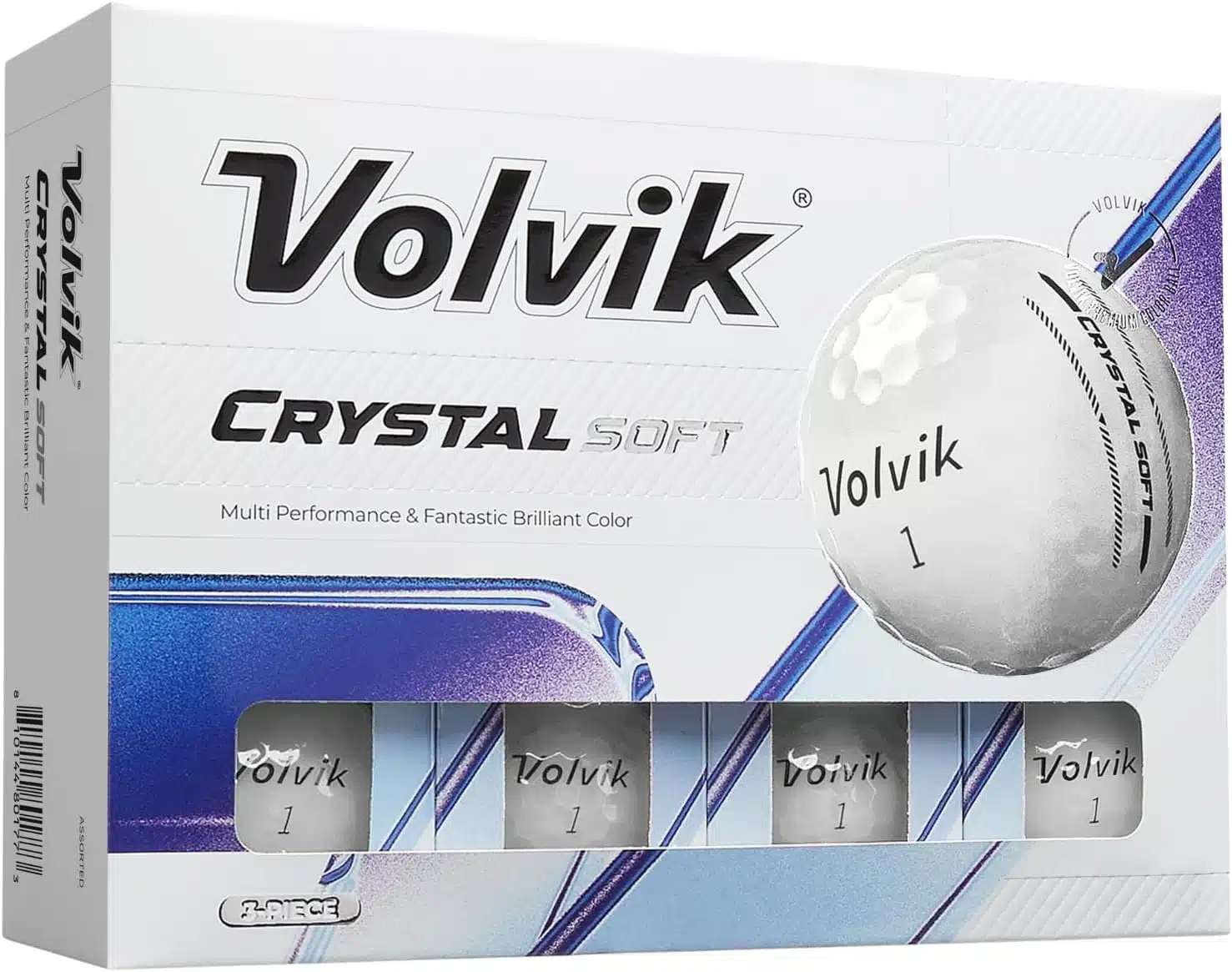
Can a high-visibility distance ball actually check up on the greens? Read our deep-dive Volvik Crystal Soft review covering spin, feel, and putter response.
The first thing you notice, and I mean the very first thing, is the color. These aren't your standard white or yellow golf balls with a logo slapped on them. The Volvik Crystal comes in high-visibility semitransparent colors like pink, orange, yellow, and green, and they have this high-gloss, almost jewel-like finish that genuinely catches your eye. When I pulled them out of the box (a dozen in assorted colors), it felt less like unboxing golf balls and more like opening a display case at a candy store.
But here's the thing. I've been fooled by pretty packaging before. A ball that looks good sitting on a tee means nothing if it doesn't perform once you stripe it down the fairway. So I tucked my skepticism away, teed up a translucent pink Crystal, and decided to let the ball speak for itself.

Let's get into what's actually going on under that glossy exterior, because the engineering here is more sophisticated than you might expect from a ball in this price range. The Volvik Crystal is a three-piece construction built around a dual-core design and wrapped in a zirconium-coated Surlyn cover. That's a mouthful, so let me break it down.
The dual-core is the engine room. Most recreational golf balls use a single core with a solid center that determines compression and energy transfer. Volvik went with two layers in the core, which allows them to tune the inner portion for explosive energy return off the driver face while using the outer core layer to manage spin and feel on shorter shots. It's a design philosophy you typically see in balls costing appreciably more.
Then there's the cover. Surlyn has been the workhorse material in golf ball covers for decades. It's durable, it resists scuffing, and it helps keep costs reasonable. But Volvik added a zirconium coating to their Surlyn, which gives the ball that distinctive translucent sheen and, according to Volvik, improves the ball's total resilience. I can tell you from experience that after a full 18 holes, these balls held up remarkably well. No major cuts, no gouges from cart path mishaps, and the color stayed vivid.
At roughly $32 to $33 per dozen, you're getting a three-piece ball with a dual-core and a specialty cover for less than what most tour-level urethane balls charge. That's a genuinely persuasive value proposition, especially if you're not a scratch golfer who needs to shape every wedge shot within an inch of its life.
The compression sits in the mid range, approximately 65 to 70, depending on the specific variant, which places it squarely in the sweet spot for moderate to slower swing speed players. It's not a rock, and it's not a marshmallow. It's that Goldilocks zone where you get energy transfer without needing to swing out of your shoes. Worth noting, the Crystal carries an 80-compression rating that confirms its positioning as a ball engineered for players who don't generate tour-level clubhead speed. Volvik specifically designed this ball for golfers with swing speeds in the 60-95 mph range, so if you fall anywhere in that window, the Crystal is built to optimize your launch conditions.
I've tested a lot of "distance" balls over the years, and the claims usually outpace the reality. So when I read that the Volvik Crystal might be the longest ball in the entire Volvik lineup, I raised an eyebrow. But after several rounds and a couple of dedicated range sessions, I have to concede the point.
Off the driver, the Crystal supplies strong, consistent distance with a flight that tends to stay straight. I'm not talking about those thin, knuckling line drives you sometimes get with hard distance balls. This was a penetrating path with a solid apex and reliable carry. My drives were landing in their usual neighborhood, and on a couple of occasions, I picked up what felt like an extra five to seven yards compared to the mid-range Titleist I'd been gaming the previous month. Was it always five to seven yards? No. But the average was noticeably up.
Part of this comes down to the 350-octahedron dimple pattern, which is Volvik's aerodynamic design for maximizing surface coverage and reducing drag. Without getting too deep into the physics (because honestly, that's not my forte), the dimple pattern helps the ball maintain its speed through the air more efficiently. I could see it in real time, the ball seemed to hold its line through the wind better than I expected, and the rollout after landing was consistent.
For golfers with moderate to slower swing speeds, and let's be honest, that's most of us once the ego leaves the room, the Crystal provides the kind of distance and accuracy combination that makes the game more enjoyable. You're not sacrificing control to get those extra yards. The ball just does its job and gets out of the way.
I also noticed that the Crystal rewarded centered contact more obviously than some other balls I've played. When I caught one flush, I knew it immediately. The feedback was clear, and the ball responded with impressive speed off the face. Miss-hits still went a reasonable distance, but there was a noticeable drop-off that actually helped me diagnose my swing during the round (an unintentional coaching aid, if you will).

"Soft feel" gets thrown around in golf ball marketing the way "artisanal" gets used in restaurant menus so frequently that it starts to lose meaning. But the Volvik Crystal does have a genuinely soft feel, particularly on mid-irons and approach shots. There's a satisfying compression at impact that tells your hands, "Yes, you hit that well," without feeling mushy or dead.
That said, I want to be straight with you here, because this is where my experience got a little subtle. Compared to some of Volvik's matte-finish colored balls (like the Vivid line), the Crystal felt slightly firmer. Not dramatically so, we're talking about a minor difference that you'd really only notice if you played them back to back, which I did. The Crystal has a bit more "click" to it, especially off the putter face, while the matte balls felt a touch softer and more dampened.
Is that a dealbreaker? Not for me, and probably not for most golfers. But if you're coming from a very soft urethane ball and expecting the Crystal to replicate that buttery sensation exactly, you might need a hole or two to recalibrate your expectations. Once I adjusted, I actually preferred the Crystal's feel because it gave me more feedback. I could tell the difference between a well-struck 7-iron and one I caught a groove thin, and that kind of tactile information is useful during a round.
On and around the greens, the feel translated into solid feedback on chips and putts. I never felt like the ball was getting away from me on short shots, and the audible "click" off my mallet putter was clean and consistent. It's the kind of feel that builds confidence over 18 holes rather than creating doubt.
Here's where I expected the Volvik Crystal to fall flat. Surlyn-covered balls, in my experience, tend to trade short-game spin for durability and distance. It's a known compromise. So I was genuinely prepared to write something like, "The Crystal is great off the tee but limited around the greens." I had that sentence half-formed in my head before I even teed up.
Then I started pitching.
From about 40 to 60 yards, the Crystal generated strong backspin noticeably more than I get from most Surlyn balls and enough to actually stop the ball near where it landed rather than watching it release 15 feet past the pin. In one particularly telling test, my pitching wedge shots were finishing an average of about eight feet from the pitch mark. That's not tour-level check-and-spin performance, but it's well within the range of "I can work with this."
The key here is that the Crystal isn't trying to be a tour ball. It's trying to balance feel, distance, and spin without maxing out any single trait, and in my experience, it hits that balance better than most balls in its class. You're not going to zip a 56-degree shot back three feet on a firm green. But you will get enough grab to hold greens on approach shots and enough control on pitches and chips to feel like you're actually playing golf, not just watching the ball roll wherever gravity takes it.
For the mid-handicapper who doesn't need to manufacture crazy spin but does want reliable stopping power on pitch shots, the Crystal delivers. And it does so without asking you to pay urethane prices for the privilege.
I saved this for its own section because, frankly, the visibility of the Volvik Crystal deserves more than a passing mention. Those semitransparent colors, the pinks, oranges, yellows, and greens, aren't just a gimmick. They fundamentally change how you experience certain parts of the game.
In the air, the ball is absurdly easy to track. I play a lot of early morning and late afternoon rounds where the sun can make following a white ball an exercise in squinting and guessing. With the Crystal, I could track the ball from launch to landing almost every time. On overcast days, the orange and pink stood out against the gray sky like a lighthouse. On sunny afternoons, the yellow and green were similarly visible against blue skies and tree lines.
On the ground, the advantage is just as pronounced. I spend an embarrassing amount of time looking for balls in the rough (don't pretend you don't), and the Crystal cut my search time noticeably. A bright orange ball sitting in four inches of rough practically waves at you. It sounds like a small thing, but over 18 holes, the time saved and the frustration avoided genuinely improved my enjoyment of the round. Pace of play matters, and being able to find your ball quickly keeps you in rhythm.
There's also a subtle psychological benefit that I didn't expect. Seeing that vivid color on the tee gives each shot a slight lift of personality. Golf can feel monotonous sometimes, same white ball, same routine, same everything. The Crystal adds a small injection of fun without compromising substance. It sounds silly, but it's real.
The one caveat: if you play in a group that's going to make jokes about your pink golf ball for all 18 holes, you'll need thick skin or new playing partners. I'd recommend the latter.
Can a high-visibility distance ball actually check up on the greens? Read our deep-dive Volvik Crystal Soft review covering spin, feel, and putter response.
Yes, they're legal. Volvik Crystal Soft balls conform to USGA and R&A rules, so you're fine using them in tournament play. The only Volvik model you need to dodge is the Magma, which is the non-conforming one. Still, if you want zero doubt, check the USGA's conforming ball list for the exact model before tee time. But honestly, you shouldn't have any issues with Crystal Soft.
They hold up pretty well in the cold. The ~70 compression means they'll still compress decently when temperatures drop, so you won't feel like you're hitting a rock. You'll lose some distance, figure roughly 1.5% per 20°F drop, but that's true of any ball. The real win is feel; softer construction keeps things playable when firmer balls turn into marbles. Plus, those bright colors are clutch in winter's flat light.
Yes, you'll absolutely benefit. The Crystal's three-piece design helps slower swing speeds get more distance. One test showed 275-yard carries, and the straight flight tendency means fewer wild misses. The bright colors make tracking shots dead easy, which honestly matters more than you'd think when you're losing a dozen balls per round. It's not the softest ball out there, but for beginners? It's a solid, practical pick.
Yes, they do. You can grab Volvik Crystal Soft in White, Red, or an assorted pack that includes Green, Orange, Pink, and Yellow. That's six colors total, which gives you solid variety. The high-gloss finish makes them ridiculously easy to locate on the fairway or in the rough, where you'll probably need them most. If visibility matters to you, you're covered.
So, is the Volvik Crystal for everyone? No. If you're a low-handicap player with a fast swing speed who demands maximum spin control and the ability to work the ball in multiple directions around the green, you're probably better served by a premium urethane ball like a Pro V1 or a TP5. The Crystal isn't trying to compete in that arena, and it would be unfair to judge it by those standards.
But if you're a mid-to-high handicap golfer with a moderate or slower swing speed who wants a ball that flies long and straight off the tee, feels soft in your hands, provides reliable short-game performance, and, as a bonus, is genuinely fun to play because you can actually see it? I don't think there's a better option at this price point right now. The Volvik Crystal is a ball with real substance behind its flashy exterior, and after several rounds of testing, it's earned a permanent spot in my bag rotation. I didn't see that coming, but the best reviews are the ones that surprise the reviewer.