To pack golf clubs for a flight, you'll need a quality travel bag, a stiff arm to protect your shafts, and individual headcovers on every club. Wrap clubheads with towels or bubble wrap, position heavier woods at the top, and stuff empty spaces with clothing to prevent shifting. Most golfers obsess over the bag but skip the stiff arm, that's the single accessory that'll save your shafts from baggage handler chaos, and understanding why changes everything.
Before you start wrapping your clubs in bubble wrap and hoping for the best, you need to understand that airline golf bag policies aren't as straightforward as the carriers want you to believe.
Here's the reality: every airline plays by different rules. American Airlines lets you pack clubs, balls, tees, and one pair of shoes under standard checked bag fees. United counts your golf equipment as one checked bag per customer. Alaska charges just $30 for your clubs as an initial checked bag, while Frontier caps you at 40 pounds, significantly lower than the industry-standard 50-pound limit. JetBlue allows 14 clubs, 3 balls, and 1 pair of shoes in a checked golf bag with a 50-pound weight limit.
The weight game matters most. Most carriers charge $30-$60 for bags under 50 pounds, but exceed that threshold and you're looking at steep overweight fees up to 70 pounds. Budget carriers like Spirit impose steep overweight fees that can add up to $125 extra to your travel costs. To avoid unexpected costs, booking online before your trip is recommended since airport fees are typically higher.
When you're staring at the wall of golf travel bags at your local pro shop, or scrolling through endless Amazon listings, the marketing claims all blur together: "maximum protection," "airline-friendly," "tour-tested durability." Here's what the manufacturers won't tell you: the perfect travel bag doesn't exist, but the right bag for your specific travel habits absolutely does.
Your selection hinges on three variables: travel frequency, destination types, and storage constraints. Hard cases deliver maximum protection for international trips where baggage handlers treat your clubs like cargo, because that's exactly what they are. Soft covers work for occasional domestic trips and fold flat in your garage. Hybrid bags split the difference with padded sides and reinforced sections. The Club Glove remains the most popular choice among frequent travelers, with proven durability across 10 years of multiple trips.
Before packing, consider re-gripping your golf clubs since fresh grips can be ready in as little as 30 minutes to an hour, though waiting 24 hours ensures optimal results. Wheeled systems like the Sun Mountain ClubGlider Meridian change airport guidance from exhausting to effortless.
Your travel bag is only as protective as the preparation inside it. I've seen golfers spend hundreds on premium hard cases, then toss their clubs in loose ones; that's asking for trouble.
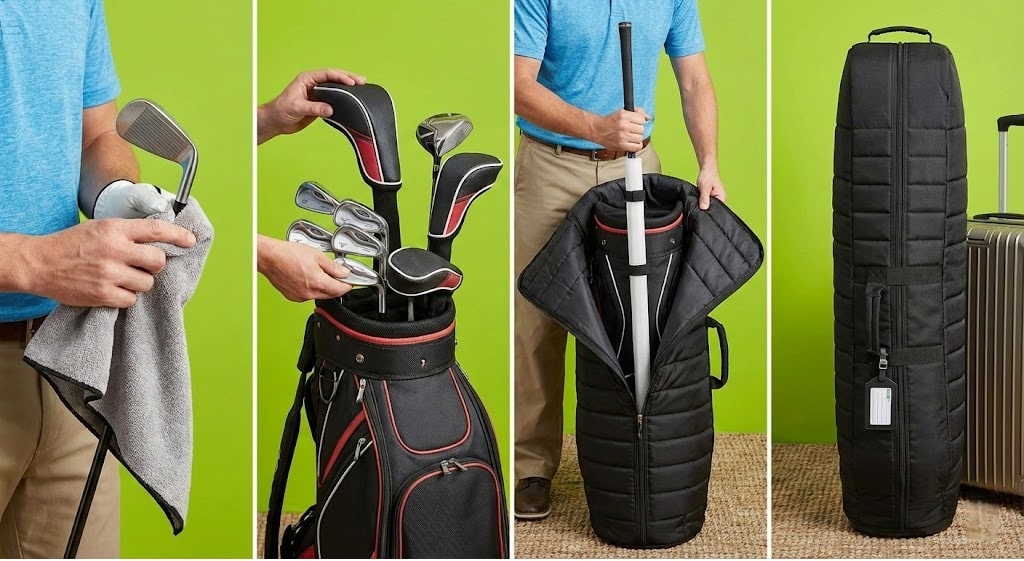
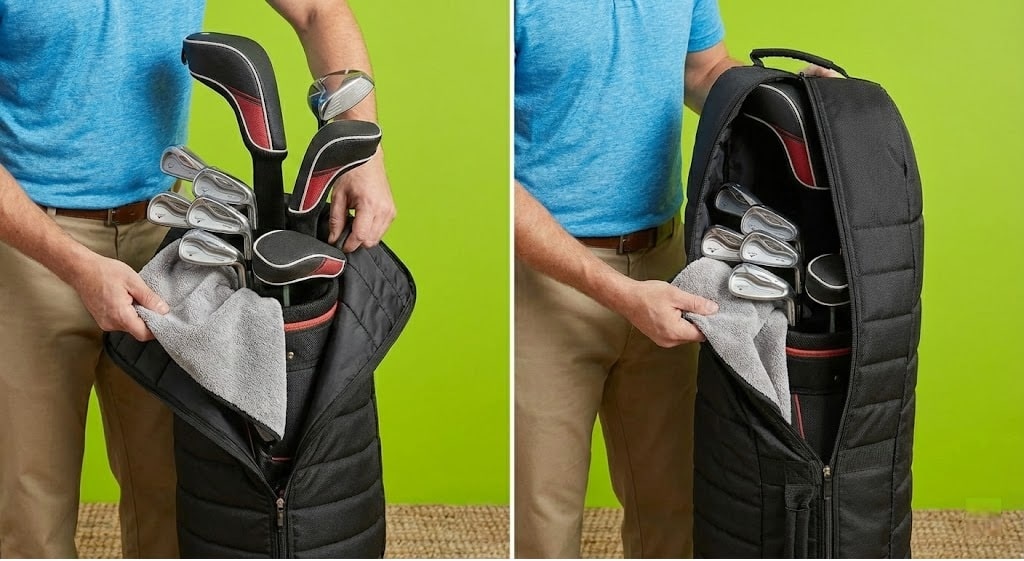
Start by wrapping each club head individually with bubble wrap or a towel, securing it with rubber bands. Every club gets a headcover, no exceptions. Your shafts need protection, too; wrap them with padded material to prevent bending and scratching. Using a stiff arm or support rod inside your bag provides additional structural protection against impact damage.
Putters deserve special treatment. Their delicate designs make them vulnerable, so separate them from your irons and add extra padding. You can use socks to cover irons and putters as a simple way to reduce scratches between clubs. Remove your driver head entirely and store it in a padded pouch; it's the most exposed club in the bag and the most expensive to replace.
Before you begin wrapping anything, keep clubs clean to avoid trapping dirt and debris that could scratch finishes during transport. This preparation takes fifteen minutes and saves you from disaster.

Even the best preparation means nothing if your clubs shift and flex inside your travel bag during those inevitable rough landings and careless tosses by baggage handlers.
Stiff arms are your primary line of defense. These rigid internal supports, typically fiberglass or lightweight metal, distribute impact forces evenly and prevent shaft bending. Position them from just below your clubheads to the shaft midpoint, focusing on your longest clubs. Secure them with integrated straps so they don't shift.
Don't stop there. Layer your protection with EVA-molded liners that cushion against shocks, and add headcovers to shield your woods and putter from nicks. Club Glove and Sun Mountain build this layered approach into their premium bags for good reason; it works. Multiple protective accessories create cumulative defense against drops, stacking, and compression. CaddyDaddy travel bags feature a reinforced structure and support pole that provides exceptional stability for your clubs during transit. For additional clubhead protection, consider a Travel Golf Club Protector, which offers a compact design at just $39.00 to enhance safety during transport. While investing in quality protection, keep in mind that accessories and customization costs vary widely, so budget accordingly for items like protective gear and travel essentials.
Proper weight distribution separates a well-packed golf bag from one that arrives with bent shafts and dented clubheads, yet most golfers get this fundamentally wrong.
Here's what actually works: Position your heavier clubs, drivers, and 3-woods at the top of the bag to keep weight centered. Distribute irons evenly through the middle section. Place clubs upside down to protect vulnerable hosel connections while maintaining balance. Store heavier items like shoes and rain gear at the bottom to create a stable base that prevents tilting during transport. Keep in mind that your steel-shafted irons weigh significantly more than your driver, with a typical 5-iron reaching around 425 grams compared to a driver's 310 grams.
Now for space-saving tactics that matter. Remove detachable clubheads from woods and drivers, storing screws back into shafts so they don't vanish into airport limbo. Use bag dividers to enhance separation and efficiency. Fill every gap with shoes, clothing, or towels; this isn't wasted space, it's strategic padding that prevents movement and redistributes weight. If you've recently re-gripped your clubs, wait at least 24 hours before packing to ensure the grips have fully adhered to the shafts. You'll meet airline restrictions while protecting your investment.
The honest answer? It depends on your layovers and schedule. If you've got tight connections under 90 minutes or flights during peak travel chaos, ship them; airlines lose bags constantly. But if you're flying direct on Southwest, you're checking them free anyway. Don't ship if you need practice time before your round; clubs can sit in transit for days. Weigh convenience against cost and timing.
Yes, you can absolutely carry golf balls and tees in your carry-on luggage. TSA has no restrictions on either item, and there's no limit on quantity. The confusion stems from golf clubs being banned in carry-ons, as they're considered potential weapons. But balls and tees? You're completely clear. Pack them in your carry-on for better protection, and you'll breeze through security without issues.
You'll need a passport valid at least six months beyond your return date, non-negotiable. Check visa requirements for your specific destination and nationality. I'd strongly recommend keeping purchase receipts for your clubs to avoid customs headaches and potential import duties. Label your golf bag with full contact details, photograph everything before you leave, and get travel insurance that explicitly covers sports equipment loss and damage.
Report the damage immediately to airline staff before leaving the airport; this is non-negotiable. You'll need to grab a file reference number from the baggage service office and complete their official claim form. For international flights, you've got seven days to submit. Document everything: take photos of the damage, gather your purchase receipts, and keep records of every conversation. Airlines typically cap compensation at around $1,800 internationally.
Yes, it's worth it if you're traveling with expensive clubs or have high prepaid costs. Here's the reality: standard travel insurance rarely covers golf-specific losses. You'll need a dedicated add-on. The math is simple: if your clubs cost $2,000+ and you've prepaid green fees, a $50-100 policy beats eating thousands in losses from damage, theft, or trip cancellation. Don't skip it for international trips where your health insurance won't help.
You've done the hard work; now trust it. With the right travel bag, proper club protection, and smart packing techniques, your gear will arrive ready to play. Don't let fear of damaged clubs keep you from destination golf. I've flown with my sticks dozens of times using these methods and never lost a round to broken equipment. Pack smart, fly confident, and play well.