Forget expensive specialty products; white vinegar is your best weapon against rusty golf clubs. Submerge the clubhead in undiluted vinegar for 15-20 minutes, then scrub the grooves with a stiff-bristle brush. For stubborn spots, make a baking soda paste and let it sit for 20 minutes before scrubbing. Rinse thoroughly with clean water and dry completely to prevent new oxidation. The real turning point, though, is what you do after the rust is gone.
Before you grab that wire brush and start attacking the rust on your favorite seven-iron, let's get one thing straight: aggressive scrubbing without proper preparation is the fastest way to ruin a perfectly good club.
Start by setting up a well-ventilated workspace; your garage or backyard works perfectly. Grab protective gloves and eyewear because you'll be dealing with cleaning agents that don't play nice with skin and eyes. Plan your workflow to keep cleaned clubs separate from untreated ones to avoid cross-contamination.
Fill a bucket with warm water and mild dish soap, then submerge only the clubhead for a few minutes. Keep those ferrules and grips bone dry. Use a soft-bristle brush to scrub the grooves clean, rinse thoroughly, and dry immediately with a lint-free cloth. If you've recently had your clubs re-gripped, remember to wait at least 24 hours before handling them extensively to ensure the grips have fully adhered. Now, inspect under good light, you need to distinguish actual rust from stubborn grime before proceeding. Gather your essential supplies, including fine steel wool, a hard-bristle toothbrush, wet and dry sandpaper, white vinegar, and metal polish, before beginning the rust removal process.
The vinegar method gets thrown around golf forums like it's some miracle cure, but here's what most articles won't tell you: it works brilliantly on surface rust, yet it'll do absolutely nothing for deep pitting that's already compromised your clubhead's integrity.
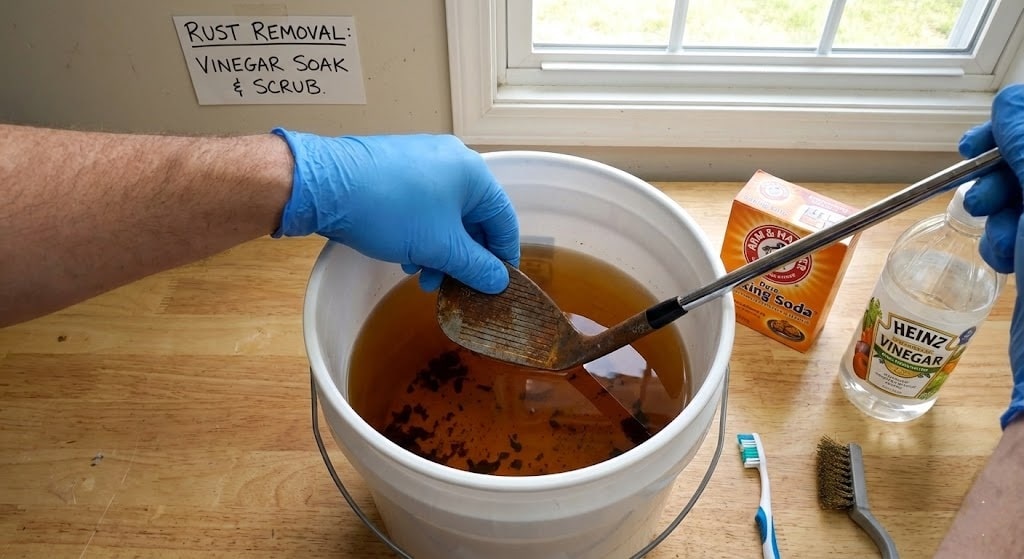
For standard oxidation, submerge your clubhead in white vinegar for 10-20 minutes. Dampen fine synthetic wool in the solution and scrub lengthwise along the shaft with moderate pressure. Re-dip frequently; dry steel wool becomes ineffective fast. Avoid soaking clubs too long, as extended exposure to acidic solutions can damage the club's finish rather than help restore it.
Here's my go-to approach: mix equal parts vinegar and lemon juice for stubborn spots. The combined acidity penetrates rust more aggressively. Apply with a soft cloth, wait 15 minutes, then scrub grooves with a vinegar-dipped toothbrush. Use gentle circular motions when scrubbing to avoid scratching the clubhead surface. For deeper rust stains that won't budge, consider an overnight treatment to allow the solution more time to work.
Always wear gloves. Rinse thoroughly afterward; residual vinegar damages finishes over time.
Vinegar works well for everyday rust, but when you're dealing with stubborn oxidation that laughs at your acidic solutions, baking soda and commercial rust removers step up as the heavy hitters.
Mix baking soda with water until you've got a thick paste, then apply it directly to those rust spots. Let it sit for 20 to 30 minutes before scrubbing with a soft brush. For maximum firepower, pour vinegar onto the rust initially, then add baking soda—that fizzing reaction attacks oxidation from multiple angles. Similar to how medium-grit sandpaper can expose fresh rubber on worn golf grips, this combination exposes clean metal underneath the rust layer.
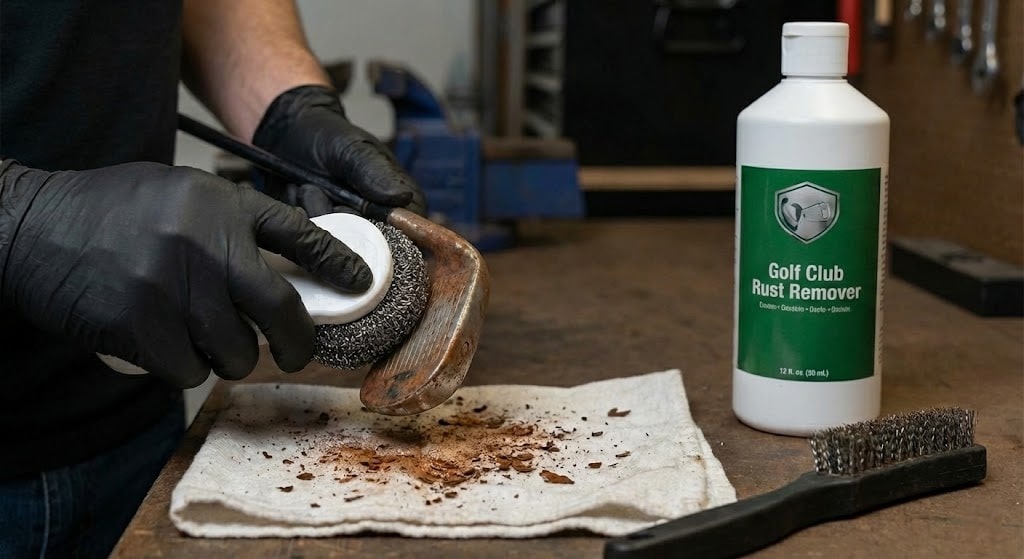
When home remedies fail, grab a commercial rust remover designed for chrome or stainless steel. Test it on a hidden spot first. These products work faster on severe rust, but you'll need gloves and proper ventilation. After removing all rust, apply a protective coating to shield your clubs from future oxidation.
Scrubbing away rust sounds straightforward until you're staring at pitting that's survived vinegar baths and baking soda treatments. That's when you reach for mechanical methods, and where most golfers make costly mistakes.
Start with 0000 steel wool dampened with white vinegar. Use light pressure and work with the grain, not against it. Forged irons respond particularly well to this approach without sacrificing their finish.
For deeper spots, fine wet/dry sandpaper up to 2000 grit does the job when used with water. Scotch-Brite pads handle surface rust effectively on chrome finishes. When using these pads, employ circular motions to maximize effectiveness in lifting rust from the metal surface.
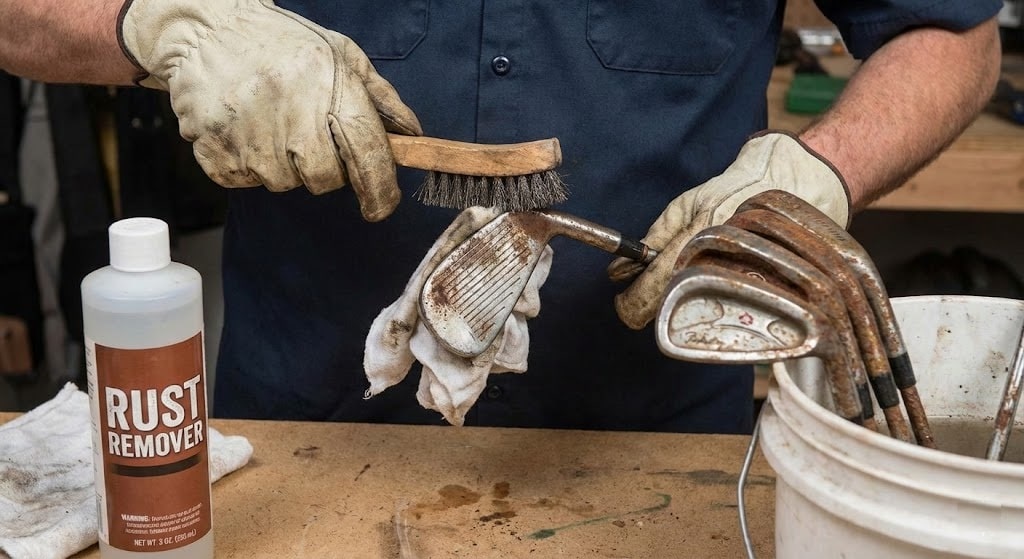
Don't overlook grooves; a hard-bristle toothbrush reaches where steel wool can't. Work in small circular motions to lift rust from crevices without gouging the face. Maintaining clean grooves is essential since groove wear affects spin control and can significantly impact your short game performance. Always dry thoroughly afterward. Before reaching for mechanical methods, soaking in white vinegar for two to three hours can loosen stubborn rust and make scrubbing significantly easier.
After all that scrubbing, you've got one more step before your clubs are truly protected, and it's the one most golfers rush through or skip entirely.
Rinse every club with clean water to flush away loosened rust and cleaning residue. Here's the critical part: dry them completely with a clean cloth, then let them air dry for at least an hour. Skip this, and you'll see new rust spots within hours, especially in humid conditions.
Once they're bone dry, apply a golf club-specific polish with a clean cloth using circular motions. Generic metal polishes contain harsh chemicals that'll damage your finish. Buff off excess product, inspect for streaks, and store your clubs somewhere dry and cool. For chrome finishes, polish with a soft cloth to restore that factory shine before storage. This final step creates a protective barrier that keeps corrosion from returning. Take this opportunity to inspect shafts for any visible damage or irregularities that may have gone unnoticed during the cleaning process. Avoid storing your clubs in garages or basements where temperature swings can promote moisture buildup and accelerate future rust formation.
Once you've restored your clubs to their former glory, the real challenge begins: keeping them that way.
Here's the truth most golfers ignore: rust prevention isn't about expensive products, it's about discipline. Store your clubs in a cool, dry space, never in your car trunk, where heat and humidity wage war on metal. After rainy rounds, remove those headcovers immediately and let everything dry completely.
I recommend tossing silica gel packets in your bag to absorb ambient moisture. For extra protection, apply WD-40 or T-9 spray to clubheads every few months, just avoid the clubface entirely. That's non-negotiable. Pay special attention to cavity back areas since these spots are particularly prone to rust development.
Inspect your clubs regularly for early rust spots. Catching corrosion early means a quick fix rather than permanent damage. While you're maintaining your equipment, consider whether worn grips might also need attention, as professional re-gripping services are widely available at golf retailers and pro shops. Prevention beats restoration every single time.
Yes, rust affects your performance, but not how you'd expect. Contrary to popular belief, rust doesn't increase spin; it actually decreases it while raising your launch angle. Think of heavy rust like sand on your clubface; it interferes with the flat surface contact you need for consistent ball striking. Your groove geometry matters most, and rust degrades those critical edges. Clean clubs simply perform better.
You should perform a quick visual check after every round and carry out a deep inspection every one to two months. That's the baseline. If you're playing in wet conditions, storing your bag in a car trunk, or living in a humid climate, you'll need to inspect more frequently. Monthly clubface assessments catch rust before it damages grooves and kills your spin control.
No, rust on your golf clubs isn't covered under manufacturer warranties, and that's the blunt truth most golfers don't want to hear. Manufacturers like TaylorMade, Callaway, and Titleist explicitly exclude surface rust from coverage, classifying it as normal wear or user neglect. You'd need to prove the rust punched an actual hole through the metal from a manufacturing defect. Don't count on warranty departments bailing you out here.
No, you can't use the same rust removal methods on graphite shafts, and here's the critical point most golfers miss: graphite doesn't rust. It's a composite material, not metal. Applying vinegar, steel wool, or abrasive polishes will actually damage your graphite shafts by stripping protective coatings and weakening the resin. Stick to mild soap, a soft cloth, and thorough drying. Save the rust removal arsenal exclusively for your steel shafts.
You need professional help when you spot pitting corrosion, those small holes eating into the metal surface. If rust resists your vinegar soak and steel wool treatment, you're past DIY territory. Multiple clubs showing extensive rust buildup signal systemic moisture damage requiring expert assessment. Grooves damaged beyond cleaning need regrooving at roughly $20 per club. Don't risk structural integrity; severe rust warrants a pro's evaluation before you swing again.
Rust doesn't have to mean retirement for your favorite irons. Whether you've grabbed vinegar from the pantry or invested in a commercial remover, you've now got the tools to restore those clubfaces to working condition. The real turning point? Prevention. Dry your clubs after every round, store them properly, and you won't be scrubbing rust again anytime soon.