
Your driver probably travels 225 yards, not the 250 you're claiming, and that honest gap exists across every club in your bag. A mid-handicap 7-iron actually flies 140-155 yards, while high handicappers sit closer to 120-135 yards. These numbers aren't meant to deflate your ego; they're the foundation for smarter club selection that'll save you strokes. Understanding how your stage of life, swing speed, and skill level affect each club changes everything about your approach.
Let's settle one of golf's most persistent delusions right now: you probably don't hit your driver as far as you think you do.
The 2024 PGA Tour average reached 301 yards, with bombers like Cameron Champ pushing 323 yards. You're not them. The average male amateur drives 225 yards, not the 250 you've convinced yourself you're hitting.
Here's where it gets interesting. A scratch golfer in their twenties averages 271 yards. Drop to a 40-year-old scratch player, and you're looking at 259 yards. Your years and handicap tell the real story. These insights come from data tracking over 1 billion shots, giving us unprecedented accuracy in understanding real-world performance.
Female golfers average 178 yards, roughly 47 yards shorter than men, with surprisingly consistent numbers across age groups. Senior golfers typically lose 10-20 yards off their driver compared to their younger playing days.
Stop guessing. Track your actual distances with GPS or launch monitors. The data won't lie, even if your ego does. For perspective on elite power, LIV Golf's longest hitter, Joaquin Niemann, averages 330.4 yards off the tee.
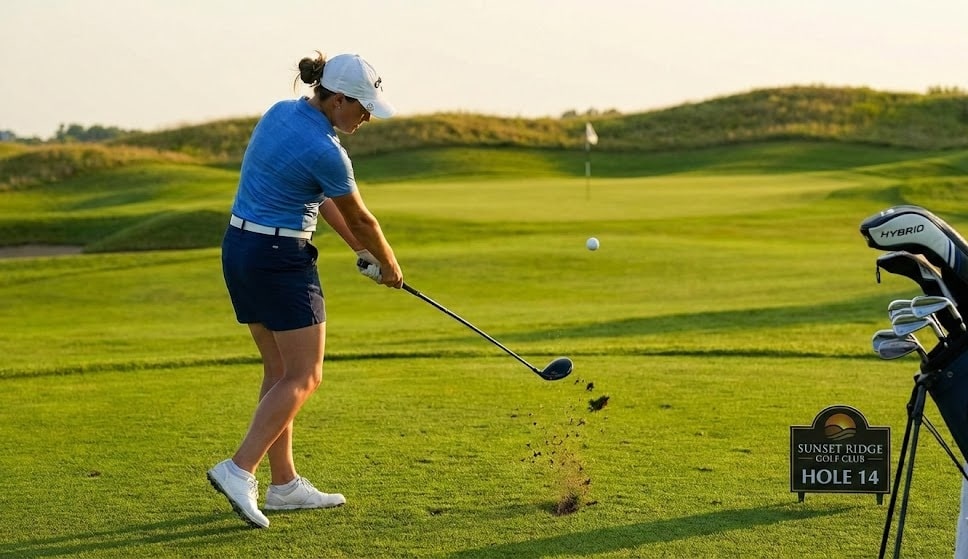
Your driver distance matters, but here's the uncomfortable truth: most of your approach shots come from fairway woods and hybrids, clubs you've probably never tracked with the same obsession.
A 15-handicap player averages 212 yards with a 3-wood and 190 yards with a 5-wood. Drop to a 20 handicap, and those numbers fall to 196 and 179 yards, respectively. Here's what nobody tells you: your 3-hybrid isn't replacing your 3-wood. A 3-hybrid plays closer to a 5-wood, averaging 190-200 yards for a 15-handicap golfer. Just as perimeter-weighted design in mallet putters helps golfers still refining their game, hybrids offer similar forgiveness benefits for players working on their long game consistency.
The real decision comes down to ball flight. Fairway woods generate more spin and carry. Hybrids produce lower launches with extra roll-out. If you're playing firm conditions, hybrids give you control. Soft fairways favor the higher-landing fairway wood. Weather conditions also play a role, as temperature and air density can alter how far your ball travels with each club. Hybrids also offer greater forgiveness from the rough, making them the smarter choice when your ball finds trouble off the fairway.
How accurately do you actually know your iron distances? Most golfers overestimate by 10–15 yards, and that gap destroys scoring potential.
Here's the reality: a mid-handicap golfer hits a 7-iron 140–155 yards, not the 170 they claim at the bar. Low handicappers reach 160–175 with the same club. High handicappers? You're looking at 120–135 yards, and there's nothing wrong with that.
The 10–12 yard gap between clubs holds across skill levels. What changes is your delivery. Lead wrist extension at impact adds loft and kills distance. Flexion and forward shaft lean compress the ball and enhance carry. Club speed is the most significant factor determining how far you'll hit each iron. Quality of strike matters more than raw swing speed for most club golfers, so focus on consistent contact before chasing extra miles per hour. Using impact tape and the gate drill for precise contact feedback can help you identify exactly where you're striking the face and improve consistency.
Seniors naturally lose speed; a 7-iron drops to around 130 yards. Stop fighting physics and start playing your actual numbers.

Wedge play separates scratch golfers from weekend hackers more than any other skill, yet most players treat their wedges like abbreviated versions of their irons.
Here's the truth: your pitching wedge carries 90 to 140 yards, your gap wedge handles 79 to 126, and your sand wedge covers 65 to 105. But those full-swing numbers mean nothing without a distance chart built around partial swings.
You need multiple yardages per wedge. A 52-degree angle at your 7:30 swing position might fly 55 yards, while 9:00 produces 85 yards, and 10:30 reaches 105. This clock-face system alters guesswork into precision. Ball position changes affect flight path and rollout, giving you even more scoring versatility from each club.
Grab a launch monitor or spend time on the range with a rangefinder. Document carry distances for full, three-quarter, half, and quarter swings. Perform 4-5 shots with each swing percentage to determine your true average rather than relying on your best strike. That chart becomes your short-game secret weapon.
Most golfers ignore the elephant in the room when comparing their distances to tour averages: biology doesn't care about your ego.
Your swing speed drops predictably with maturity. A 25-year-old male averages 113 mph with the driver, producing 230 yards. By 60, that same golfer swings 93 mph and carries 190 yards. That's a 40-yard reality check nobody wants to hear.
Women face steeper declines. Female swing speed drops from 93 mph in their twenties to 73 mph after 60, a 22% reduction compared to men's 18% decline. Despite hitting shorter distances, women can still achieve competitive scores because accuracy and course management matter more than raw power.
Here's what matters: a 60-year-old male hitting 190 yards isn't underperforming. He's hitting exactly where physics says he should. As swing speed decreases with age, switching to lighter shaft options can help maintain clubhead speed and maximize remaining distance potential. Stop chasing distances your body can't produce and start playing the game your swing speed allows.
When you obsess over distance charts without knowing your actual swing speed, you're playing a guessing game with every club in your bag.
Here's the reality: your swing speed determines everything. At 86 mph with your driver, you're looking at roughly 215 yards carry, not the 250 you've convinced yourself you hit. That's not an insult; it's physics. Every 1 mph increase translates to about 2.5-3 yards more carry distance.
The efficiency gap matters too. Tour pros extract 2.61 yards per mph while mid-handicappers squeeze out just 2.29 yards. That difference comes down to center-face contact, not talent. PGA TOUR players average roughly 115.80 mph swing speed with an average drive of 299.9 yards, putting your own numbers into perspective.
Get on a launch monitor. Know your 7-iron speed sits around 76 mph if you're a 16-20 handicapper. Build your distance expectations from that hard data, not wishful thinking. Research confirms that clubhead speed at impact is the most influential factor in determining how far your drives actually travel. Using a quality launch monitor can improve shot accuracy by 20-25% through instant feedback on your actual performance numbers.

At altitude, you'll hit the ball farther, period. Thinner air creates less drag, so your shots maintain velocity longer. Expect roughly 2.5 extra yards of carry per 1,000 feet of elevation. A 250-yard drive at sea level becomes about 265 yards in Denver. You'll also notice your hooks and slices aren't as severe since reduced air density softens sidespin effects. Adjust your club selection accordingly.
No, and expecting to is a fast track to frustration. Even Tour pros see 3–5 yards of variation shot to shot. You're dealing with natural fluctuations in swing speed, strike quality, and tempo that make identical distances impossible. Throw in wind, temperature, and turf conditions, and you've got even more variables. Focus on knowing your average distances and accepting a realistic range for each club.
A 10 mph headwind costs you roughly 10% of your carry distance; that's about a club and a half. But here's what most golfers miss: the effect isn't linear. A 20 mph headwind doesn't double your loss; it actually cuts distance by around 22%. Higher-lofted clubs suffer more because they launch the ball into the wind longer. You'll also notice steeper landing angles, which kill your roll.
Golf ball choice matters far less than marketers want you to believe. The truth? Brand and price differences add up to just a few yards, not enough to change your round. What does matter is matching compression to your swing speed. If you're swinging under 85 mph with a high-compression tour ball, you're leaving 15–25 yards on the table. That's the only ball decision worth making.
You should reassess your club distances based on your skill level: beginners every 6–12 months, intermediate players every 2–3 years, and advanced golfers annually. Don't wait for a schedule, though. If you're suddenly coming up short, your dispersion's gotten wild, or you've changed equipment, that's your signal. Your distances aren't static numbers; they're living data that shifts with your game.
Stop chasing numbers you saw on YouTube. Your distances are your distances, own them. Grab a launch monitor or GPS app, hit 10 balls with each club, throw out the outliers, and record your real averages. That data beats any chart I've shown you. Play the clubs that work for your swing speed, maturity, and body, not someone else's game. That's how you actually score better.

