If you've ever skulled a wedge across the practice green and looked around to see if anyone noticed, welcome to the club. Thin shots are the silent killers of a golf scorecard; they don't look as dramatic as a chunked iron that takes a divot the size of a dinner plate, but they'll cost you just as many strokes. For years, I've tested everything from $500 launch monitors to elaborate swing trainers with moving parts and Bluetooth apps, all in the name of improving ball striking. So when a pack of rubber discs showed up on my radar claiming to fix thin contact, I'll be honest. I raised an eyebrow. The GoSports Golf Pure Strike Golf Training Discs promise to do one thing and do it well: force you to make ball-first contact or face immediate, undeniable feedback that you didn't. No batteries. No software. No complicated setup. Just 24 small rubber discs and a brutally honest mirror for your swing. I spent several weeks putting them through their paces on the range, on a hitting mat in my garage, and even out on the course during practice rounds. Here's what I found.
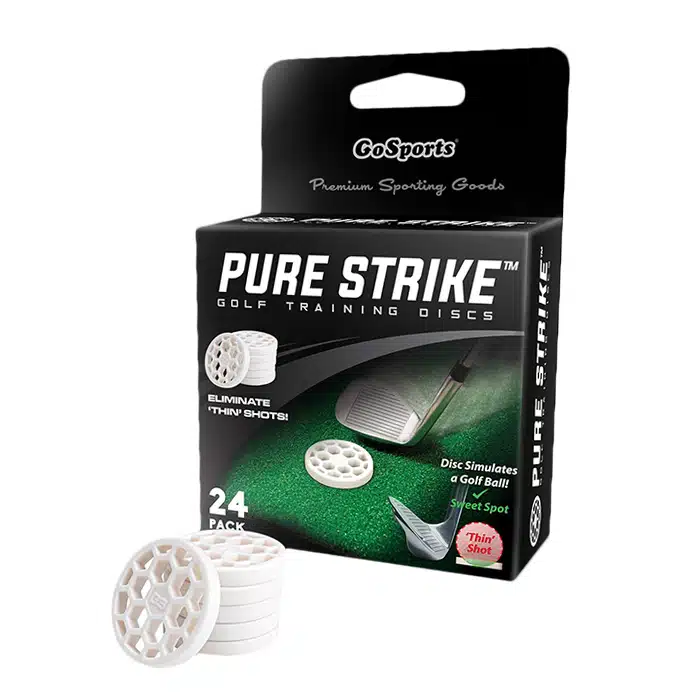
Engineered to eradicate thin and skull shots. These ball-footprint discs offer unforgiving, instant feedback on your low-point control, demanding clean ball-first contact to achieve launch.
Let me set the stage. There's no fancy box here, no instruction manual the size of a novella, no QR codes linking you to a setup tutorial. You open the package and find 24 soft rubber discs. That's it. They're small, roughly the size of a golf ball, and they feel like a premium, pliable rubber that won't crack after a few sessions in cold weather. The color makes them easy to spot on grass or on a mat, and they stack neatly in a bag pocket when you're done. After years of unboxing training aids that require Allen wrenches, smartphone pairing, or a PhD in biomechanics, I found the simplicity genuinely invigorating. You grab a disc, set it down where your ball would sit, and swing. New impressions? This is either brilliantly minimalist or suspiciously basic. Spoiler: it turned out to be the former.

The entire value proposition of the Pure Strike discs lives and dies on one thing: feedback at impact. And honestly, this is where the product earns its keep. When you set up a disc and make a proper ball-first strike, you'll compress the disc cleanly and feel a solid, satisfying contact. When you catch it thin, blade it, belly it, pick it, you'll know immediately. The disc reacts differently. You feel it. You hear it. There's no ambiguity, no gray area, no squinting at a data screen trying to interpret a number.
I've used impact tape, foot spray on the clubface, and even high-speed video to diagnose thin contact, and they all work to varying degrees. But here's what separates the Pure Strike discs: the feedback loop is instantaneous and requires zero post-swing analysis. You don't hit, then walk to the club to check a mark, then walk back to the ball. You know the moment the club passes through. That immediacy matters more than most golfers realize, because the closer the feedback is to the action, the faster your brain can make the correction.
During my initial session, I set up a disc with a 7-iron on a hitting mat in my garage. The first five swings were eye-opening. I thought my contact was pretty clean. I'm a single-digit handicap, after all, but two of those five swings produced that unmistakable thin sensation. It was humbling. And that's exactly the point. The discs don't care about your ego. They're not going to tell you your swing speed is impressive or your launch angle is tuned. They're going to tell you the truth about whether you compressed the ball properly, and that truth is sometimes uncomfortable.
The simplicity of the feedback mechanism is what makes it stick. After about 50 swings, I was already self-correcting. My hands were staying ahead of the clubhead more consistently, and I was more conscious of my low point. That's not something a $20 pack of rubber discs should be able to teach, and yet, here we are.
Here's where things get interesting from a swing-improvement viewpoint. The discs don't coach your swing. They don't tell you your path is two degrees out-to-in or that your angle of attack is too steep. But what they do, almost sneakily, is reinforce the mechanical positions that produce good contact. And that's arguably more worthwhile for most recreational golfers than a spreadsheet full of Trackman data.
Think about it this way. When you're standing over a Pure Strike disc and you know that a thin strike is going to feel terrible and be immediately obvious, your body starts to self-organize. You stay in your posture a little longer. You resist the urge to early-extend. Your hands lead the clubhead into impact because your subconscious brain is screaming, "Don't blade this thing." Over the course of a bucket of balls (or in my case, several sessions over two weeks), those micro-adjustments start to become habit.
I noticed the biggest improvement with my short irons and wedges, the clubs where thin contact is most punishing on the course. Pitching wedge through 9-iron, I was seeing noticeably more consistent divot patterns after working with the discs. The compression felt better. The flight was more penetrating. Was this solely because of the discs? Hard to say definitively, but the correlation was strong enough that I kept reaching for them.
What I appreciated most is that this improvement happened organically. I wasn't thinking about seventeen swing thoughts. I was just trying to hit the disc cleanly. The training aid created the constraint, and my body figured out the solution. That's the hallmark of a well-designed practice tool; it teaches without lecturing. Beyond swing mechanics, the discs also helped me refine my setup routine, subtly improving my alignment and foot placement each time I addressed one on the ground.

One of the underrated strengths of the Pure Strike discs is that they go wherever you go. I used them on a driving range mat, on natural grass during a quiet afternoon at my local course, on a hitting mat in my garage, and even on carpet indoors when I was working on chipping technique with foam balls. They performed consistently in every setting.
On a mat, the discs sat flat and stayed in place through repeated strikes. I didn't have to reposition them constantly, and the rubber material gripped the mat surface well enough that they weren't sliding around between swings. On grass, they conformed to minor undulations without any issue. I could place one on a slightly uneven lie and it would still provide accurate feedback.
The indoor versatility is a bigger deal than it might sound. If you live somewhere with a real winter (I do), having a training aid that works in your garage or basement is enormously valuable. I paired the discs with a hitting mat and a net for some off-season work, and the feedback was just as immediate and useful as it was outdoors. There's no technology to malfunction in cold temperatures, no battery to die, no connectivity issue to troubleshoot. You just set it down and swing.
I also liked having 24 discs in the pack. That's not an arbitrary number; it means you can set up multiple stations, line up a row of discs for repetitive drill work without stopping to reposition after every swing, or share them with a practice partner without running short. It's a thoughtful quantity that suggests GoSports actually thought about how golfers practice, not just how to package a product. One effective approach is to alternate between hitting a disc and a regular ball, which helps reinforce the clean-contact mentality in actual shots.
There's a subtle but powerful benefit built into the disc design that I didn't fully appreciate until about my third session: the target is small. Really small. When you're hitting a golf ball, the ball itself provides a relatively forgiving visual target. You can make contact slightly toward the heel or toe and still produce an acceptable result. But when you replace the ball with a disc that mimics only the ball's footprint, its contact patch with the ground, you're shrinking your acceptable margin of error dramatically.
This forces precision. Your eyes lock onto a smaller target, your alignment sharpens, and your swing path tightens up because the consequence of being even slightly off is amplified. It's the same principle behind the old practice trick of trying to hit a tee out of the ground without a ball on it. A smaller target demands a more precise swing, and precision under practice conditions translates to confidence on the course.
I found this particularly useful for wedge work inside 100 yards, where the difference between a clean strike and a thin one is often the difference between a birdie putt and a scramble for par. After a few sessions of targeting these tiny discs, going back to a full-size golf ball almost felt too easy. The ball looked enormous. My strike confidence was significantly higher, and that confidence carried into actual rounds. I hit more greens in regulation the week after incorporating the discs into my routine than I had in the previous three weeks combined. (Correlation isn't causation, I know, but I'll take it.)
I'd be doing you a disservice if I didn't address what the Pure Strike discs don't bring to the table. This is a feedback-at-impact tool, period. It tells you whether you made ball-first contact. That's it.
It won't tell you your clubhead speed. It won't tell you your spin rate, launch angle, carry distance, or smash factor. It won't analyze your swing path in degrees or show you a 3D model of your swing plane. If you're a data-driven golfer who thrives on metrics and wants to geek out over numbers after every session, this product is going to feel incomplete because it is. It's designed to do one thing, and it does that one thing very well, but it's not trying to be a launch monitor or an all-encompassing swing-analysis system.
I also want to flag that the discs are a training aid, not a magic fix. If your swing has fundamental issues, a reverse pivot, a severe over-the-top move, a grip that would make Hogan weep, the discs will tell you that your contact is bad, but they won't tell you why it's bad beyond the thin-or-clean binary. You still need a lesson, a knowledgeable friend, or video analysis to diagnose root causes. The discs are best thought of as a complement to other training methods, not a replacement.
That said, at this price point, I think expectations should be calibrated accordingly. This isn't competing with a $300 swing analyzer. It's competing with impact tape and foot spray, and it beats both of those in speed, convenience, and reusability.
Engineered to eradicate thin and skull shots. These ball-footprint discs offer unforgiving, instant feedback on your low-point control, demanding clean ball-first contact to achieve launch.
Yes, they'll work fine for you. The Pure Strike discs are just rubber markers you lay on the ground, they're not molded to a specific hand. You place them around the ball to get feedback on fat or thin contact, and that works regardless of which side you swing from. Just mirror the setup. One gripe: GoSports doesn't include left-handed-specific placement instructions, so you'll need to figure that out yourself.
GoSports products carry a 6-month warranty through P&P Imports, LLC, covering defects in materials and workmanship, that's it. You'll need your original delivery receipt and must file the claim through the retail dealer where you bought it. There's no separate Pure Strike–specific warranty published anywhere. Six months is honestly pretty short, so hang onto that receipt. Don't expect coverage for wear and tear or misuse.
Yes, you absolutely can. The Pure Strike discs give you instant visual feedback on fat and thin shots, no coach needed to understand that. You'll learn ball-first contact, proper ball position, and basic alignment just through repetition. But here's the honest part: if you've got deeper issues like bad grip or posture, these discs won't diagnose why you're missing. They'll show you what's wrong, but they won't fix everything. Use them alongside occasional lessons for best results.
No, you shouldn't assume they're allowed. Pure Strike discs are training aids, built for practice, not competition. Tournament rules strictly limit what you can use during a round, and no ruling body has specifically approved these discs for official play. If you're even thinking about tossing one down mid-round, check with the tournament committee initially. Bottom line: keep 'em on the range where they belong.
With regular use, you're looking at months to a couple of seasons before they start showing real wear. The soft rubber scuffs before it breaks, so you'll notice faded visibility long before they fall apart. Rough surfaces and hard strikes speed that up. Since you get 24 discs, you can rotate them and stretch the life out. Store them out of heat and sun, and they'll last way longer.
So, is the GoSports Pure Strike Golf Training Disc set for everyone? No. If you're the type of golfer who wants granular data, real-time analytics, and a training aid that doubles as a conversation piece, look elsewhere. But if you're a golfer who knows, deep down, that your ball striking needs work, that you catch it thin more often than you'd like to admit, and that you'd benefit from a dead-simple practice tool that holds you accountable on every single swing, then I honestly can't think of a better value in the training aid market right now.
This product reminded me of something I sometimes forget after years of testing gadgets and gizmos: the best training aids are often the simplest ones. The ones that create a clear constraint, provide honest feedback, and get out of your way so you can actually improve. The Pure Strike discs do exactly that. I'm keeping them in my range bag permanently, and for a guy who's tested hundreds of training aids, that's about the strongest endorsement I can give.