
The fundamental difference comes down to attack angle: you'll sweep your woods with the clubhead traveling upward at impact, while you'll strike down on your irons with the low point past the ball. Your driver sits forward near your front heel with a wide stance, but irons move center with a narrower base. Understanding these mechanical distinctions and why your clubs are engineered this way transforms how you approach each shot.
When you're standing over a ball with a driver in your hands versus a 7-iron, you're holding two fundamentally different tools built for completely different jobs, and understanding those construction differences will change how you approach each swing.
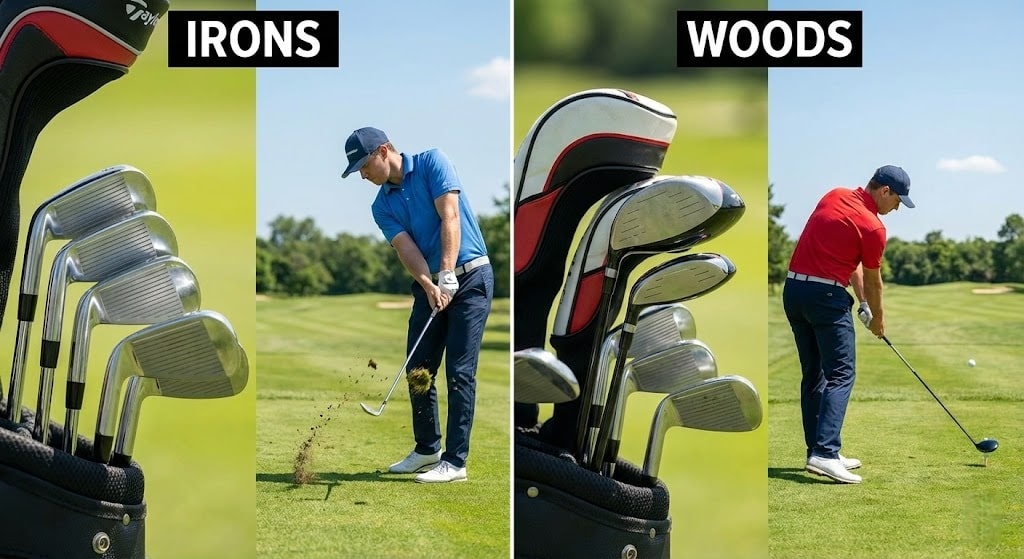
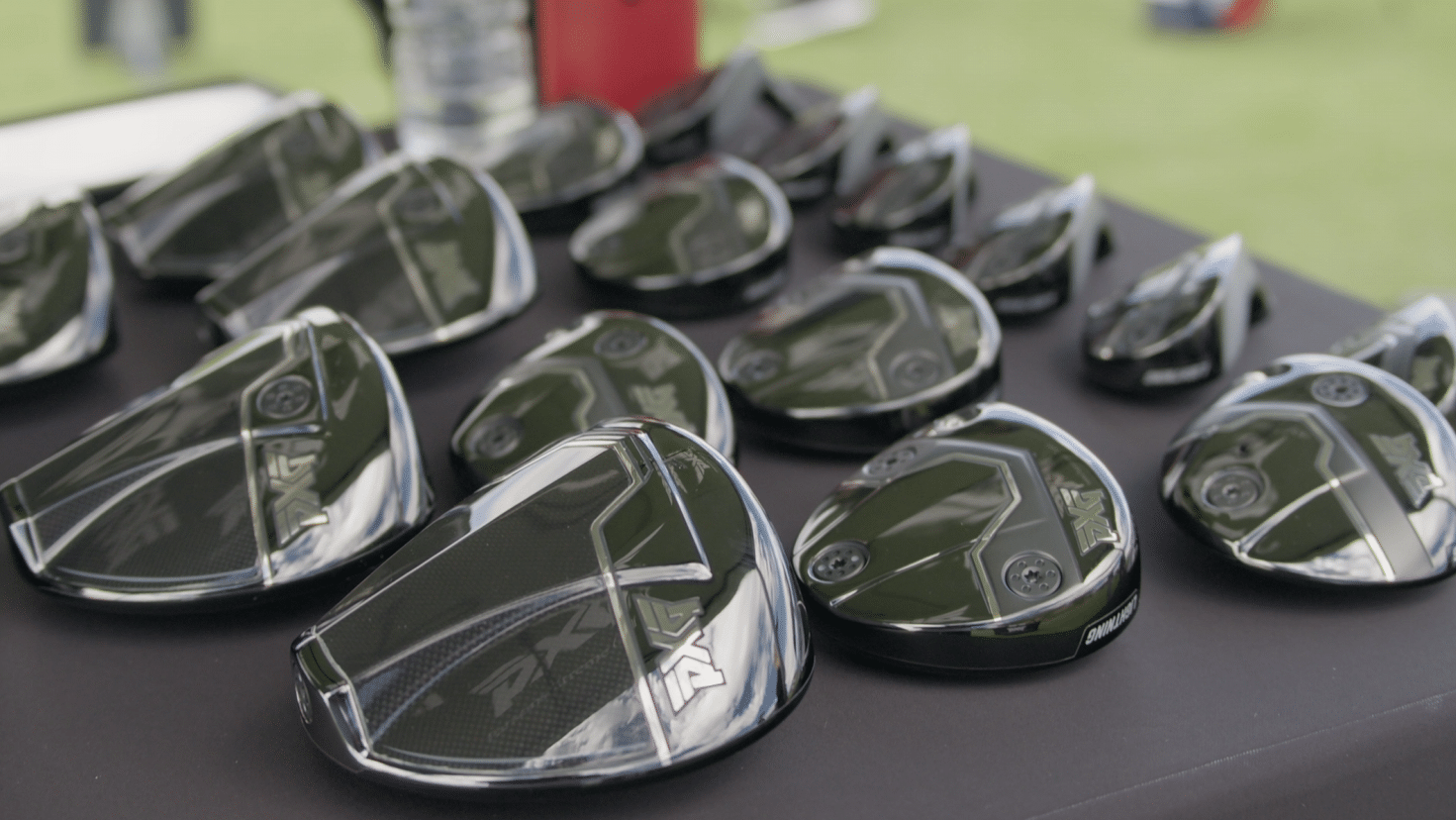
Woods feature large, rounded clubheads made from titanium or steel with a low, deep center of gravity. This design creates a bigger sweet spot and promotes higher launch with less spin. Irons take the opposite approach, thin, flat clubheads with grooved faces designed to grab the ball and impart spin. Long irons are specifically intended for penetrating, lower ball flight, making them ideal for windy conditions or when you need the ball to run out after landing. The grooved face on irons allows them to compress the ball effectively, giving players greater precision on approach shots.
Here's what matters: woods use longer shafts to generate speed and distance, while irons prioritize control through shorter shafts. The longer shafts on woods require a sweeping swing motion, whereas irons favor a more descending blow into the ball. You can't swing these clubs similarly because they weren't built similarly.
Ball position and stance width might sound like minor setup details, but they're actually the invisible design that determines whether your swing produces a pure strike or a topped grounder.
Here's the reality: your driver demands a position just inside your front heel with a wide stance, creating a low point 2-3 inches behind the ball for that crucial upward strike. Move to your irons, and you're centering the ball with a narrower stance, generating a low point 3-4 inches ahead for crisp, descending contact. This descending contact works in harmony with your club groove sharpness to maximize spin and control on approach shots.
The same swing mechanics produce completely different angles of attack based purely on where you place the ball. Fairway woods and hybrids split the difference, one ball's width inside your front heel. Get this wrong, and you've reversed the engineering your clubs were designed to deliver. Using alignment sticks on the driving range helps you verify these positions until they become second nature. While your posture, grip, and alignment should remain consistent across all clubs, the ball position shifts forward progressively from irons to hybrids to woods due to the increasing length of each club.
The most persistent myth in golf instruction says you need two completely different swings, one for woods, another for irons. That's overcomplicating things. The real difference comes down to where your club bottoms out.
With woods, you're sweeping the ball. Your swing arc reaches its lowest point behind the ball, letting the clubhead travel slightly upward through impact. This shallow angle of attack launches the ball higher with maximum distance. To achieve this motion, your club must stay low to the ground throughout the swing.
Irons flip the script entirely. You're striking down on the ball, with your low point landing 2–4 inches past it. This descending blow compresses the ball against the turf, generating the spin and control you need for precision shots. The key is that ball position shifts depending on which club you're using, more forward for woods, just inside the lead foot for irons. Striking the ball dead center on the clubface can add as much distance as swinging faster, making consistent contact crucial for both club types.
Same swing fundamentals, different low points. Master that distinction, and you've cracked the code.
Contrary to what you might assume, controlling path doesn't require reinventing your swing for every club in your bag; your equipment handles most of this automatically.
Your iron's shorter shaft forces you closer to the ball, creating a steeper swing plane and that descending strike I mentioned earlier. Woods positions the ball forward in your stance, flattening your plane and producing a shallower attack angle. You don't consciously adjust anything; the club length dictates the geometry. The iron's higher center of gravity, combined with its thin, flat head design, contributes to the control and workability that skilled players prefer.
Here's what this means for flight path: irons generate around 4000 rpm of backspin with steeper landing angles, while drivers produce minimal spin on a flatter plane. That reduced spin makes woods incredibly sensitive to clubface errors at impact. Your five wood launches higher than a three iron while producing far more consistent carry distances. This is why professionals often choose a 3 wood over a driver in challenging conditions, prioritizing accuracy over distance. Many golfers now carry hybrids instead of long irons because they offer comparable distances while being significantly easier to hit consistently.
When you grab a different club, your brain often makes unnecessary adjustments that sabotage perfectly good mechanics.
The biggest culprit? Ball position paranoia. With fairway woods, you're tempted to play the ball off your front heel like a driver. Don't. Move it slightly back, and you'll immediately strike it cleaner. The ideal position falls between center stance and lead heel for optimal ball-turf interaction.
Here's another trap: you've heard "hit down on irons" so many times that your upper body lunges forward, creating steep divots and chunked shots. Think "swing up" instead, the same feeling you have with woods actually produces better iron contact. This out-of-sync motion creates steep angles of attack that ruin your ball striking. The adjustment becomes even more critical depending on your iron type, since cavity back irons offer more forgiveness on off-center hits than traditional blades.
Your arc width changes, too. With woods, you unconsciously narrow your swing, pulling your arms close to your body. This kills speed and invites fat shots. Maintain that wide arc regardless of what's in your hands.
Fixing swing mistakes only gets you halfway there; you've also got to pick clubs that actually work with your natural tendencies, not against them.
Here's the truth: your swing speed dictates everything. If you're generating serious clubhead speed, woods become your distance weapons, lower loft, longer shafts, and that sweeping motion translates into ideal launch angles with minimal spin. But if your swing speed runs slower, don't fight physics. Irons and hybrids give you the higher loft and shorter shafts needed for consistent contact.
Your swing arc matters too. Steep swingers struggle with fairway woods because they're built for sweeping motions. If that's you, hybrids bridge the gap perfectly, offering wood-like distance with iron-like forgiveness. For shots over 180 yards, hybrids generally outperform long irons in both distance and consistency for most amateur golfers. Match the club to your swing, not the other way around.

The user wants me to write a 70-word answer about whether high handicap golfers should replace all long irons with hybrids. I need to:
Let me craft this response:
Yes, you should ditch those long irons. The data's crystal clear: you're nearly twice as likely to hit greens from 180+ yards with a hybrid. You'll gain 8–15 yards, launch the ball higher, and actually stop it on greens. Long irons demand swing speeds that most high handicappers simply don't have. Don't fight physics; get fitted for hybrids that match your swing, and watch your scores drop.
You'll typically pick up 5 to 15 yards with a fairway wood over a comparable hybrid. A 3-wood carries roughly 195-250 yards versus a 3-hybrid's 175-220 yards. But here's what matters: that distance gap only shows up if you're making solid contact. If you're fighting longer shafts and lower lofts, you'll lose that advantage to mishits. Distance means nothing without consistency.
You're treating your hybrid like a long iron, and that's the trap. Your steeper, iron-style attack angle causes the clubface to close prematurely through impact. Combine that with a strong grip and the ball positioned too far forward, and you've created a perfect hook recipe. The hybrid's design, with less offset and, lower center of gravity, amplifies every mistake. Shallow out your swing path, and you'll eliminate those snap hooks immediately.
Hybrids outperform long irons and fairway woods from thick rough. You'll get more consistent contact because the hybrid's design combines mass distribution with a shorter shaft you can actually control. Long irons twist and snag in heavy grass, their narrow soles dig instead of gliding. Fairway woods have the mass, but their longer shafts make clean contact unpredictable. When you're buried in Bermuda, grab your hybrid and swing confidently.
Long irons actually deliver better accuracy for you as a mid-handicapper; studies show they're roughly 33% more precise on approach shots. I know that contradicts the marketing, but here's the catch: you'll likely struggle to make consistent contact with them. Your greens hit percentage ends up nearly identical between both clubs because hybrids' forgiveness compensates for their lower peak accuracy. The real answer? Test both yourself.
Stop treating every club the same way; that's the fastest path to inconsistent golf. You've got the structure now: sweeping with woods, descending with irons, and adjusting your setup accordingly. The difference isn't subtle, and neither should your approach be. Practice these distinctions deliberately, and you'll stop fighting your clubs and start letting them do what they're designed to do.

