
The best golf simulator manufacturers use real measurement technology instead of guessing. Top brands like TrackMan, Foresight, and Uneekor track actual ball flight with radar or high-speed cameras running at 40,000 frames per second, hitting 99% accuracy. Budget options just estimate where your ball went based on the landing spot, which means they're missing vital data like spin rate, club path, and face angle at impact. The difference shows up in your practice: elite systems give you tour-level feedback, while cheap ones leave you wondering what actually happened. Keep going to see exactly what separates each price tier.
When you're shopping for a golf simulator, the price tags can range from less than a thousand bucks to well over $80,000, and there's a reason for that massive gap. Budget options under $2,000 use simpler radar or basic camera systems that'll give you core metrics like ball speed and launch angle. They won't track clubface impact or provide the granular data serious players crave. Elite systems, on the other hand, employ advanced high-speed cameras and radar for tour-level accuracy. Take the Foresight Falcon at $14,999; it delivers precise club and ball data with professional-grade dispersions. Mid-tier options like the FlightScope Mevo+ balance affordability with pro package add-ons, giving you improved metrics without breaking the bank completely! Budget simulators typically feature fewer virtual courses and simpler graphics compared to their high-end counterparts. Lower-end systems may also suffer from delayed feedback that disrupts the natural rhythm of your swing.

The accuracy battle between TrackMan, Foresight, and Uneekor isn't just about which one costs more; it's about understanding what each system actually measures and how they get their numbers. TrackMan's dual radar tracks your ball at 40,000 frames per second, capturing full flight data with 99% accuracy on club and ball metrics. Foresight uses high-speed cameras to nail impact location and launch angles within 1-2% of course measurements. Uneekor's overhead cameras excel in enclosed spaces, matching radar standards for ball speed and smash factor. The key point is: all three hit that 1-3% variance sweet spot for carry distance. The real difference? TrackMan dominates outdoors, while Foresight and Uneekor shine indoors, where lighting won't mess with your data. TrackMan's adoption by 90 of the top 100 golfers worldwide proves its reliability at the professional level, making it the go-to choice for tour players who demand precision. The system's ability to measure critical data points like swing speed, angle of attack, and spin rate enables golfers to make informed adjustments that directly improve their performance.
While your launch monitor might nail every ball speed measurement down to the decimal point, it's the software that actually turns those numbers into something you'd want to look at for more than five minutes.
TrackMan leads the pack with the most realistic graphics, providing smooth course renderings that'll make you forget you're in your garage. GSPro and E6 Connect both support 4K resolution with photorealistic physics, though GSPro's lighting feels a bit flat compared to TGC's superior contrast and lighting effects. The important point is: you'll need at least an RTX 370 GPU for decent 1080P performance, jumping to an RTX 380 for 4K.
TPS competes graphically with top-tier options, while budget choices like Creative Golf sacrifice visual polish to keep costs down. E6 APEX takes graphics to another level with stunning photorealistic visuals utilizing Unreal Engine 5. Sky Track Course Play delivers solid visuals with an RTX 360, offering detailed flyover views and accurate course representations.
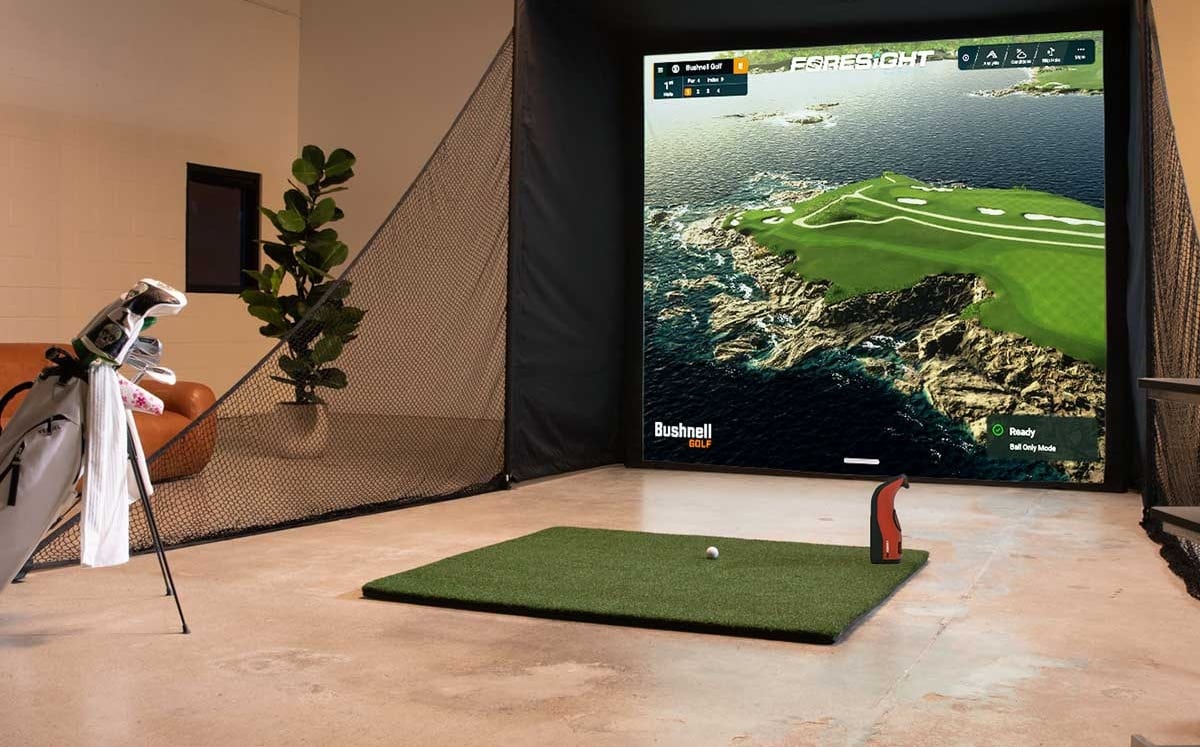
Unless you know exactly what numbers your simulator tracks, you're basically flying blind regarding improving your game. Different manufacturers measure varying metrics, some offer basic data, while premium models deliver extensive analytics. You'll typically see club speed (how fast your club head moves before impact), ball speed (velocity after contact), and launch angle (your shot's initial path). Most simulators track spin rate, which measures backspin and sidespin in revolutions per minute. The key point is: too much spin kills your distance potential. Advanced units also display club path (your swing's horizontal direction), face angle (where your club points at impact), and smash factor, that's the efficiency ratio between club speed and ball speed. Better simulators even show attack angle and impact location for pinpoint feedback! Understanding carry distance helps you select the right club for different course situations and optimize your shot strategy. Rather than obsessing over individual shots, monitor trends over multiple sessions to get a clearer picture of your actual performance patterns.
Before dropping thousands of dollars on a golf simulator, you need to understand what your money actually buys at each price point, and honestly, the differences between budget levels are massive. the realistic features of golf simulators can vary significantly, affecting both performance and user experience. Higher-end models often offer more advanced technology, including better ball tracking and high-definition visual displays, which can enhance practice sessions and gameplay simulation. Understanding these features is crucial for making an informed decision that aligns with your specific needs and budget. When considering the best golf simulators for putting, it's important to look for models that offer accurate mimicking of green conditions and realistic putting mechanics. Additionally, features such as adjustable slope and customizable practice drills can significantly enhance your indoor putting experience. Investing in the right simulator can lead to improved skills on the course and a more enjoyable overall practice routine.
Entry-level setups ($500-$4,000) include basic launch monitors like the Garmin R10 at $599.99, giving you simple swing feedback without advanced metrics. Mid-tier packages ($5,000-$15,000) bring accurate ball flight data with options like SkyTrak+ or Mevo+, plus complete enclosures and screens.
Upper mid-tier systems ($15,000-$35,000) add club path tracking and premium projectors, while premium setups ($40,000-$80,000) deliver industry-leading accuracy with the GCQuad at around $16,000 or QuadMAX at $19,999+. At this level, you'll also benefit from sophisticated software that renders famous courses in great detail for a more immersive experience. Commercial-grade simulators over $80,000, like the aG Curve at $69,500, offer unmatched realism for serious enthusiasts.
The quality of your launch monitor directly impacts data accuracy and insights, which becomes increasingly important as you invest in higher-tier systems.
How do you figure out which golf simulator actually makes sense for your specific situation? Start with your ceiling height; you'll need at least 8.5 feet for unrestricted swings, though 9-10 feet works better for most players. Next, measure your available space. A compact setup requires just 9 feet high, 10 feet wide, and 14 feet deep, while comfortable configurations need 15-16 feet wide and 25 feet deep. The key point is: your launch monitor choice matters too. Camera-based units work in tighter spaces, but radar systems like Trackman 4 demand 18+ feet of depth. Match these physical requirements with your budget from the previous section, and you'll quickly narrow down which manufacturers actually fit your reality.
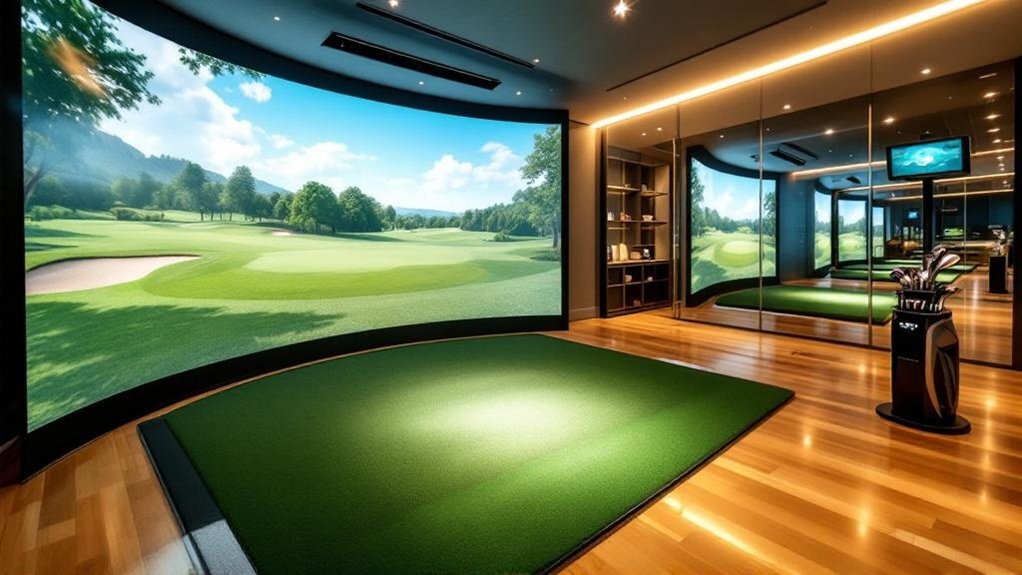
Yes, you'll typically face ongoing costs. Most golf simulators require annual software subscriptions ranging from $200 to $1,500, depending on the features you want. Basic apps run free to $200 yearly, while premium platforms like GSPro cost around $250 annually. You'll also need to replace screens or mats every 1–3 years, plus budget $20–$100 yearly for accessories. Some options, like TGC 2019 ($950 one-time) or certain Foresight models, skip subscriptions entirely, saving you money long-term.
You can definitely use golf simulators both indoors and outdoors! Radar-based units like the Garmin R10, FlightScope Mevo+, and Swing Caddie SC4 Pro work great outside. Camera-based systems like the SkyTrak+ and Rapsodo MLM2PRO also function outdoors, though direct sunlight can mess with camera-only models. Indoor setups need more controlled environments with specific spacing requirements, typically 10-20 feet of depth, depending on your launch monitor type.
You'll need at least 12 feet long, 10 feet wide, and 8.5 feet high for basic swings, but that's pretty tight. A comfortable setup runs about 16 feet long, 12 feet wide, and 9 feet high. If you want the ideal experience, go for 18 feet long, 15 feet wide, and 10 feet high. The key is keeping your tee 10-12 feet from the screen and leaving at least 2 feet of buffer space behind your mat.
You'll want radar-based monitors like the Garmin Approach R10 or FlightScope Mevo that sit behind the ball; they work seamlessly for both righties and lefties without repositioning. Overhead units like the GC Hawk are even better since they never need moving. Just avoid side-positioned systems like SkyTrak+, which require recalibration every time you switch hands. Make sure your room's at least 15 feet wide to accommodate swings from both sides!
Yes, you can have multiple players on most golf simulators, but it depends on your system. TruGolf's Apogee Range handles up to seven players simultaneously, while Golfzon TwoVision supports six at once. TGC Software allows four local players to take alternating turns. The thing is, some simulators show everyone's data on screen at the same time during practice, while others use a turn-based setup where you wait for your shot based on distance to the pin.
Selecting the appropriate golf simulator hinges on aligning your budget with your objectives. If you're committed to enhancing your skills and can invest $10,000+, TrackMan or Foresight provides tour-level precision. For recreational use, budget-friendly alternatives starting around $500 still offer useful feedback. The point is: even entry-level simulators surpass estimating at the range. Measure your area, determine your budget, and choose the technology that will genuinely be utilized!

