If you've ever stood over a pitch shot and felt like your wedge was working against you, the ball jumping off the face with zero predictability, the sole digging into the turf like it's trying to reach China, you know how maddening the short game can be. I've tested more wedges than I can count over the years, from the big-name staples like Vokey and Jaws to boutique offerings that promise the world and deliver a parking lot. So when PXG dropped the Stick 'Em wedges, I'll admit I was curious but cautious. PXG has a reputation for premium engineering and equally premium price tags, and I wanted to know if the performance actually backed up the hype. After several weeks of testing across a range of conditions, tight lies, fluffy bunker sand, soggy rough, and everything in between. I'm ready to share exactly what I found.
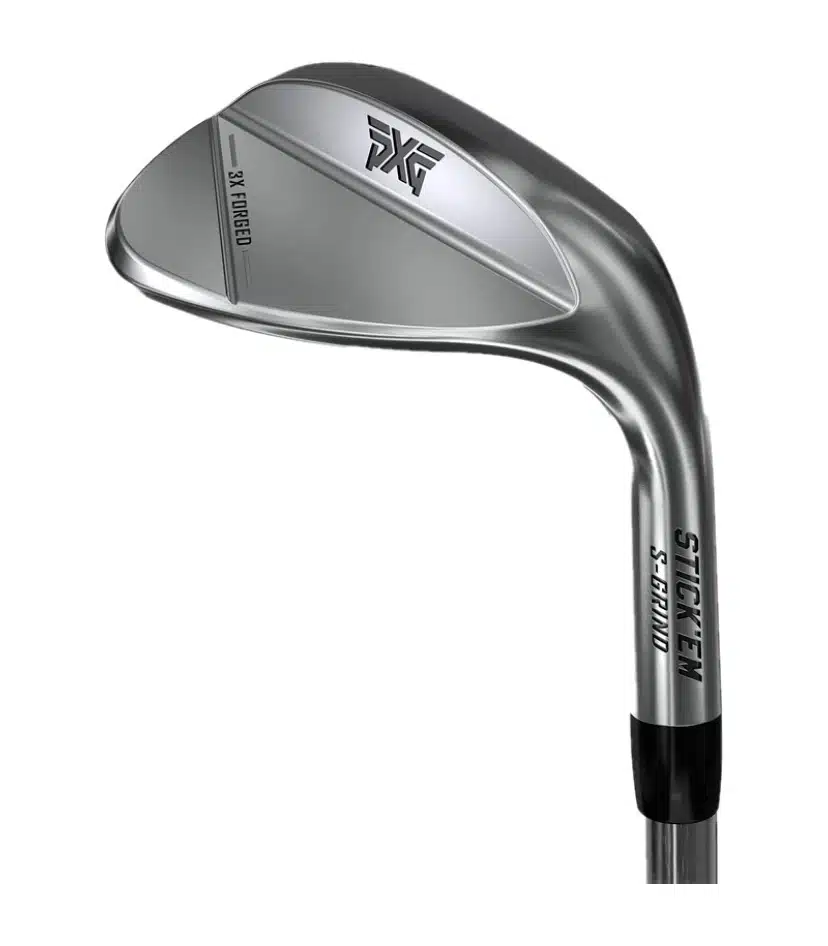
Master your short game with PXG Stick 'Em 56° wedges. Choose the versatile S Grind or the high-bounce BP Grind for maximum spin and control. Engineered for precision, upgrade your bag today.
The moment I pulled the PXG Stick 'Em out of the box, I could tell this wasn't a rushed-to-market product. The finish is clean, understated, and has that matte quality that reduces glare at address without looking overly flashy. There's a confidence that comes from setting a well-shaped wedge behind the ball, and PXG nailed the profile here. The toe is slightly more prominent than what you'd see on something like a Cleveland RTX or even a Titleist Vokey SM10, and that's by design (more on that in a minute). The sole grinds are clearly defined, and the grooves, especially on the higher-lofted models, extend across the entire face, which immediately tells you PXG is thinking about the creative shotmaker. Overall, the aesthetic strikes a nice balance between modern performance and classic wedge design. No garish colors, no unnecessary branding overkill. Just a serious-looking tool that you'd be proud to pull out of the bag.

Let me get this out of the way early: the feel of the PXG Stick 'Em wedges is, without exaggeration, one of the best I've experienced. And I don't say that lightly. I've hit thousands of wedge shots with forged clubs from Mizuno, TaylorMade, Callaway, and Titleist, and the Stick 'Em holds its own against every single one of them.
The secret is in the construction. PXG uses 8620 soft carbon steel that's been forged not once, not twice, but three times. Now, I know that sounds like marketing speak, "triple-forged" has a nice ring to it, but the science actually checks out. Each forging pass refines the grain structure of the metal at a microscopic level, compressing and aligning the material into a tighter, more uniform structure. The result is a clubhead that feels softer at impact without sacrificing solidity. It's a subtle distinction, but if you've ever hit a butter-soft forged blade and then hit a cast wedge back-to-back, you know exactly what I'm talking about. Beyond feel, the increased material strength from the triple-forging process helps the grooves maintain sharpness longer and preserves the club's appearance over time.
On the course, this translated into something I can only describe as "responsive softness." Full swings from the fairway produced a crisp, satisfying click, not a harsh ting, not a dull thud, but that sweet spot right in the middle that tells your hands everything they need to know about the strike. Partial shots around the green felt even better. I could genuinely feel the ball compressing against the face on delicate pitch shots, which gave me an incredible sense of control over distance. When you're trying to land a 30-yard flop shot on a specific patch of green, that feedback is worth its weight in gold.
Honestly, I was a little skeptical that I'd notice a meaningful difference between triple-forged and the standard single-forged process used by most competitors. I was wrong. The Stick 'Em has a purity of feel that lingers in your hands after impact, and it made me more confident over every short-game shot I attempted. If you're the kind of golfer who values feel as much as performance metrics, this alone might be enough to sell you.
Every wedge manufacturer on the planet talks about their grooves like they've reinvented the wheel. Sharper edges, tighter tolerances, maximum spin, you've heard it all before. So I approached PXG's groove claims with the same healthy skepticism I bring to every review. But after putting the Stick 'Em through its paces in a variety of conditions, I have to give credit where it's due: these grooves perform.
PXG went with a high-performance groove geometry that's wider than what you'll find on many competing wedges. The wider grooves increase the cross-sectional area, which means more of the ball's cover material is being gripped and engaged at impact. Think of it like the difference between a narrow-tread tire and a wide one on a wet road; more contact area means more friction, and more friction means more spin. But it's not just about width. The groove spacing is tighter, too, so there are more groove edges interacting with the ball on any given shot. It's a dual approach: wider grooves for deeper engagement and tighter spacing for more frequent engagement.
Where I noticed this most was in less-than-ideal conditions. On a clean, dry lie from the fairway, almost any decent wedge will generate respectable spin numbers. The real test is when there's moisture on the face, grass trapped between the ball and the clubhead, or you're coming out of light rough. The wider grooves on the Stick 'Em do an excellent job of channeling away debris, grass, water, and sand, so the groove edges can still do their job. I tested back-to-back with a set of wedges I'd been gaming for about six months, and the spin consistency from wet rough was noticeably better with the PXG. Not marginally, noticeably. The ball just behaved more predictably, checking up on the green instead of releasing with that unpredictable hot-and-slide that drives you crazy.
One more detail that's worth mentioning: the 54° through 60° lofts come with full-face grooves, meaning the scoring lines extend all the way across the face from heel to toe. If you play a lot of open-face bunker shots or flops where you're catching the ball out toward the toe, those full-face grooves are a genuine advantage. The 50° and 52° models use a more traditional groove layout, which makes sense since those clubs are typically used for fuller, more controlled swings where center-face contact is the norm. It's a smart, thoughtful design choice that tells me PXG actually considered how golfers use different lofts rather than applying a one-size-fits-all approach.

Here's where the Stick 'Em wedges start to separate themselves from the pack in a way that might not be immediately obvious. PXG loaded weight into the toe of the clubhead, and while that might seem like a small detail, the performance implications are meaningful.
First, the high-toe weighting increases the moment of inertia MOI, which is the club's resistance to twisting on off-center hits. In plain English, that means mishits don't punish you as severely. If you catch one a little toward the heel or a little out on the toe, the clubhead stays more stable through impact, and you get a result that's closer to what you intended. For a wedge, where precision is everything, stability is a major advantage. I'm not saying you can blade a chip shot and expect a miracle, but the forgiveness margin on slight misses is genuinely improved.
Second, and this is the part I found most interesting- the high-toe design positions the center of gravity in line with where the ball makes contact on open-face shots. When you lay a wedge open for a bunker shot or a lob, you're naturally shifting the strike point toward the toe of the club. Most traditional wedges don't account for this, so your CG is misaligned with the impact point, leading to inconsistent launch conditions. PXG specifically engineered the Stick 'Em so that when the face is open, the CG is right where it needs to be. The result? More consistent flight and more predictable launch on the exact shots where most golfers struggle with consistency.
I tested this extensively out of greenside bunkers and on flop shots around the practice green. With the face laid open on my 58°, the ball came off with a remarkably consistent trajectory, same height, same flight, same landing angle, shot after shot. Compare that to a more traditionally weighted wedge, where opening the face can produce a frustrating range of outcomes from one swing to the next. If you're a player who likes to get creative around the greens (and honestly, who doesn't want to be?), this weighting philosophy is a real asset. It turns what's normally the most unpredictable part of your game into something you can actually trust.
PXG offers the Stick 'Em in two distinct sole grinds, and I appreciate that they didn't try to overcomplicate things with six different options that would confuse the average golfer. Two choices, clearly defined, each built for a specific type of player and swing.
The BP-Grind comes with 13° of bounce and features a wider, fuller sole. This is the grind for golfers who tend to have steeper attack angles, players who really drive the club down into the ball, and need a sole that will glide through the turf rather than dig. I found the BP-Grind to be absolutely outstanding out of bunkers. That wider sole just floats through the sand, making it almost impossible to stick the leading edge and chunk one into the lip. If you play courses with soft turf or heavy sand, or if your natural swing is on the steeper side, the BP-Grind is the one you want. It's also more forgiving on full shots from the fairway, where that extra bounce keeps the club moving through impact rather than grabbing and decelerating.
The S-Grind, on the other hand, is built for versatility. It has 10° of bounce with a tapered sole that includes heel-and-toe relief. That relief allows you to open the face significantly without adding excessive bounce, which means you can hit those low spinners and high flops without the club feeling like it's sitting too far off the ground. I gravitated toward the S-Grind for most of my testing because I like to manipulate the face around the greens, and it rewarded creativity. Tight lies, firm turf, partial shots with an open face, the S-Grind handled everything I threw at it. If you consider yourself a feel player who likes to manufacture shots, this is your grind.
The key here is matching the grind to your swing and the conditions you play in most often. PXG doesn't try to sell you on a one-grind-fits-all solution, and that honesty is refreshing. Steeper swing, softer conditions? BP-Grind. Shallower swing, firm conditions, creative shotmaking? S-Grind. It's that simple, and both options deliver exactly what they promise.
PXG offers the Stick 'Em in six lofts, 50°, 52°, 54°, 56°, 58°, and 60°, which covers essentially every gap you could need from your gap wedge down to your lob wedge. I tested the 54° and 58° models most extensively, and both slotted perfectly into the distance gaps in my bag.
What impressed me most was the thoughtfulness behind the groove configuration across lofts. As I mentioned earlier, the 54° through 60° models feature full-face grooves, which makes perfect sense because those are the lofts you're most likely to open up for creative shots around the green. The expanded hitting area means you're generating spin even on off-center strikes and open-face plays. The 50° and 52° models, meanwhile, use traditional grooves because those clubs are primarily used for full swings where you're making center-face contact. It's a detail that shows PXG really thought about how each loft would actually be used in real playing conditions rather than just stamping the same design across the entire lineup.
With multiple shaft and flex options available, fitting the Stick 'Em to your game is straightforward. I tested with the stock steel shaft in stiff flex, and the weight and balance felt dialed in, not too heavy, not too light, with a smooth transition through the swing. Whether you're building a two-wedge setup or going with a full four-wedge complement, the loft options give you the flexibility to dial in your yardages precisely. And honestly, having that kind of range means you're never forced to manufacture a half-swing when you could just grab the right club and make a committed pass. That alone will save you strokes.
Master your short game with PXG Stick 'Em 56° wedges. Choose the versatile S Grind or the high-bounce BP Grind for maximum spin and control. Engineered for precision, upgrade your bag today.
You've got solid options. Hit pxg.com directly for custom fitting and free shipping on full bag orders; that's your cleanest route. Official PXG retail stores in Arizona, Texas, California, Florida, New Jersey, and New York let you demo them in person. For deals, 2nd Swing carries 890+ PXG wedge models with trade-in credit, and Major Golf Direct offers online fitting. StickHawk's worth checking for gently-used pairs at lower prices.
PXG covers your Stick 'Em Wedges against defects in materials and workmanship from the purchase date. Third-party shafts get one year of coverage. You've also got a 30-day money-back guarantee, though they'll hit you with a 12% restocking fee plus shipping costs, annoying, but standard. Normal wear and tear isn't covered, and don't modify anything or you're out of luck. Contact their support Monday–Friday, 9 a.m.–4 p.m. EST.
Yes, PXG offers the Stick'em Forged Wedges in left-handed models across the full lineup, all six lofts (50°–60°), both grinds (BP and S), and both finishes. No restrictions, no limited selection, no "sorry, lefties" nonsense. Pricing's identical too: $199 for Chrome, $219 for Xtreme Dark. You can even build blended sets with custom shaft and flex options. PXG actually treats left-handed players as they exist. Invigorating.
Yes, you can. PXG offers graphite options like the MCA Diamana S+, Graphite Design Tour AD-IZ, and Tour AD-TP across multiple weights and flexes, for Ladies through Extra Stiff. Steel shafts are available, too. You've also got hybrid options like the PX HZRDUS Black GEN4. Custom fitting dials in the right shaft alongside loft, lie, and grind. Honestly, the shaft selection here is legit impressive for a wedge lineup.
So, is the PXG Stick 'Em for everyone? No, but no wedge is. If you're a beginner who hasn't developed consistent contact yet, you'd be better served by a more forgiving, game-improvement-style wedge at a lower price point. And if you're locked into a specific grind preference that doesn't align with the BP or S options, you'll want to look elsewhere.
But if you're a mid-to-low handicap player who values feel, demands consistent spin, and likes to get creative around the greens, the PXG Stick 'Em is one of the best wedges I've tested in recent memory. The triple-forged construction, the intelligent groove design, the high-toe weighting, and the well-thought-out grind options all add up to a wedge that doesn't just look premium, it plays premium. I walked away from this review genuinely impressed, and that doesn't happen as often as you'd think. If your short game is holding you back and you're ready to invest in a wedge that rewards good technique with great results, put the Stick 'Em on your shortlist. You won't regret it.