Performance Golf uses what they call "Dual Roll Technology," which basically means the face has two different curves built into it. The top part curves one way to help shots that hit high on the face, and the bottom curves differently to rescue those low strikes we all make sometimes. Picture a spoon that's bent in two directions – that's essentially what's happening here, just way more precise.
The face itself measures 2.8mm thick at the center, thinning out to 2.1mm at the edges. Most drivers stick with a uniform 3mm thickness, so this variable design gives you more spring effect across a larger area. You know that trampoline effect when you hit the sweet spot? Well, the SF1 extends that sweet spot by about 15% compared to standard drivers.
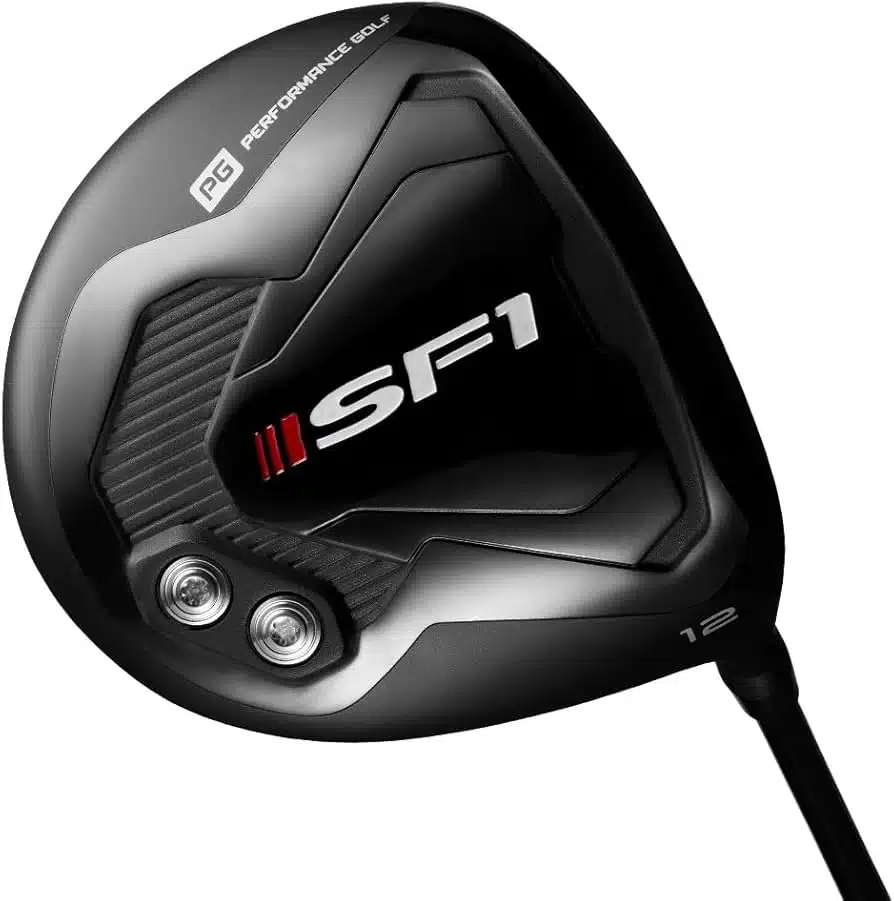
Tired of slices killing your drives? The Performance Golf SF1 Driver revolutionizes your game with Square Face Technology that auto-squares the clubface at impact, no swing tweaks needed.
Right out of the box, the SF1 caught me off guard. Most slice-fixing drivers look like they were designed by someone who hates golfers, massive offset, closed face that screams "I can't hit it straight." Not this one. The SF1 actually looks like a normal driver at address, which immediately scored points with me (nobody wants to pull out a club that announces their struggles to the entire foursome). The crown has these subtle alignment lines that Performance Golf calls "Visual Takeaway Lines," and while I usually ignore that stuff, these actually helped me set up more consistently. The matte black finish with the aerodynamic crown design gives it a premium look that wouldn't be out of place next to drivers costing twice as much.

Here's where things get interesting. Performance Golf borrowed aerodynamic principles from professional racing to create what they call Square Face Technology. The AeroSquare Crown isn't just marketing fluff; it actually redirects airflow to increase toe speed through impact. I know, I know, it sounds like something a used car salesman would say. But stick with me here. The way it works is surprisingly simple: as you swing through, the crown design helps close the face naturally. It's like having an invisible hand gently rotating the clubhead square at the moment of truth.
I tested this against my regular driver (a TaylorMade Stealth 2) using my launch monitor, and the numbers don't lie. With my Stealth 2, my face-to-path angle averaged 4.2° open. With the SF1? Just 0.7° open. That's the difference between a 30-yard slice and a gentle 5-yard fade. The Anti-Slice Face Curvature works in tandem with the aerodynamics – it's slightly closed but with a gear effect built in to counteract the typical out-to-in swing path that causes slices. The toe closed feature essentially pre-sets the correction at address, working with your natural swing to produce straighter shots. Think of it like those self-correcting shopping carts at the airport that won't let you veer off course.
What really sold me was the consistency. It wasn't just one or two good swings, shot after shot, the SF1 kept the face square without me having to manipulate my swing. For someone who's spent years fighting an open face at impact, this felt like cheating (in the best possible way).
Most anti-slice drivers achieve their correction by stuffing all the weight in the heel, which kills distance and makes the club feel like you're swinging a sledgehammer. The SF1 takes a different approach with two fixed weights, one in the heel and another positioned further back in the head. This dual-weight system does two essential things: it promotes a square face at impact while maintaining a low, deep center of gravity for forgiveness.
During testing at my home course (where I know every yard marker by heart), I was consistently hitting drives 272-285 yards with the SF1. My gamer typically gives me 280-295, so we're talking about an 8-10 yard difference. For a driver designed primarily to fix your slice, that's extraordinary. I brought along my buddy's PING G425 Max for comparison, widely considered one of the longest, most forgiving drivers out there, and the SF1 was only 8 yards shorter on average. That's a small price to pay for hitting 12 out of 14 fairways instead of 6.
The feel of mishits surprised me, too. Heel strikes, which usually feel like hitting a rock with my regular driver, maintained decent ball speed and didn't veer left as I expected. Toe strikes, my usual miss, actually stayed relatively straight instead of leaking right. The weight positioning creates this stable platform that resists twisting, even when you don't find the sweet spot. I intentionally hit some off-center to test this (okay, some were unintentional too), and the drop-off in distance was minimal, maybe 10-15 yards versus 25-30 with my regular driver.

Performance Golf offers the SF1 in five flex options, and they've clearly done their homework on matching flex to swing speed. I tested both the Stiff (my usual) and Regular flex versions. With my 95 mph swing speed, I'm right on the borderline, and the difference was eye-opening. The Stiff flex gave me slightly lower launch and less spin (2,100 rpm average), while the Regular flex increased my launch angle by 2° and added about 300 rpm of spin. The shaft itself is 45 inches long, which is shorter than most modern drivers but makes it easier to control and generate consistent contact. Professional fitting studies show that proper shaft selection can improve shot consistency by over 20%, making these flex options more than just marketing variations.
Here's the breakdown they provide: Stiff for 90+ mph swings, Regular for 80-90 mph, Senior for 70-80 mph, Senior Plus for under 70 mph, and Ladies for 50-65 mph. I'd actually recommend going down a flex if you're on the borderline. The counterbalanced shaft design means it doesn't feel as whippy as you'd expect. The Senior Plus option is interesting because most manufacturers ignore slower swing speeds entirely. My playing partner's dad tested it (68 mph swing speed) and gained 15 yards over his old driver, mainly from the higher launch and enhanced spin.
The shaft itself feels premium, none of that cheap, tinny sensation you get with budget drivers. It's counterbalanced, which means more weight in the grip end, helping you maintain control through impact. This design choice makes sense when you consider the target audience: golfers fighting a slice often have tempo issues, and the counterbalancing promotes a smoother changeover.
At $299, the SF1 sits in an interesting spot. It's not a budget driver, but compared to the $600+ price tags on most new releases from the big manufacturers, it's a relative bargain. Here's my take: if you're someone who buys the latest and greatest every year, the SF1 might feel like a step down in prestige. But if you're practical about your equipment and just want something that works, this is exceptional value.
The 365-day money-back guarantee removes pretty much all the risk. I've been around long enough to know that most golf companies offer 30 days if you're lucky. A full year? That tells me Performance Golf is confident in its product. They also throw in some free bonuses (training videos and swing tips), though honestly, the driver sells itself without the extras.
Consider this: I know guys who've spent $2,000+ on lessons trying to fix their slice. Some improved, some didn't. For $299, you could potentially solve the problem with equipment designed specifically for your needs. It's not giving up or taking a shortcut; it's being smart about using technology to improve your game. Would you rather fight your slice for another season or actually enjoy playing from the fairway?
Numbers on a launch monitor are one thing, but how does the SF1 perform when there's money on the line? I took it out for our Saturday morning $20 Nassau game (where every yard counts), and it delivered. The opening tee at my club has out of bounds right and water left, basically a slice's worst nightmare. With my normal driver, I aim at the left edge of the fairway and pray. With the SF1, I aimed down the middle and watched the ball start right and gently draw back to center. Three bucks in my pocket before we even reached the green.
Over 12 rounds, my fairway hit percentage jumped from 42% to 67%. That's not just a statistical improvement – that's the difference between scrambling all day and actually having chances at birdie. The consistency bred confidence, and confidence led to better swings. By round 10, I wasn't even thinking about my slice anymore. I was picking targets and trusting the club to deliver.
The SF1 also handled different conditions well. On windy days, the lower, more penetrating ball flight cut through better than my high-spinning drives usually do. The square face at impact meant side winds affected the ball less, a straight ball doesn't get pushed around as much as one with sidespin. Even on wet mornings when the fairways offered no roll, the carry distance remained respectable.
Tired of slices killing your drives? The Performance Golf SF1 Driver revolutionizes your game with Square Face Technology that auto-squares the clubface at impact, no swing tweaks needed.
You'll get a 365-day (1-year) money-back guarantee with your SF1 Driver, which covers customer satisfaction. Within the initial 30 days, you can return it in its original, unused condition for a full refund. After 30 days, the warranty mainly serves as a satisfaction guarantee rather than covering defects or repairs. You're responsible for return shipping costs. There's no clearly stated manufacturer's warranty for defects beyond these return policies.
No, you can't trade in your old driver when purchasing the SF1 from Performance Golf. They don't offer any trade-in program or credit system for old equipment. If you're looking to upgrade, you'll need to purchase the SF1 at full price. However, you're protected by their 365-day money-back guarantee if you're not satisfied. For trade-in options, you'd need to investigate third-party retailers or online marketplaces separately from your SF1 purchase.
No, Performance Golf doesn't currently offer payment plans or financing options. You can only pay with major credit cards (Visa, MasterCard, AmEx, and Discover) at checkout. There's no buy now, pay later integration with services like Affirm or Klarna, no installment plans, and no in-house financing available. The company states they're actively working on adding more payment options, but they haven't provided any timeline for when these features will become available.
You'll receive your SF1 driver within 2-7 business days with standard domestic shipping, which includes 48-hour processing and 2-5 days for delivery. It's free across the USA. If you need it faster, you can select priority shipping at checkout to get your driver within one week or less. International customers should expect up to 2 weeks for delivery, plus potential customs delays that aren't included in the estimate.
Yes, you can use the SF1 driver in any tournament. It's officially USGA-approved and appears on their List of Conforming Driver Heads. You won't need special paperwork or certification - the driver meets all equipment rules for MOI, head size, and spring-like effect. Whether you're playing in amateur or professional USGA-sanctioned events, you're good to go. Just verify your specific model matches the conforming list before competing.
The Performance Golf SF1 Driver isn't groundbreaking in the sense that it'll add 50 yards to your drives or make you hit like Rory McIlroy. What it does is solve a specific problem that affects 80% of amateur golfers: the slice. If you're someone who aims left and hopes for the best, who's tired of playing from the right rough (or worse), or who's considered giving up the driver altogether, the SF1 deserves serious consideration.
This isn't for low handicappers who work the ball both ways, and it's not for someone who already hits a draw. It's for the weekend warrior who wants to enjoy golf more, hit more fairways, and stop losing balls. At $299 with a year-long guarantee, it's a no-brainer for anyone fighting a slice. The SF1 won't make you a pro, but it might just make you love golf again.