If you've ever skulled a chip shot into your garage wall, or worse, your neighbor's window, you know that practicing your short game at home comes with a certain amount of risk. I've been through just about every type of practice ball on the market over the years, from wiffle balls that float like butterflies to rubber balls that bounce off walls like they're auditioning for a racquetball court. So when the GoSports Foam Golf Practice Balls landed on my doorstep, I was curious but cautious. Could a compressed foam ball actually feel like the real thing, or was this just another gimmick destined for the bottom of my garage bin?
After spending several weeks hitting these balls around my backyard, living room, and even a buddy's indoor studio, I've got some thoughts. And honestly? A few of them surprised me.
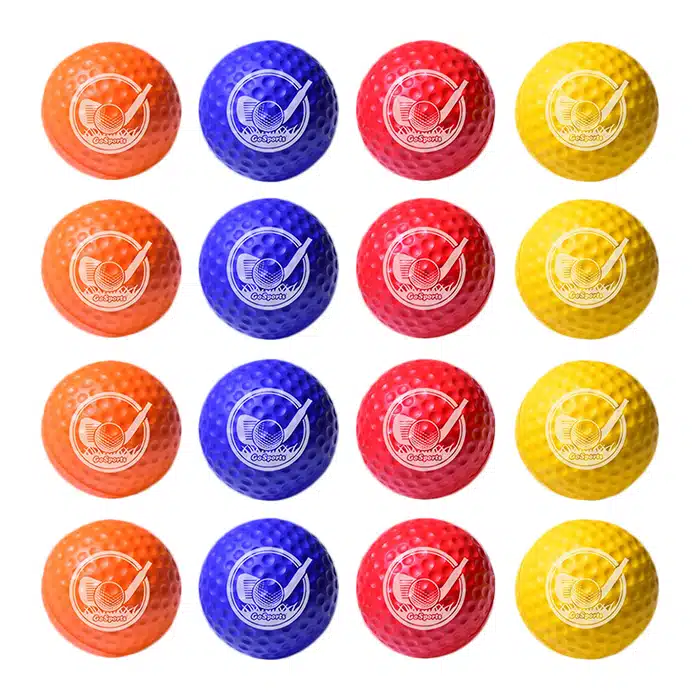
Plastic golf balls crack, crack windows, and fly weird. Discover why GoSports dense foam construction offers a superior, quiet, and ultra-realistic practice alternative.
The initial thing that caught my eye when I opened the package was how much these foam balls actually resemble standard golf balls. I'm not talking about those oversized, clearly fake practice balls you see at big-box stores. The GoSports foam balls feature a realistic dimple pattern that, at a glance, could fool you into thinking someone left a sleeve of Pro V1s on your counter. They come in a 16-pack, which is a nice touch; you get enough balls to set up a proper practice station without having to chase one ball across the yard after every shot.
The size and weight are obviously different from a real golf ball (they're foam, after all), but they sit behind a wedge or iron in a way that doesn't feel jarring. There's no cartoonish color scheme or bizarre texture. They're white, dimpled, and ready to be hit. For someone like me who appreciates when a practice tool doesn't feel like a toy, that initial impression mattered.

Here's where I have to be honest. I was skeptical. I've hit a lot of foam and plastic practice balls over the years, and most of them feel like you're hitting a marshmallow. There's no feedback, no compression, no sense that you actually made solid contact. It's one of the biggest reasons I've abandoned other practice balls in the past. If the feel is off, my brain doesn't register the repetition as real practice, and the whole exercise starts to feel pointless.
The GoSports foam balls are different. They're made from compressed foam, and that compression is the key word. When you make clean contact with a wedge or short iron, there's a noticeable resistance at impact, not identical to a real golf ball, but genuinely in the neighborhood. You can feel the difference between a flush strike and a thin one, which is exactly what you need when you're working on your chipping technique. I set up a small mat in my living room and hit about 50 chips one evening, and by the end, I could consistently tell the difference between a well-struck chip and one I caught a little heavy. That kind of feedback loop is everything regarding productive practice.
Now, does it feel exactly like a Titleist off the face of a Vokey? No. Let's not get carried away. But for a foam ball at this price point, the strike sensation is closer to reality than anything else I've tested in this category. I've hit foam balls from other brands that feel like slapping a pillow. These actually provide feedback, and that matters more than most people realize when they're shopping for practice balls. It's worth noting that some brands also offer limited flight foam balls that feel very solid like a rock compared to the standard soft foam variety, providing an even more realistic impact sensation for players who want that heavier feedback.
One more thing worth mentioning: the sound. It's obviously quieter than hitting a real ball, which is part of the appeal for indoor use. But it's not silent. There's a satisfying little "thwack" that gives your ears some confirmation alongside the feel in your hands. It's a small detail, but it adds to the comprehensive experience of the practice session feeling legitimate rather than like you're goofing around.
Let's talk about distance, because this is where I think some buyers might get confused if they don't understand what these balls are designed for. The product description mentions a maximum distance of about 110 yards, and independent comparisons suggest foam practice balls in this category fly roughly 60 to 70 percent of a real golf ball's distance. Some sources I came across even cap certain foam balls at around 45 yards. In my own backyard testing with a pitching wedge, I was getting somewhere in the 40-to-60-yard range depending on how aggressively I swung.
If your initial reaction to those numbers is disappointment, I'd encourage you to reframe your expectations. These aren't meant to replicate a full round of golf. They're meant to let you practice your short game chipping, pitching, and partial swings in spaces where launching a real golf ball would be dangerous, impractical, or both. The reduced flight is the feature, not the flaw. My backyard is maybe 30 yards deep, and with these balls, I can take smooth pitch shots without worrying about clearing the fence into my neighbor's pool (something I nearly did once with a harder practice ball, a story for another day).
The dimple pattern on these balls does contribute to a more natural ball flight shape compared to smooth foam balls I've used in the past. You can actually see the ball rise, apex, and descend in a somewhat realistic path. Is it perfect? No, the lighter weight means wind has a bigger effect, and the ball doesn't check up on landing the way a real ball would. But for the purpose of grooving a swing motion and seeing a visual representation of your shot shape, it's more than adequate.
Where the limited distance becomes an issue is if you're trying to use these for full-swing driver or long-iron practice. I tried a few driver swings just for fun, and while the ball did travel a decent distance (probably 80-ish yards), the feedback was so different from a real ball that I didn't find it particularly useful. These shine in the short-game zone, and I'd recommend keeping them there.

This was one of my primary reasons for testing these balls. I have a small practice area set up in my basement, a hitting mat, a chipping net, and just enough ceiling clearance to make a three-quarter wedge swing without remodeling the drywall. I've broken a light fixture, dented a wall, and scared my dog with other practice balls. (Sorry, Biscuit.) So the safety question was personal for me.
After dozens of indoor sessions, I can confidently say the GoSports foam balls are about as safe as a practice ball can be. On the rare occasion when I missed the net and the ball hit a wall, there was zero damage, no scuff marks, no dents, nothing. The foam absorbs impact in a way that hard plastic and rubber practice balls simply don't. I even accidentally caught one thing and sent it ricocheting off a basement shelf, and the worst thing that happened was a slight wobble of a picture frame. Compare that to the rubber practice ball that once bounced off my basement wall and hit me in the shin hard enough to leave a bruise, and you'll understand why I'm a convert.
For anyone with kids in the house, this is a major selling point. I handed a few balls to my ten-year-old nephew who's been getting into golf, and I didn't spend the entire session wincing every time he topped one. He could hack away to his heart's content, and the worst-case scenario was a foam ball gently rolling into the couch. That's the kind of peace of mind that makes home practice actually enjoyable instead of stressful.
The one caveat I'll mention is that while these balls won't break anything, they can still knock over lightweight objects if you catch one flush indoors. I wouldn't set up next to a shelf of fine china. But in any reasonable indoor practice space, these are as safe as it gets.
Let me address the elephant in the room: price. These balls are inexpensive. Really inexpensive. And in my experience, "cheap golf training aid" usually means "disappointing golf training aid." I've bought bargain putting mats that warped in a week, discount alignment sticks that bent if you looked at them wrong, and practice nets that collapsed during their second session. So I approached the GoSports foam balls with the expectation that the low price would come at a cost.
It didn't, at least not in any way that matters for the intended use. The foam construction is solid and consistent across all 16 balls in the pack. After several weeks of regular use, none of the balls have cracked, chipped, or deformed. They've been hit hundreds of times each with wedges and short irons, bounced off walls and nets, stepped on (accidentally), and even chewed on briefly by the aforementioned dog. They're holding up. The dimple pattern is still intact, and the compression feel hasn't degraded.
At the price point these are sold at through major retail channels, you're getting a full 16 balls, more than enough for a resilient practice session. Compare that to some premium practice balls that sell for three or four times the price of a pack of six, and the value proposition becomes pretty clear. Are the premium options marginally better in terms of feel and flight realism? Maybe. But the GoSports balls deliver about 85 percent of the experience at a fraction of the cost, and for most home practice scenarios, that's more than enough. At roughly ten dollars a box, these sit comfortably in the budget-friendly tier of practice balls without sacrificing the quality you need for meaningful repetitions.
I think the key perspective here is that practice balls are, by nature, consumable. You're going to lose some in bushes, your dog is going to steal a few, and eventually they'll wear out. Spending top dollar on balls that are going to live in your backyard and get hit into a net feels unnecessary. The GoSports foam balls hit the sweet spot of "good enough to be useful" and "cheap enough to not stress about."
Plastic golf balls crack, crack windows, and fly weird. Discover why GoSports dense foam construction offers a superior, quiet, and ultra-realistic practice alternative.
Yes, they're safe for indoor use around furniture, way safer than any hard plastic or real golf ball. The foam build limits flight distance and cuts rebound energy, so you're unlikely to dent or chip anything. That said, don't be stupid: move fragile stuff out of the way and stick to chipping drills, not full swings. They're not zero-risk, but they're about as close as you'll get.
With regular use, you're looking at roughly 6 to 12 months before they start losing shape or breaking down. Hit 'em daily with irons, and you'll lean closer to that six-month mark. Occasional weekend sessions? You could stretch past a year easily. They won't just disintegrate one day; you'll notice inconsistent flight and surface wear first. Once that happens, don't fight it, just replace 'em.
Yes, but check your machine initially. GoSports foam balls work with spring-loaded pitching machines and mini machines like the SKLZ Lightning Bolt. They're great for rapid-fire batting practice reps in that setup. However, they're not compatible with fast-pitch wheel machines, two-wheel, three-wheel, none of that. Don't just assume they'll work universally. Match the ball to your specific machine type before you waste money or jam something up.
Yes, GoSports Foam Flight practice balls come in Classic White and Hi-Vis Yellow. That's it for colors. As for sizes, there's only one ball size, but you'll find different pack counts: 16, 24, and 64 packs. Don't confuse pack size with ball size, the balls themselves are all the same. If you want visibility, grab the yellow. If you don't care, white works fine.
They're fine for supervised play, soft, oversized, and way safer than real golf balls. Kids can roll, toss, or whack them without anyone getting hurt. But don't treat them as certified toddler toys. GoSports doesn't list a minimum years, and there's no ASTM F963 toy certification in the specs. If your kid still mouths everything, check for wear and stay close. For unsupervised play, grab an actual year-labeled toy ball instead.
So, is the GoSports Foam Practice Ball set for everyone? No. If you're looking for a practice ball that perfectly replicates on-course conditions with realistic distance, spin, and flight characteristics, you're going to need to head to the driving range. No foam ball is going to replace that experience, regardless of what the marketing copy says.
But if you're a golfer who wants to groove your chipping motion in the living room after dinner, hit some pitch shots in the backyard on a Saturday afternoon, or give your kids a safe way to practice without turning your home into a demolition zone, this is one of the best options available. The feel is legitimate enough to build real muscle memory, the safety factor is excellent, and the price makes it a no-brainer impulse buy. I've spent more on a single sleeve of premium golf balls than I dunked in a water hazard on the 14th hole. At least these GoSports foam balls are still in my garage, ready for tomorrow's practice session. For anyone prioritizing short-game repetition and space efficiency on a budget, I don't think you'll find a better value on the market right now.