If you've ever clipped a golf GPS to your belt and then completely forgotten it was there until you needed it, you already understand the appeal of the Garmin Approach G12. I've tested dozens of golf GPS devices over the years, watches, handhelds, clip-ons, phone apps, you name it, and I keep coming back to one fundamental question: how much technology do you actually need between shots? The G12 is Garmin's answer for golfers who want reliable distance data without strapping a smartwatch to their wrist or fumbling with a touchscreen. I spent several weeks with this little device clipped to my bag, my belt, and even my back pocket, and I have some strong opinions about where it shines and where it falls short. Let me walk you through it.
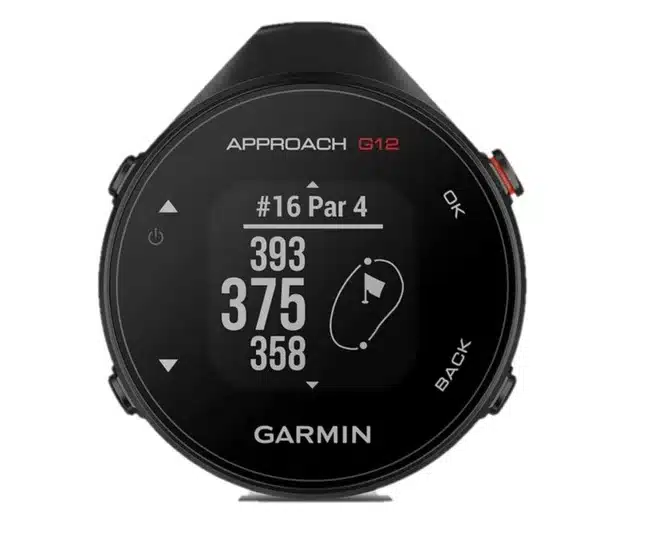
The Garmin Approach G12 is a premium golf GPS device with a sleek design, sunlight-readable screen, 42,000+ courses preloaded, and 30-hour battery life.
When I initially pulled the G12 out of its packaging, I'll be honest, my initial reaction was, "That's it?" This thing is genuinely pocket-sized. It's roughly the footprint of a thick car key fob, and the clip on the back feels sturdy enough to latch onto pretty much anything: your belt loop, your hat, the edge of a cart, the side pocket of your bag. It's the kind of device you toss into your golf bag and forget about until Saturday morning.
The build quality feels solid without being heavy. It's all black with a compact, no-nonsense aesthetic; there's nothing flashy here, and I think that's deliberate. Garmin designed this for golfers who don't want to think about their GPS. They want to glance at it, get a number, and hit the ball. The 1.3-inch black-and-white display is simple, almost retro compared to the color touchscreens you see on premium handhelds. But let me be clear. I didn't miss the color. Not once. When you're standing in the fairway squinting into the sun, you don't need a beautiful graphic of the hole. You need a number you can read. And the G12 delivers that with zero fuss.

Let's talk about the feature that made me raise an eyebrow before I even turned the G12 on: the 30-hour battery life in GPS mode. Thirty hours. To put that in relation, that's roughly six full rounds of golf on a single charge. I've owned GPS watches that barely survive a weekend trip, and here's this tiny clip-on device that could theoretically get you through an entire golf vacation without ever seeing a charging cable.
I tested this claim over three consecutive rounds without recharging, and the battery indicator barely budged. By the end of the third round, roughly 15 hours of active GPS use. I still had well over half the battery remaining. That's not marketing fluff. That's real-world performance that matters, especially if you're the kind of golfer who forgets to charge things (and let's be honest, that's most of us).
For comparison, the older Garmin G10 offered around 15 hours of battery life, which was respectable at the time. The G12 effectively doubles that number, and it's one of the single biggest reasons to weigh upgrading if you're still rocking the previous model. I've used competitors like the Bushnell Phantom 2 that offer solid battery performance, but the G12's endurance is genuinely in a class of its own at this price point. It's also worth noting that the device is water-resistant, so you won't need to worry about it during unexpected rain showers mid-round.
What does this mean practically? It means you can leave the charging cable at home for a golf trip. It means you're never going to be standing on the 14th tee watching your GPS die. It means one less thing to worry about, and when you're already worrying about your swing, your putting, and whether you remembered to bring enough balls, that peace of mind is worth more than you might think.
I'll admit I was a little skeptical about how quickly this small device would pick up satellites. GPS watches have the advantage of being on your wrist and constantly searching, but a clip-on that spends most of the week in your golf bag? I figured there'd be a longer warm-up period. I was wrong.
On my first round, I powered up the G12 in the parking lot while I was lacing up my shoes. By the time I walked to the first tee, maybe 90 seconds later, it had locked onto satellites and was already displaying the hole layout. In subsequent rounds, the connection time ranged from about 20 to 30 seconds, occasionally faster depending on how clear the sky was. One round on an overcast morning took closer to 30 seconds; a sunny afternoon round connected in what felt like 10. Either way, it was never an issue. I never stood on the tee waiting for my GPS to figure out where it was.
The yardage accuracy is where the G12 really earns its keep. It consistently displays distances to the front, center, and back of the green, and in my testing, these numbers lined up almost perfectly with my laser rangefinder readings. We're talking within a yard or two on virtually every shot. That's the kind of accuracy that builds trust, and trust is everything with a distance device. If you don't believe the number, you're not going to commit to the club, and uncommitted swings rarely end well.
Beyond green distances, the G12 also provides hazard and layup yardages, bunkers, water, forced carries, the works. On courses I know well, these numbers matched my expectations. On unfamiliar courses (which is where a GPS really proves its value), the hazard information was genuinely useful for course management decisions. Knowing there's a bunker at 237 and water at 260 changes everything about how you approach a tee shot, and the G12 gives you that information with a glance.

I need to address the elephant in the room: the black-and-white screen. If you're coming from a Garmin Approach G80 or any modern color GPS handheld, you're going to notice the difference immediately. There are no satellite images of the hole, no green contour maps, no colorful flyover views. The G12 gives you numbers on a monochrome display, and that's about it.
To be frank, after several weeks, I didn't care. And I say that as someone who genuinely enjoys the visual features on higher-end devices. The G12 isn't trying to be those devices. It's trying to be the GPS equivalent of a perfectly reliable watch; it tells you what you need to know, quickly, clearly, and without distraction. The 1.3-inch sunlight-readable display does exactly what it promises. Even on the brightest afternoons, I could read the yardage without shading the screen with my hand or adjusting my angle.
The Big Numbers Mode deserves a special mention here. When activated, it enlarges the primary distance readout so it's almost impossible to miss, even from arm's length while the device is clipped to your bag. For golfers with less-than-perfect eyesight (or anyone over 40 who's started holding restaurant menus at arm's length, no judgment, I'm right there with you), this feature alone could be the deciding factor. I found myself leaving Big Numbers Mode on permanently after the second round because the readability was just that much better.
The automatic hole switching worked flawlessly in every round I played. As I walked from one green to the next tee, the G12 quietly advanced to the next hole without any input from me. It sounds like a small thing, but if you've ever used a GPS that requires manual hole changes, you know how annoying it is to realize you've been looking at distances for the wrong hole. The G12 handles this seamlessly, and it's one of those invisible features that you only appreciate when it works, which it always did.
With over 42,000 preloaded courses worldwide, the G12 has you covered whether you're playing your home track or teeing it up on vacation in Scotland. I tested it on six different courses during my review period, including two I'd never played before, and every single one loaded without a hitch. No downloads, no waiting, no searching. You turn the device on, it finds satellites, it identifies your course, and you play golf. That's it.
The Garmin Golf app integration via Bluetooth adds a layer of functionality that extends the G12's usefulness beyond the course. After each round, I synced my data to the app and could review my scores, track trends, and even see how I performed hole by hole over time. The digital scorecard on the device itself is straightforward; you input your scores as you go, and it keeps a running total without adding any complexity to the interface. I wouldn't call it a full stat-tracking system (you won't get strokes gained analysis or detailed putting metrics), but for basic round history and scoring trends, it gets the job done.
The Garmin ecosystem is genuinely one of the brand's underrated strengths. If you already use a Garmin fitness tracker or smartwatch for other activities, having your golf data feed into the same app creates a convenient single hub for all your activity data. It's not a make-or-break feature, but it's the kind of thoughtful integration that adds value over time, especially compared to standalone GPS devices from competitors that don't offer the same level of post-round connectivity.
The Garmin Approach G12 is a premium golf GPS device with a sleek design, sunlight-readable screen, 42,000+ courses preloaded, and 30-hour battery life.
Yes, the Garmin G12 works perfectly fine without a phone. It's a standalone GPS that locks onto satellites all by itself, no Bluetooth, no app, no internet required. You just power it on outdoors, wait for satellite acquisition, and you've got yardages. Pairing with the Garmin Golf app via your phone is optional and only adds syncing features. For actual on-course distances, the G12 handles that entirely on its own.
Garmin rates the G12 at up to 30 hours on a single charge in GPS mode. That's legitimately impressive; you're looking at roughly seven rounds before you need to plug it in. The "up to" caveat matters, though. Cold weather will knock that number down, and the battery naturally loses capacity over time with repeated charging. But fresh out of the box? It's a beast.
Yes, it's tournament legal, but only when the event's committee adopts the Local Rule allowing distance-measuring devices. That's the catch most people skip over. You need to confirm the rules are in effect before your round, and you've gotta keep the G12 on distance-only mode. No slope, no wind, no club recommendations. If you can't disable a non-conforming feature, leave it in your bag.
No, the G12 doesn't support over-the-air Wi-Fi firmware updates. You'll need to plug it into your computer via USB and use Garmin Express to grab any available updates. Some fancier Garmin devices handle updates wirelessly, but the G12 isn't one of them. It's a little annoying, sure, but the process through Garmin Express is straightforward and takes just a few minutes.
Garmin backs the G12 with a one-year limited warranty covering defects in materials and workmanship. They'll repair or replace it at no charge for parts or labor; you just cover shipping to their service center. After a repair, you'll get 90 days or whatever's left on your original warranty, whichever's longer. Standard stuff, nothing special. If you want more protection, you're buying third-party coverage on your own dime.
So, is the Garmin Approach G12 for everyone? No. If you're a golfer who loves analyzing green contours on a full-color display, tracking every shot with GPS mapping, or using your device as a daily smartwatch off the course, you'll want to look at the Garmin Approach S62 or S70, or a premium handheld. The G12 isn't built for that crowd, and pretending otherwise would be dishonest.
But if you're the golfer who wants to clip something small and reliable to your belt, glance at it for a distance, and then focus entirely on your next shot, the G12 is about as good as it gets. The battery life is extraordinary, the accuracy is rock solid, the course coverage is thorough, and the simplicity of the interface is, in my experience, genuinely invigorating. After weeks of testing devices packed with features I rarely use, the G12 reminded me that sometimes less really is more. It does a few things, and it does them exceptionally well. It also includes a built-in shot measurement feature that lets you validate your club distances after each swing, which is a surprisingly handy tool for dialing in your gapping. For the minimalist golfer who values reliability and ease of use above all else, I don't think there's a better option at this price point right now.