But here's the thing about being a golf reviewer for as long as I have: the weirdest-looking products are sometimes the ones that surprise you the most. And BirdieBall? It surprised me.
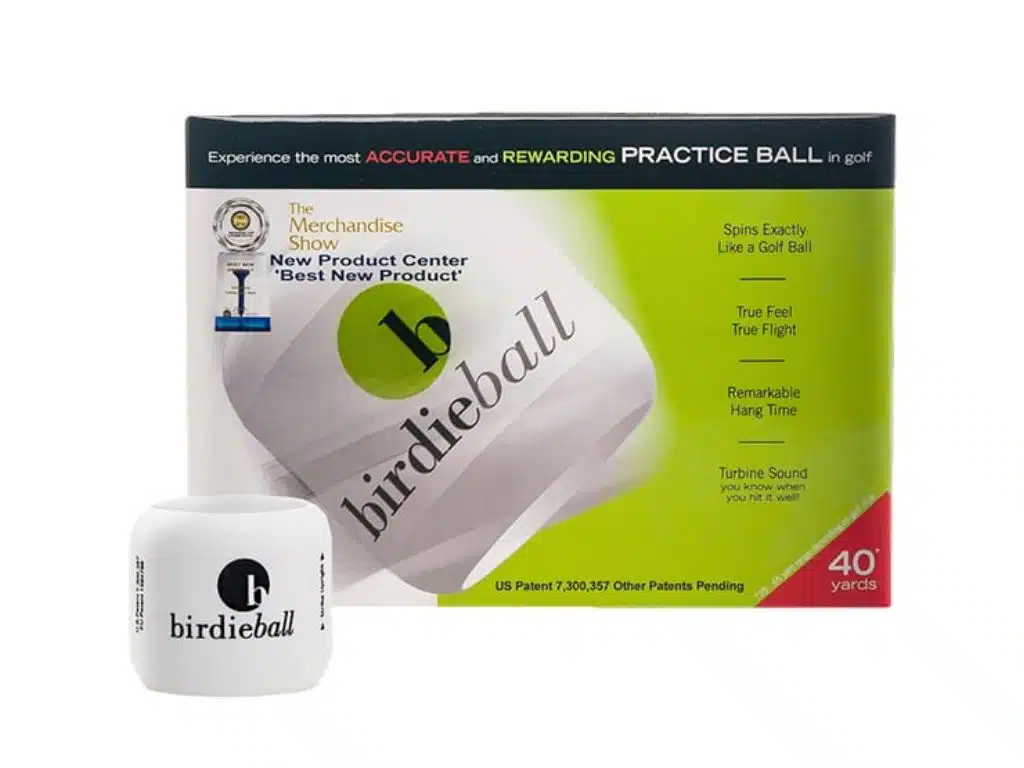
Buy BirdieBall Full-Swing Limited Flight Practice Golf Balls? Read our honest review on durability, feel, and distance control before you purchase the best backyard golf training aid.
Let's get the obvious out of the way, BirdieBall looks nothing like a golf ball. When I pulled it out of the packaging, my first thought was that someone had shipped me a plumbing part by mistake. It's a hollow cylinder, roughly the shape of a napkin ring, made from a hard PVC-like plastic that feels durable and industrial. There are no dimples, no soft urethane cover, no alignment line. It's just this odd little tube that sits flat on the ground and stares back at you like it's daring you to take a swing.
The material feels solid in your hand, definitely not flimsy. I've tested foam practice balls that disintegrate after a dozen swings, and I've used plastic ones that crack the first time you catch them thin with a wedge. BirdieBall immediately felt like it was built to take a beating. The packaging is straightforward and unpretentious, which I appreciate. No flashy marketing gimmicks, no claims about adding 30 yards to your drive. Just a simple promise: this thing flies like a real golf ball, but only goes about 40 yards. We'll see about that, I thought.

This is where BirdieBall earned my respect, and it earned it fast. I set up in my backyard with a pitching wedge, addressed the ball (which felt strange given its cylindrical shape sitting on the grass), and took a smooth swing. The sound off the clubface was clean, not the hollow plastic tick I was expecting, but something closer to an actual golf ball strike. I stood there for a second, genuinely surprised.
Over the next hour, I worked through wedges, short irons, mid irons, and even a 5-iron. Every solid strike produced a satisfying sensation that reminded me of flushing a real ball. Now, I'm not going to sit here and tell you it's identical to compressing a Pro V1; it's not. But compared to every other practice ball I've tested (and I've tested a lot), BirdieBall is in a completely different league with respect to impact feel. The hard PVC construction gives it just enough resistance that your hands register the hit the way they would on a range.
Here's what really matters, though: you can feel the bad shots too. Hit it thin, and you'll know instantly, the sound changes, the sensation in your hands is different, and the ball flight tells you exactly what happened. Fat shots chunk into the turf with appropriate disappointment. Off-center contact produces that uncomfortable vibration through the shaft. This is what separates BirdieBall from foam and wiffle alternatives. Those products mask your mistakes. BirdieBall exposes them. And if you're practicing to actually improve (not just to kill time in the backyard), that feedback loop is everything.
The realistic sound deserves its own mention. I've hit foam balls that make no sound at all, and plastic balls that produce this annoying high-pitched crack. BirdieBall gives you an audible cue that reinforces what your hands are feeling. When you pure one, you hear it. When you don't, you hear that too. It's a small detail, but it makes the practice experience feel markedly more authentic.
If BirdieBall's only trick were feeling realistic at impact, I'd call it a decent product and move on. But at this point things get genuinely impressive; this little cylinder curves through the air just like a real golf ball.
I noticed it on maybe my fifth or sixth swing. I'd been hitting a slight fade with my 8-iron all morning (a pattern I'd been fighting at the range), and sure enough, BirdieBall was drifting right with the same gentle left-to-right shape. I adjusted my grip, closed the face slightly, and the next shot drew. Not a lot, we're talking about a ball that only travels 40-odd yards, but the curvature was visible, consistent, and directly correlated to what my clubface and path were doing.
This is a pivotal development for backyard practice. With foam balls or wiffle balls, every shot kind of floats and dies in the same general direction regardless of your swing. You could hood the face 10 degrees or leave it wide open, and the ball doesn't care. BirdieBall cares. Hook it, and the ball hooks. Slice it, and the ball slices. Hit a push-draw, and that's exactly what you see sailing across your yard. The physics of the cylindrical shape somehow replicate the aerodynamic behavior of a spinning golf ball. I won't pretend to understand the engineering, but I can tell you it works.
I spent an entire afternoon working on eliminating my fade, using BirdieBall as my feedback mechanism. By the end of the session, I was consistently producing a baby draw with my irons. When I went to the range two days later with real balls, the improvement carried over. That's the supreme test of any training aid: does the work you put in translate to the course? In this case, it genuinely did.
For golfers who struggle with shot shape consistency or who want to experiment with working the ball both ways, BirdieBall provides a practice environment that's remarkably close to what you'd get at a driving range. The only difference is that your "range" is 50 yards of backyard instead of 300 yards of open field.

The core value proposition of BirdieBall is simple: practice golf where you normally can't. And on that front, it delivers exactly as advertised. On a full swing with a mid-iron, I was consistently seeing the ball travel between 40 and 55 yards before dropping softly to the ground. With wedges, I was in the 25-to-40-yard range. The flight is high enough to be visually useful; you can actually track trajectory and curvature, but short enough that you're not endangering anyone beyond your immediate practice area.
I tested BirdieBall in my backyard (which is maybe 60 yards deep), at a local park, and on a football field near my house. In all three settings, the limited flight distance made practice feel safe and manageable. I never once worried about sending a ball into traffic, through a window, or into some poor jogger's kneecap. (That last one has happened to me with a real ball at a range. Long story.)
Wind does play a factor, which is worth mentioning. On a calm day, the flight is predictable and consistent. On a breezy afternoon, the light weight of the ball means gusts can push it around more than a real golf ball would travel sideways. This isn't necessarily a negative; wind is part of golf, after all, but it does mean your distance and direction will vary more on windy days. If you're trying to do precise distance work in a gale, you might want to wait for calmer conditions.
The distance limitation is both BirdieBall's greatest strength and its most obvious trade-off. You're never going to replicate the feeling of watching a 280-yard drive split a fairway. You can't practice distance control on 150-yard approach shots. What you can do is work on the fundamentals that make those shots possible: clean contact, clubface control, consistent swing path and do it in a space no bigger than a large backyard. For most amateur golfers, those fundamentals are where the real improvement lives anyway.
Every product has a weakness, and for BirdieBall, it's this: you can't tee it up like a normal golf ball. The hollow cylindrical design means a standard tee just pokes through the middle of the ball. It sits on the ground fine for iron shots, but if you want to practice driver or fairway wood off a tee, you're out of luck without an accessory. For optimal iron practice, the recommended approach is to set it vertically on a tee so you strike through the center of the ring.
BirdieBall does sell a companion product called the Velocity Tee, which is designed to support the ball's unique shape and allow teed-up shots. I didn't test the Velocity Tee for this review, so I can't speak to how well it works. What I can say is that without it, driver practice isn't really feasible with BirdieBall. You can sweep a fairway wood off the ground with reasonable results, but anything that requires the ball sitting elevated above the turf demands the accessory.
For me personally, this wasn't a dealbreaker. I bought BirdieBall primarily for iron and wedge practice, and on that front, the product performs beautifully. But if you're someone who wants a single practice ball solution for your entire bag, driver through lob wedge, you should know upfront that BirdieBall requires additional investment and setup for teed shots. It's a design limitation that's inherent to the product's shape, and I don't see an easy way around it. Just go in with realistic expectations, and you won't be disappointed.
At roughly $4.49 per ball or $84.99 for a bucket of 50, BirdieBall sits in a price range that's going to make some golfers pause. That single-ball price is about what you'd pay for a premium golf ball like a Pro V1, and the bucket price is a meaningful investment for what is, at the end of the day, a practice aid.
Here's how I think about it, though. A single range session costs me $12-15 for a large bucket at my local range. If I go three times a week, that's $40-50 per week, or roughly $200 a month. BirdieBall's bucket of 50 pays for itself in less than a month if it replaces even half of my range sessions, and the balls are reusable indefinitely. The hard PVC construction means they don't wear out the way foam balls do, and I haven't noticed any degradation after hundreds of strikes.
The durability factor is consequential. I've gone through multiple packs of foam practice balls that fall apart within weeks. The little plastic wiffle-style balls crack and lose their shape. BirdieBall looks and performs the same after extensive testing as it did out of the package. The thick plastic construction is tough enough to withstand impacts against asphalt and wooden fences without showing damage, which speaks to the quality of materials they're using. When you factor in the long-term cost per use, the value equation starts to look very favorable, especially for golfers who practice frequently and want to supplement (not replace) their range time.
That said, if you're a casual golfer who only practices occasionally, the single-ball option at $4.49 is probably the smarter move to start. Buy one, test it, see if it fits your practice routine. If it clicks, then invest in the bucket.
Buy BirdieBall Full-Swing Limited Flight Practice Golf Balls? Read our honest review on durability, feel, and distance control before you purchase the best backyard golf training aid.
Yes, you can absolutely use BirdieBalls with an indoor hitting net. BirdieBall literally sells its own portable driving range net for exactly this. Just make sure you've got enough room: roughly 10 ft long, 8 ft wide, and 8 ft tall, so your backswing doesn't smack a ceiling fan. Use a heavy-duty net, not some flimsy Amazon special. The real limitation isn't the ball; it's your space and setup.
You'll get a few hundred solid shots out of a set before they start cracking, that's the honest answer. No one's giving you a precise month count because it depends entirely on how hard you swing and how often you practice. Cold weather (below 45°F) kills them faster, and high club speeds accelerate the breakdown. Once they crack, toss them. They're durable for practice balls, but they're not immortal.
BirdieBalls are safer than real golf balls around kids, but they're not harmless. They still travel up to 40 yards with real force behind them, so a kid standing in the swing path is getting stung. Keep children completely out of the hitting zone, supervise every session, and don't let younger kids swing unsupervised. The durable polymer won't shatter like cheap foam alternatives, which helps. Smart precautions make all the difference here.
They work okay in wind, but don't expect perfection. BirdieBalls are noticeably more affected by wind than real golf balls; you'll see shots drift off line, especially at longer carries near that 40-yard max. That said, you can still read your swing mechanics, spot hooks and slices, and dial in tempo. Just don't use windy sessions to judge distance or shot shape accuracy. Swing practice? Great. Precision testing? Nah.
Check Amazon and the official BirdieBall store initially; both carry the standard 12-pack. If you're buying more than a dozen, look for the add-on deal where a second dozen drops to $19.99. That's the best per-ball price I've seen for small quantities. For serious practice, the 50-pack at $84.99 is your smartest move. Walmart sells a 3-pack, but honestly, that's overpriced per ball.
So, is BirdieBall for everyone? No. If you're looking for a cheap foam ball to chip around the living room, this isn't it. If you need a full driver-through-wedge practice solution in one product without accessories, BirdieBall has a gap you should know about. And if you're expecting a perfect 1:1 replica of hitting a real golf ball at a real range, you're setting yourself up for disappointment; nothing short of actually hitting golf balls will give you that.
But if you're a golfer who wants to work on contact quality, clubface control, and swing path in your backyard, at a park, or anywhere with 50-60 yards of space, and you want feedback that's actually meaningful. I don't think there's a better practice ball on the market right now. BirdieBall does what it promises. It flies like a golf ball (just shorter), it feels like a golf ball (remarkably so), and it curves like a golf ball (which is the part that matters most for improvement). I came into this review skeptical about a napkin ring masquerading as a golf ball, and I'm walking away with it permanently in my practice bag. That's about the highest compliment I can pay any training aid.