The Performance Golf SF2 Driver genuinely fixes slices better than anything else at its $350 price point. Its 3-degree closed face, deep heel weighting, and shorter counterbalanced shaft work together to keep your drives in the fairway. The forged titanium build feels legit, not cheap. But here's the catch: those "20–30 extra yards" mostly come from eliminating slice distance loss, not raw power gains. The full breakdown below covers exactly who should and shouldn't buy it.
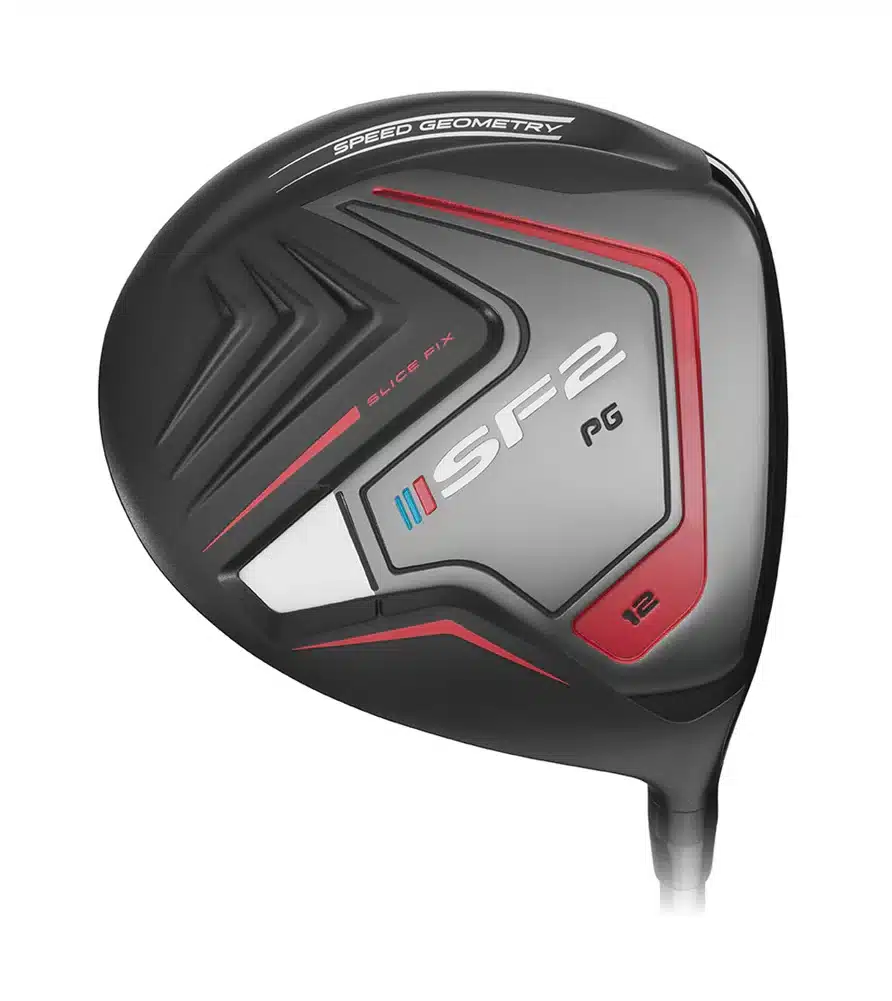
Crafted for serious golfers, the Performance Golf SF2 Driver features a next-generation titanium face and precision tuning. Maximize energy transfer at impact for unmatched distance. Upgrade your golf gear and lower your scores this season.
The first thing I noticed pulling the SF2 out of the box was that it didn't look like a gimmick club. And trust me, that matters. I've tested enough "game-improvement" drivers that look like they were designed in a garage to know that aesthetics play a role in confidence at address. If a club looks weird, you're going to feel weird standing over it, and that mental hesitation bleeds into your swing whether you want it to admit it or not.
The SF2 has a clean, modern look with a 445cc head that sits beautifully behind the ball. It's not quite the full 460cc you'll find on most major OEM drivers, but it's close enough that it doesn't feel small. The dark crown and overall shaping reminded me more of a mainstream Callaway or TaylorMade head than something from a direct-to-consumer brand. At the address, you can notice the slightly closed face if you're really looking for it, but it's subtle, not the kind of dramatic hood that makes you feel like you're aiming into the left trees.
The shaft felt solid in my hand, with a counterbalanced design that gave the club a different swing feel than I'm used to. More on that later. Overall, initial impressions were genuinely positive. This felt like a $350 driver, not a $150 one pretending to be premium.

Let me take you back for a moment. When I tested the original SF1, my biggest gripe wasn't the slice-fixing technology; it was the materials. The SF1 used aluminum construction, and while that's not inherently terrible, it produced a sound and feel at impact that just didn't inspire confidence. It felt hollow in a bad way. Every time I made contact, there was this tinny feedback that screamed "budget club."
The SF2 fixes this problem entirely with a 3-piece forged titanium construction, and the difference is night and day.
Forged titanium is the same material family you'll find in drivers from Titleist, Callaway, TaylorMade, and Ping. It's stronger, lighter, and more responsive than aluminum, which means the engineers can make the face thinner without sacrificing structural integrity. A thinner face flexes more at impact, which translates directly into ball speed. And ball speed, as any club fitter will tell you, is the single biggest factor in how far you hit the ball.
When I took my first swing with the SF2, the difference in feel was immediately apparent. The sound off the face was a satisfying, mid-pitched crack, not booming like some hot-faced drivers, but confident and clean. It felt like the ball was jumping off the face rather than being pushed off it. That's the titanium doing its job.
The 3-piece construction also allows Performance Golf to strategically place weight in specific locations throughout the head, which plays directly into the slice-correction features I'll get into next. It's a smarter design than the SF1 in every way, and honestly, it's the upgrade that makes this club worth taking seriously as a legitimate driver, not just a training aid with a loft on it.
Alright, let's talk about the headline feature, the anti-slice technology. Because this is what you're really here for, right? You want to know if this thing can actually straighten out that banana ball that's been ruining your tee shots for the last five years.
Here's what Performance Golf has done, and I want to break it down clearly because it's not just one trick, it's a system of features working together.
Initially, the 3-degree closed face angle. At address, the face is already pointing slightly left of your target line (for a right-handed golfer). This means that even if you deliver the club with an open face, which is exactly what slicers do, you're starting from a position that's 3 degrees closer to square than a neutral driver. That alone won't fix a 30-yard slice, but it's a meaningful head start.
Second, the deep heel weighting. This is where the physics gets interesting. By placing concentrated weight deep in the heel of the clubhead, Performance Golf has shifted the center of gravity toward the heel side. Why does that matter? Because when the center of gravity is closer to the heel, the clubhead naturally wants to rotate closed through impact. It's the same principle that draw-biased drivers from Callaway (like the Paradym X) and TaylorMade (like the Qi10 Max D-Type) use, but the SF2 pushes it further than most mainstream options.
Third, the flatter face bulges toward the heel. This one's more subtle, but it matters. Bulge is the horizontal curvature across the face of a driver. By flattening the bulge on the heel side, the SF2 reduces the gear effect that would normally push heel-struck shots further right. Since slicers tend to make contact toward the heel (because the face is open and the path is out-to-in), this design choice specifically targets where slicers actually hit the ball.
When I put all of this together on the range, the results were genuinely impressive. My natural ball flight with a neutral driver tends to be a slight fade, sometimes a push-fade when I'm tired or lazy with my rotation. With the SF2, that push-fade turned into a straight ball or a gentle draw on the majority of swings. On my worst swings, the ones where I knew I came over the top, the ball still started right but curved back toward center instead of diving into the next fairway.
Did it completely eliminate every slice? No. If you have a severely out-to-in path with a wide-open face, no equipment is going to fully save you. But for the average recreational slicer who loses 8–20 yards to the right on most drives, this club does exactly what it promises. The anti-slice effect is real, and it's the most aggressive draw bias I've tested in a driver at any price point.

Here's a feature that doesn't get enough attention in marketing but made a real difference in how this club performed for me: the counterbalanced shaft.
A counterbalanced shaft has extra weight added near the grip end of the club, which effectively raises the balance point of the entire club. The practical effect is that the clubhead feels lighter relative to the grip, which gives you more control over the club's path and face angle through the swing. For slicers, this is a sneaky-smart addition because one of the biggest reasons golfers leave the face open at impact is that they can't control the rotation of a heavy clubhead through the hitting zone.
At 45 inches, the shaft is also slightly shorter than the standard 45.5 - 46-inch shafts you'll find in most modern drivers. That half-inch difference might sound trivial (and honestly, I thought it would be), but shorter shafts consistently produce better contact patterns. There's plenty of data from club fitters showing that most amateurs hit the center of the face more often with shorter drivers, and center contact is where you get maximum ball speed and the most predictable flight.
The combination of the counterbalanced design and shorter length gave me a feeling of being genuinely "connected" to the clubhead throughout the swing. I felt like I knew where the face was at every point in my backswing and downswing, which is not something I can say about every driver I test. For a golfer who struggles with timing and if you're slicing, you almost certainly have a timing issue, this shaft design is quietly doing a lot of heavy lifting.
Okay, here's where I need to pump the brakes a little on the marketing hype. Performance Golf advertises distance gains of 20–30 yards with the SF2, and their product page even includes a chart mapping swing speeds to expected distances (ranging from 250+ yards for 100+ mph swingers down to sub-175 yards for those under 70 mph).
Are those numbers possible? Yes. Are they guaranteed? Absolutely not.
Here's the subtlety that the marketing glosses over. If you're currently losing 15–20 yards to the right because your ball is slicing into the rough (or worse), then straightening out that ball flight absolutely can recover 20+ yards of effective distance. You're not actually swinging faster or generating more ball speed; you're just wasting less energy on sidespin. That's a legitimate gain, but it's different from the club somehow adding 30 yards of raw distance to a straight ball.
During my testing, my longest carry was 214 yards with a total distance of 220 yards. For context, my typical driver carry with a mainstream OEM driver is around 230-235 yards, so the SF2 wasn't outdriving my gamer. However, and this is crucial, my dispersion with the SF2 was appreciably tighter. The shots that would normally leak right stayed in play, and that consistency matters way more on the course than one extra-long drive.
I watched several independent YouTube reviews of the SF2, and the consensus matched my experience: the anti-slice effect is genuinely effective and delivers on its promise, but the "gain 35 yards" headline is aggressive and depends heavily on how bad your slice is to begin with. If you're hitting it relatively straight already, you're not going to see massive distance jumps. If you're currently losing a ton of yardage to a slice, the SF2 could legitimately feel like you found 20+ yards because you did, just not in the way the marketing implies.
My advice? Focus on the slice-fix promise. That's where this club performs. The distance gains will come naturally as a byproduct of straighter shots, but don't buy this expecting it to suddenly turn you into a 280-yard bomber.
Crafted for serious golfers, the Performance Golf SF2 Driver features a next-generation titanium face and precision tuning. Maximize energy transfer at impact for unmatched distance. Upgrade your golf gear and lower your scores this season.
The short answer: we can't confirm it's legal. The SF2 doesn't appear on the USGA conforming driver heads list based on available evidence, and that list is the only thing that matters for tournament play. Marketing hype isn't proof. If you're playing in any USGA-sanctioned event, you need to check the USGA Equipment Database yourself before teeing up with it.
The SF2 comes with a counterbalanced stock shaft; no aftermarket menu here. You're picking from weight tiers: 65g for 100+ mph swingers, 60g for 90-100 mph, 57g for 80–90 mph, and 50–55g for under 80 mph. Standard build length is 45 inches. It's a fitting-by-speed approach, not a choose-your-own-adventure shaft wall. Simple, but it gets the job done for most players.
Not exactly. The SF2 Driver comes with a 365-day return warranty, which isn't the same as a traditional manufacturer's warranty covering defects. The product page doesn't spell out whether it covers manufacturing flaws, performance issues, or both, and it doesn't list exclusions or a claims process. Compare that to Callaway or TaylorMade, which offer clear two-year defect warranties. You're basically getting a return window, not ironclad defect coverage.
Based on current listings, the SF2 Driver only appears in right-handed configuration. No left-handed version showed up on Performance Golf's product page or any third-party retailer. That's frustrating if you're a lefty, but it's the reality. Your best bet is contacting Performance Golf directly to confirm, maybe they've got something unlisted. Otherwise, you're looking at alternative anti-slice drivers.
Performance Golf backs the SF2 with a 365-day, no-questions-asked refund policy you get 100% of your money back. No restocking fee nonsense. Just email [email protected] within a year of purchase, and they'll send return instructions, and you ship it back. You can also call 1 (833) PG1-GOLF. That's a seriously generous window, so there's zero risk in trying it out.
So, who is the Performance Golf SF2 Driver actually for?
It's for the golfer who has tried draw-bias settings on mainstream drivers and still slices it. It's for the player who knows their swing isn't perfect and maybe isn't going to be, but still wants to enjoy their tee shots instead of dreading them. It's for the mid-to-high handicapper who has spent years fighting a right-to-right ball flight and is ready for a club that commits fully to solving that problem, not one that offers a mild draw bias as an afterthought.
It is not for the single-digit handicapper who wants maximum adjustability and tour-level workability. It's not for the golfer who already hits it straight and just wants more distance. And it's not for the equipment junkie who needs the latest and greatest from the big-name brands to feel confident on the tee.
If you fall into that first group, the frustrated slicer who just wants to find more fairways, the SF2 is one of the most purpose-built solutions I've ever tested. The anti-slice technology is real, the titanium construction is a legitimate upgrade, and the overall package performs on the core promise. Just keep your distance expectations grounded in reality, and you'll be pleasantly surprised by what this club can do for your game.