
TrackMan leads the pack for outdoor accuracy with dual radar capturing 40,000 samples per second, while Foresight's GCQuad dominates indoors using four cameras that deliver 0.2 mph clubhead speed precision for $14,500. GolfZon's TwoVision+ stands out with its unique moving swing plate and floor sensors that track 24 different stances. You'll find complete commercial setups ranging from $10,000 DIY installations to $30,000 turnkey packages, and each brand pairs with software like E6 APEX or GSPro to access hundreds of courses, but the right choice depends on your specific facility needs.
When you're outfitting a commercial golf facility, accuracy isn't just a nice-to-have feature; it's the foundation of your entire business model. The reality is: your customers will immediately notice if the numbers don't match reality.
The Uneekor Eye XO2 leads the pack for gyms and country clubs, using dual cameras plus IR tracking to deliver consistent results. For multi-bay setups, ProTee VX offers camera-based precision without subscription fees eating into your profits. FlightScope Mevo+ brings radar technology to entry-level facilities, while Foresight Falcon's three-camera system costs $14,999, delivering GCHawk accuracy at half the size. TruGolf Vista's overhead monitors (available in 8, 10, and 12 models) pair seamlessly with E6 Commercial software, giving you access to 200+ courses. These systems provide accurate feedback on ball flight, club path, and swing metrics that are essential for golfers tracking their progress. The Garmin R50 provides extensive features and accuracy for under $5,000, making it a cost-effective option for facilities looking to balance performance with budget constraints.

You've narrowed your search to the top tier, and now you're facing the classic premium simulator showdown: TrackMan, Foresight, or GolfZon. The reality is—each excels differently. Foresight's GCQuad ($14,500) dominates indoor accuracy with 0.2 mph clubhead speed variation versus TrackMan's 0.8 mph, plus it nails mis-hits consistently. TrackMan 4 ($20,000+) captures 40,000 radar samples per second, making it unbeatable outdoors with 40+ swing metrics. GolfZon TwoVision+ splits the difference, blending dual cameras with floor motion sensors for immediate feedback and 200+ high-definition courses. If you're building an indoor teaching facility, Foresight's photometric cameras deliver surgical precision. Foresight's quadrascopic imaging uses multiple high-speed cameras working together to reconstruct every shot in 3D. Need outdoor versatility and exhaustive data? TrackMan's your answer. Want immersive entertainment with solid performance? GolfZon balances both worlds beautifully. GolfZon's 24-position moving swing plate replicates uphill lies, downhill angles, and sidehill stances that TrackMan and Foresight can't simulate.
Every elite golfer chasing tour-level precision eventually bumps into the same question: Should I trust radar, cameras, or both? The crucial point, dual radar systems like TrackMan 4 track your entire ball flight for six seconds using Doppler microwave signals, measuring speed, spin, and path from tee to green. Cameras capture thousands of images per second, zeroing in on club head speed, face angle, and impact precision. The Foresight GCQuad's four-camera setup reads ball dimples for simpler calculations, while radar needs 8-10 feet of space behind you. Hybrid units like the FlightScope X3C combine both technologies, providing unmatched accuracy indoors and outdoors. TrackMan's patented optically enhanced radar tracking technology merges dual radars with a camera to pinpoint exact impact location on the clubface, a precision level other systems can't match. Radar systems achieve accuracy within 2-3% of actual values when properly calibrated in optimal conditions. That's why tour pros carry both systems during practice, they're extracting every possible data advantage!
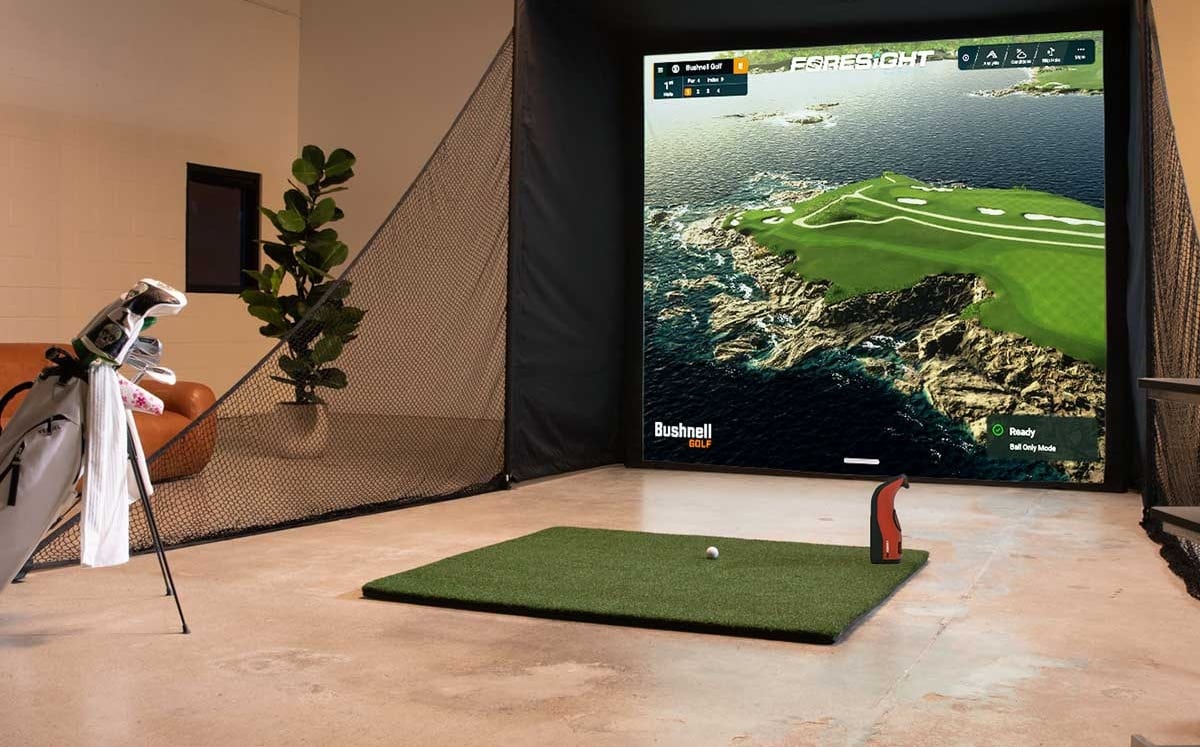
Once you've locked down your launch monitor and tracking system, the real fun begins, choosing software that reveals hundreds of world-class courses right from your garage or game room.
GSPro leads the pack with a massive, growing library of user-designed courses. You'll get photorealistic graphics, pinpoint ball flight accuracy, and community features that let you build custom layouts, all at a more affordable price than competitors.
The Golf Club 2019 takes selection to another level, offering over 100,000 virtual courses. That's practically every course imaginable, plus design-your-own capabilities.
For classic championship experiences, E6 CONNECT delivers Pebble Beach and other famous layouts with detailed club data tracking. Its successor, E6 APEX, bumps everything to 4K resolution with considerably improved graphics and game improvement features. E6 APEX harnesses Unreal Engine 5 technology to render courses with stunning photorealistic detail. Beyond visuals, these software platforms provide swing analysis and feedback that help identify specific areas for improvement in your game.
The $10,000 to $20,000 range represents a sweet spot where commercial-grade technology meets realistic pricing for serious enthusiasts and small business owners. You're looking at professional launch monitors like the GCQuad or TrackMan iO that actually measure what matters: clubhead speed, ball spin, and launch angle with radar precision. Here's what your budget gets you: a complete package with ballistics-grade impact screens, SIG Golf enclosures (available in multiple sizes), SwingTurf hitting mats, and integrated projectors. DIY installations start around $10,000 if you're handy, while turnkey setups run $20,000 to $30,000 with professional assembly. The TruGolf Apogee drops to $8,100 with promo codes, making it an affordable overhead option. You'll get tracking accuracy that rivals six-figure systems without the crazy price tag. Ensure your setup space meets the minimum dimension requirements of at least 10 feet high, 14 feet wide, and 18 feet deep for safe, comfortable swinging. Beyond the upfront investment, minimal maintenance costs make these systems economical to operate long-term.
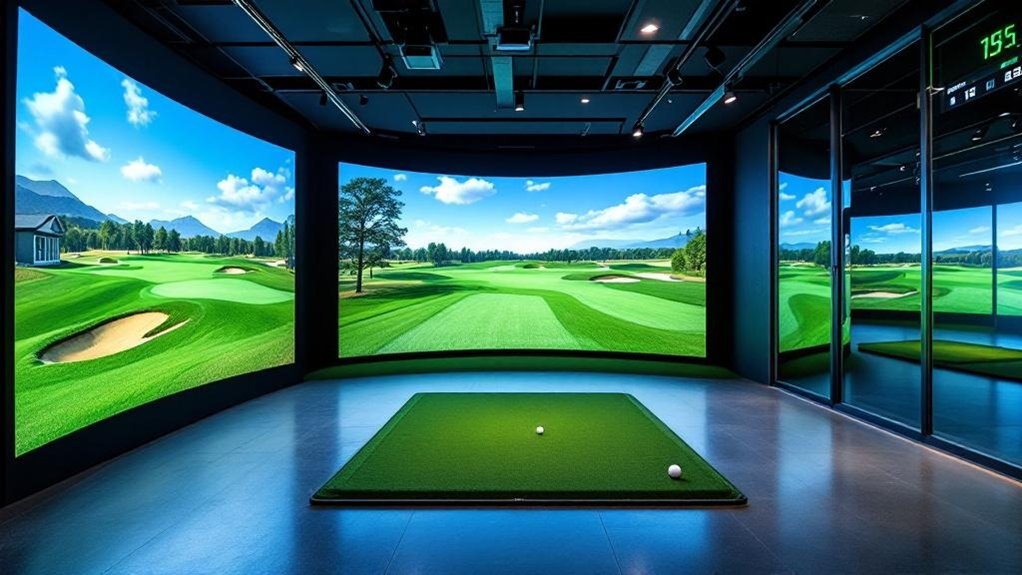
For home use, you'll want the Uneekor EYE MINI Lite with a DIY enclosure, or grab the Mevo Gen2 if you're watching your budget; it's thousands less than competitors. The Garmin Approach R10 works great for budget-conscious setups, while Rapsodo MLM2PRO nails entry-level performance.
On the commercial side, the Uneekor EYE XO2 delivers high-end experiences, and Trackman iO dominates luxury facilities. ProTee VX excels for multiplayer environments, starting around $19,999 with pro-grade features.
Yes, you'll need a separate computer for most golf simulator setups. Launch monitors like Trackman, Skytrak, and Garmin don't include a PC; they're just tracking devices. You'll need a Windows gaming PC that meets your software's specs. For example, FSX Pro requires at least an Intel i5 processor, 16GB RAM, and an NVIDIA RTX 3060 graphics card. Budget around $1,000-$2,000 for a capable machine that'll run everything smoothly!
You'll need a minimum ceiling height of 8.5 to 9 feet, but 10 feet is ideal if you're tall or swing aggressively. For room size, start with at least 10 feet wide by 10 feet deep, though 12-15 feet wide and 16-18 feet deep feels much better. High-end systems like Trackman require 15 feet wide and 18 feet deep for accurate tracking. Basically, bigger rooms give you more freedom and better data!
Most golf simulators work best indoors, but some can handle outdoor use with limitations. TrackMan 4's radar technology functions well outside since it's similar to weather forecasting systems, and portable monitors like Mevo+ and SKYTRAK ST+ support outdoor setups with nets. However, camera-based systems struggle outdoors because sunlight interferes with sensors, projectors wash out, and weather affects accuracy. You'll get the most reliable performance in a controlled indoor space.
You'll need to calibrate your golf simulator sensors every 3-6 months, depending on how often you use them. Before tournaments or significant practice sessions, run a quick calibration check to guarantee accuracy. For maintenance, clean your sensors monthly to prevent dust buildup, update software whenever manufacturers release patches, and check your lighting conditions weekly. If you notice tracking issues or wonky ball flight data, that's your system telling you it needs attention right away!
You've got the facts, the features, and the price breakdowns; now it's decision time. If you're running a commercial facility, you can't go wrong with TrackMan's dual-radar precision or Foresight's camera-based consistency. Both deliver tour-level data that your customers will notice. GolfZon brings solid value if you're budget-conscious but still want realistic gameplay. The key point is: your choice depends on space, goals, and how much accuracy you're after!

