If you've ever squinted at a tiny watch screen trying to figure out whether you're looking at 147 or 174 yards, you know the frustration. For years, I've bounced between wrist GPS units, laser rangefinders, and phone apps trying to find the perfect on-course distance solution. Each one had its tradeoffs; the watch was convenient but hard to read, the laser was precise but slow, and the phone app drained my battery by the back nine. So when Shot Scope dropped the H50 handheld GPS with a 4.3-inch AMOLED touchscreen, I was genuinely curious. Could a dedicated handheld unit actually be the sweet spot I'd been missing? I spent several rounds with the H50 clipped to my cart, tucked in my pocket, and cradled in my hand to find out.
While the manual shot-tracking process demands explicit player inputs, its backend integration with the Shot Scope ecosystem is robust. Syncing with the companion app unlocks over 100 deep performance metrics, including core Strokes Gained statistics.
Let me just get this out of the way upfront: the display on the Shot Scope H50 is stunning. I've tested a lot of golf GPS devices over the years: Garmin watches, Bushnell handhelds, SkyCaddie units, and the H50's 4.3-inch AMOLED screen is in a class of its own for a device at this price point. The colors are vivid, the contrast is sharp, and yardage numbers pop off the screen even in direct midday sunlight. That last part is critical, because I've used devices that looked great indoors and turned into washed-out mirrors the moment I stepped onto the course.
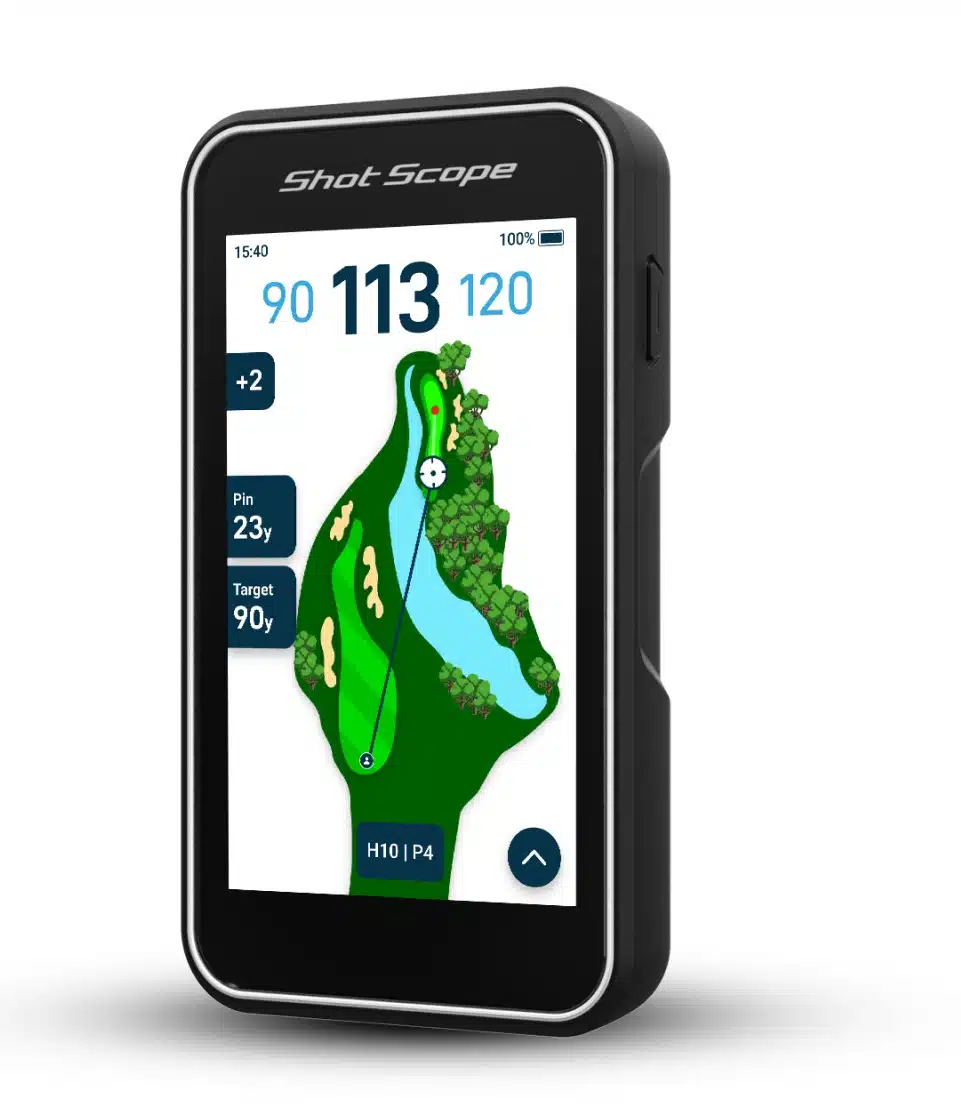
What really sets this screen apart is how it upgrades the way you interact with course information. On a watch, you're getting numbers. That's it. Front, middle, back, maybe a tiny green outline if you're lucky. On the H50, you're looking at full-color hole maps that actually show you the shape of the fairway, the positions of bunkers, water hazards, and tree lines. It's the difference between reading a spreadsheet and looking at a photograph.
I noticed this most on dogleg holes and blind shots. Standing on the tee of a tight par four I'd never played before, I could see exactly where the fairway narrowed, where the trouble was on the left, and how much room I had to bail out right. That kind of visual information is worth more than a single yardage number, and the H50 delivers it in a way that's immediately intuitive. You don't need to be tech-savvy to glance down and understand what you're looking at.
The touchscreen responsiveness is solid, too. I was able to tap on specific spots, a bunker lip, a layup area, and the front edge of a pond, and get instant distance readings. It's not laggy, it doesn't require aggressive pressing, and it works fine even with a light golf glove on. If you've ever fumbled with tiny buttons on a GPS device while your playing partners are waiting, you'll appreciate how seamless this feels.

A gorgeous screen means nothing if the numbers on it are wrong. I'll be honest. I had my doubts about how a GPS-only device would hold up against my laser rangefinder for accuracy. Lasers give you that pinpoint confidence, and I've used GPS devices in the past that were off by five, sometimes ten yards. That's the difference between sticking a green and flying it into a back bunker.
The H50 uses dual-band GPS, which connects to multiple satellite frequencies simultaneously for faster lock-on and more precise positioning. In practice, I found the yardages consistently within one to two yards of my Bushnell laser readings. On open holes with clear sightlines, the numbers were virtually identical. Where the H50 actually had an advantage was on blind approach shots and elevated tee boxes, where I couldn't get a clean laser read on the flag. The GPS just gave me the number, no hunting for a reflective target, no shaky hands, no waiting.
The plays-like distance feature is another layer of intelligence that I found genuinely useful. If you're playing a mountain course or any layout with considerable elevation change, raw yardage is only half the story. The H50 adjusts your distances based on whether you're hitting uphill or downhill, which takes the guesswork out of club selection. I played a course with about 200 feet of elevation change across 18 holes, and the plays-like numbers matched my intuition almost perfectly, but without the mental math I usually have to do.
Front, middle, and back distances are always displayed prominently, and the pin placement tool lets you drag the flag position on the green to get a more specific number. Combined with the green contour overlays that show slope and undulation, you're getting approach-shot intelligence that used to require a caddie or a $500 laser with slope built in.
This is where the H50 really separates itself from watches and basic handhelds, and honestly, it's the feature that surprised me the most. I've always been a numbers guy on the course; give me the yardage and I'll figure out the rest. But after using the H50's full-screen hole maps for several rounds, I realized how much strategic information I'd been leaving on the table.
Each hole is displayed as a detailed overhead map that fills the entire 4.3-inch screen. You can see fairway boundaries, bunker placements, water hazards, cart paths, and out-of-bounds lines, all rendered in high resolution with clear color coding. It's like having a caddie's yardage book built into your GPS, except it updates automatically as you move down the hole.
The auto hole zoom feature deserves special mention. As you walk (or ride) from the tee toward the green, the H50 automatically adjusts the map view to keep the most relevant information on screen. Off the tee, you see the full hole layout for strategy. As you approach your second shot, it zooms into the landing area and green complex. I didn't have to pinch, swipe, or tap to get the view I needed; it just anticipated where I was in the hole and adjusted accordingly. It's a small thing, but it makes the device feel like it was designed by people who actually play golf.
Where this really paid off was on unfamiliar courses. I played two rounds at tracks I'd never seen before, and the hole maps fundamentally eliminated the "where do I aim?" uncertainty that usually costs me a few shots per round. On one par five with a hidden creek crossing the fairway at about 240 yards, the map showed me exactly where the hazard was and how far I needed to lay up. Without it, I would have bombed driver and probably found water. (My playing partner did exactly that.)
The green view and contour information add another strategic dimension. When you're within approach range, you can pull up a detailed view of the green showing slopes, ridges, and fall-off areas. I found this most useful for deciding where to miss, which, if we're being honest, is the most crucial decision most of us amateurs make on approach shots.

Let's talk about the elephant in the room with golf GPS devices: ongoing costs. Some of the most popular GPS watches and handhelds on the market now require annual subscriptions for premium features like green contours, slope data, or detailed course maps. Those fees can run $50 to $100 per year, and they add up fast. After three or four years, you've essentially paid for the device twice.
The Shot Scope H50 comes with everything included, no subscription, no premium tier, no paywalled features. The 42,000+ preloaded courses, the green contours, the plays-like distances, the hole maps, all of it is available from the moment you turn the device on. Shot Scope also claims they update course maps within 48 hours of receiving changes, which means you're not stuck with outdated information if your home course renovates a bunker or moves a tee box.
I checked this claim by looking up a couple of courses that had recent renovations, and the maps were current. I can't independently verify the 48-hour turnaround, but the data I encountered was accurate and up to date. For golfers who play a wide variety of courses, travelers, buddy trip regulars, and anyone who books tee times through an app, having 42,000 courses preloaded without worrying about download limits or subscription tiers is a legitimate advantage.
Over a five-year ownership window, the no-subscription model could save you $250 to $500 compared to competitors that charge for similar feature sets. That's real money, and it makes the H50's upfront price markedly easier to justify.
A golf GPS device has to survive real-world conditions, and the H50 is built with that in mind. The 15+ hour battery life means you can comfortably get through three full rounds on a single charge, which is perfect for golf trips where you might play 36 holes in a day and not have easy access to a charger between rounds. I used the H50 for two consecutive rounds without recharging and still had over 40% battery remaining. That's reassuring.
USB-C charging is a welcome addition. I know that sounds like a minor detail, but if you've ever been on a golf trip and realized you left your proprietary charging cable at home, you know the panic. USB-C means you can borrow a cable from almost anyone, charge from a portable battery pack in the cart, or use the same cable that charges your phone. It's a small design choice that shows Shot Scope is thinking about practical convenience.
The IPX7 waterproof rating means the H50 can handle rain, morning dew, and the occasional splash from a water hazard retrieval attempt. (Don't judge, we've all been there.) I played one round in steady drizzle, and the touchscreen continued to function normally with water droplets on the surface. The device didn't fog up, and I didn't feel like I needed to baby it.
The cart magnet mounting system is a nice touch for riders. The H50 has a built-in magnet that lets you stick it to your cart frame for easy viewing while you drive. It held securely on the two different cart models I tested it with, even over bumpy cart paths. For walkers, the device fits comfortably in a hand or a pocket, though it's noticeably larger than a phone; you'll want a bag pocket or a clip rather than trying to shove it in your pants. The device also supports both portrait and landscape modes, so you can switch orientations depending on whether you're using a bag clip or cart mount.
While the manual shot-tracking process demands explicit player inputs, its backend integration with the Shot Scope ecosystem is robust. Syncing with the companion app unlocks over 100 deep performance metrics, including core Strokes Gained statistics.
It's waterproof, IPX7 rated, to be specific. That means it can handle temporary immersion, not just a few raindrops. You're totally fine playing through downpours and nasty weather. Shot Scope even calls it "shower proof" in their support docs. Just don't slather it in sunscreen or soak it in chemicals, and don't go diving with it. Bottom line: rain's no problem whatsoever.
You're looking at 15+ hours per charge, which realistically covers two to three full rounds before you need to plug in. One user squeezed seven rounds out of a single charge and still had 56% left; that's impressive. The big battery killer is that 4.3-inch AMOLED screen, so dial down brightness and use auto-dim. It charges via USB-C, though some folks report quirks with USB-C to USB-C cables.
Yes, it comes with a 2-year manufacturer's warranty from the date of purchase. If it fails or breaks within that window, Shot Scope will fix or replace it for free. No activation required, you're covered the moment you buy it. Pretty standard stuff, but honestly, not every brand makes it this hassle-free. Some retailers also offer optional extended protection plans separately, but the stock warranty is solid enough for most people.
Not directly, no. You can't just hop on Wi-Fi and pull down a firmware update straight from the H50 itself. You'll need the Shot Scope app on your phone or tablet to handle the process. The app uses your phone's Wi-Fi connection to download the update, then pushes it to the H50 over Bluetooth. Make sure your battery's at least 25% before starting.
You get four things in the box: the H50 handheld itself, a premium bag clip for attaching it to your golf bag, a USB-C charging cable, and a cleaning cloth. That's it. No wall charger, no case, no screen protector, just the necessities. Honestly, the bag clip's a nice touch since most competitors make you buy that separately. You'll need your own USB-C wall adapter, though.
So, is the Shot Scope H50 for everyone? No, and that's fine. If you're a golfer who wants the absolute smallest, most unobtrusive distance device, a GPS watch is still your best bet. If you live and die by laser precision and love the point-and-shoot ritual, a rangefinder will continue to serve you well.
But if you're a visual golfer, someone who thinks in shapes, angles, and course strategy rather than just raw numbers, the H50 is one of the best tools available right now. It converts every hole into a strategic puzzle you can actually see, and it does so with a screen that's genuinely enjoyable to look at. Add in the no-subscription model, reliable GPS accuracy, and a battery that lasts for days of golf, and you've got a handheld GPS that punches well above its weight. I came into this review mildly curious. I'm walking away genuinely impressed.