I've tested a lot of putting aids over the years. Rails, mirrors, gates, laser guides, you name it, I've probably had it sitting on my office carpet at some point, rolling ball after ball while pretending I was grinding on the practice green at Augusta. Most of them end up in the same place: the bottom of my golf bag, forgotten, buried under a handful of tees and a sleeve of range balls I accidentally stole from the driving range.
So when the Putter Wheel showed up and I pulled it out of the packaging, I'll admit my first reaction was somewhere between genuine curiosity and a healthy dose of "you've got to be kidding me." It doesn't look like any training aid I've used before. It looks like someone took a golf ball, sliced off two sides, and said, "Yeah, that's the product." A little tire. A tiny wheel. A golf ball that went through a belt sander.
But here's the reality after spending a few weeks rolling this odd little disc around my putting mat and then dragging it to the practice green, I'm convinced it does something that most putting aids don't. It tells you the truth about your stroke, and it does it instantly, with zero ambiguity. Whether you want to hear that truth is another matter entirely.
Let me break down exactly what this thing does, who it's for, and whether it's worth the price tag.
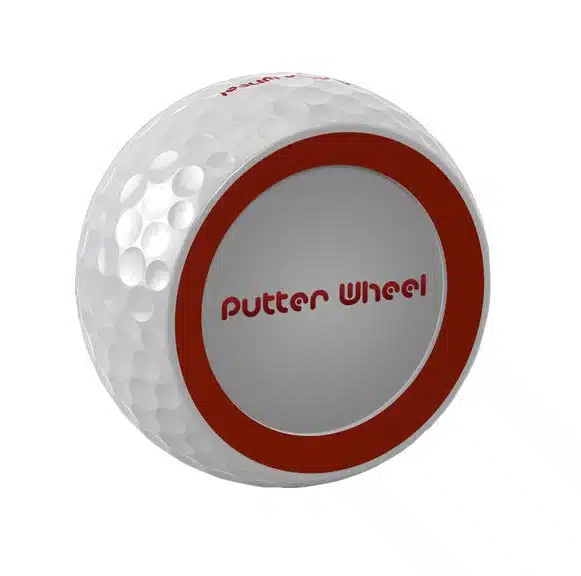
Dial in your stroke with the PutterWheel Golf Ball Putting Training Aid. Its unique wheel design gives instant feedback on your alignment and face angle. If you misstrike, it wobbles! Perfect your roll, build muscle memory, and drain more putts.
When you open the sleeve, and yes, it comes in a sleeve like actual golf balls, the first thing you notice is the weight. The Putter Wheel is designed to replicate the mass and dimensions of a standard golf ball, and it genuinely does. It sits behind your putter face and feels like you're about to hit a real putt. That's a detail that matters more than you might think, because plenty of training aids feel so foreign that whatever feedback they provide doesn't translate to actual putting.
The wheel itself has a flat profile with red beveled edges running along its perimeter. It's a clean, purposeful design, not flashy, not gimmicky-looking once you get past the initial "what is this?" moment. Mine came in a pack with multiple wheels and a ball-marking stencil tool, which I'll get to later. The whole package feels like a product someone actually thought about rather than something slapped together to ride an Instagram ad wave. The outer shell is made from a composite material that gives it a durable yet realistic feel in hand. I was impressed enough during the unboxing to give it an honest shake, which, if I'm being real, is more than I can say for a lot of the training gadgets that cross my desk.

Here's where the Putter Wheel earns its keep: feedback. And not the gentle, "oh, that was a little off" kind of feedback. I'm talking about the kind that makes you mutter things under your breath and immediately set the wheel up for another attempt.
The concept is beautifully simple. Because the Putter Wheel has a cutaway profile, flat sides rather than the full roundness of a golf ball, it is dramatically less forgiving of off-center contact or a crooked stroke path. When you strike it cleanly, with a square face and center contact, it rolls forward smoothly and tracks straight toward your target. When you don't? It wobbles. It curves. It tips over on its side like a coin spinning out on a tabletop. There is absolutely no mystery about what went wrong.
I tested it side-by-side with a standard golf ball on my indoor putting mat, hitting the same five-footer over and over. With a real ball, I could get away with a slightly open face or a minor toe strike and still see the ball track reasonably close to my line. The ball's round shape is forgiving enough to mask small errors. The Putter Wheel offers no such charity. The initial few putts I hit, I thought the thing was broken because it kept veering right. It wasn't broken. My stroke was just a hair open at impact, something I'd been getting away with for who knows how long. That realization alone was worth the price of admission.
What makes this different from, say, a putting mirror or a gate drill is the type of feedback. Mirrors show you your setup. Gates show you your path. The Putter Wheel shows you the quality of your actual strike, how cleanly and squarely you're delivering the putter face to the ball at the moment of impact. It's a piece of the puzzle that most putting aids don't address directly, and once you start paying attention to it, you realize how much it matters.
I will say this: the wheel makes a distinct sound when it rolls. It's not loud, exactly, but it's noticeably different from the soft click of a golf ball leaving the putter face. On an indoor mat it's fine. On a quiet practice green with other golfers around, you might get a few curious looks. (I did. One guy walked over and asked if I was rolling a hockey puck.)
The second major benefit of the Putter Wheel and one I honestly didn't appreciate until I'd been using it for about a week, is how effectively it trains your alignment and eye position.
The flat sides and red beveled edges create unmistakable visual reference lines when you set the wheel down on your target line. You can see immediately whether you're positioned correctly over the ball and whether the wheel is aimed where you think it's aimed. It's like having a built-in alignment stick at ball level, and it forces you to get your eyes right before you even start your stroke. Most golfers, myself included, tend to focus on the stroke itself and treat alignment as an afterthought. The Putter Wheel flips that priority, and I think that's a subtle but significant benefit.
After a few sessions, I noticed I was spending more time on my setup and less time trying to manipulate the putter during the stroke. That's a fundamental shift in how you approach putting, and it's one that every coach I've ever worked with has tried to drill into my head. Somehow, a weird little wheel did what years of well-intentioned instruction couldn't.
The included stencil tool is a nice bonus here. It lets you mark your actual golf balls with alignment lines that mimic the straight edges of the Putter Wheel, so you can carry over the same visual cues to the course. It's a small detail, but it bridges the gap between practice and play in a way that most training aids completely ignore. I marked up a dozen Pro V1s with it and found that those lines gave me a subtle confidence lift on the greens during my next round, a little mental echo of the practice reps I'd already put in.

Let me be specific about where the Putter Wheel provides its best results, because I think setting the right expectations matters with a product like this.
On putts inside six feet, this training aid is genuinely excellent. Those are the putts where face angle at impact and center-face contact matter most, and those are the exact variables the Putter Wheel is designed to expose. I spent an entire practice session hitting nothing but three-footers with the wheel, and by the end of it, my confidence on short putts had noticeably improved. I was making a cleaner, more deliberate stroke with less wrist action, and when I switched back to a real ball, everything felt tighter and more controlled.
For the short-game obsessed golfer, the player who knows that shaving strokes on and around the green is the fastest path to lower scores, this is a really effective tool. It gamifies the process, too. There's something almost addictive about trying to get the wheel to roll perfectly straight. You hit a bad one, it wobbles, and you immediately want to try again. That kind of instant-feedback loop is exactly what makes practice productive rather than mindless.
Where things get a bit less reliable is on longer putts. Once you're outside, say, ten feet, the wheel's behavior becomes less consistent. The physics of the cutaway shape mean that small imperfections in the putting surface grain, subtle slopes, and tiny bumps can affect the roll in ways that don't necessarily reflect your stroke quality. I noticed that on my outdoor practice green, which isn't exactly Tour-quality, the wheel would occasionally wobble on what felt like a decent strike simply because it caught a small irregularity in the turf. On smooth indoor mats, this isn't really an issue, but it's worth knowing if you plan to use it primarily outdoors on longer putts.
I wouldn't call this a dealbreaker by any means, but it does mean the Putter Wheel is best understood as a short-putt precision tool rather than a do-everything putting trainer. And honestly, that's fine. If you can clean up your stroke inside six feet, you're going to save more strokes than you would by tweaking your lag putting.
One of my biggest complaints about training aids in general is that too many of them require an elaborate setup that kills your motivation before you even hit a putt. I can't tell you how many times I've pulled out a putting mirror or alignment rail system, spent five minutes getting everything positioned just right, practiced for ten minutes, and then spent another five minutes packing it all up. The effort-to-practice ratio is all wrong.
The Putter Wheel has none of that friction. You pull it out of your bag, set it down, and start putting. That's it. No rails to align. No mirror to level. No string to attach to stakes. Just place and roll. It sounds like a minor thing, but in practice, it's a massive advantage. I found myself using the Putter Wheel far more often than other aids precisely because there was zero barrier to getting started. Waiting for a tee time? Pull it out on the practice green. Watching TV at night? Roll a few on the carpet. The simplicity of the thing is, paradoxically, its most sophisticated feature.
The small form factor helps, too. The wheels fit in any pocket of your golf bag. I kept mine in the valuables pouch, and the whole sleeve takes up less space than a banana. (I mention that because I once tried to carry a full putting mirror in my bag, and it was like packing for a weekend trip every time I went to the course.) For the traveling golfer who wants to keep their stroke sharp in a hotel room, you'd be hard-pressed to find something more portable and effective. It also comes with a soft carrying pouch, which makes it easy to toss in a suitcase or keep the wheels protected when they're rattling around in your bag.
Dial in your stroke with the PutterWheel Golf Ball Putting Training Aid. Its unique wheel design gives instant feedback on your alignment and face angle. If you misstrike, it wobbles! Perfect your roll, build muscle memory, and drain more putts.
Go straight to the official Putter Wheel website. You'll pay $39.95 for a sleeve plus the marking tool, which is the best deal. It's also on Amazon, Walmart, and eBay if you prefer those. eBay's got a 2-pack for $29.90, which is honestly a steal. Avoid GoSupps, they're charging $44.99 for a single pack, which is just silly. Check bundle sizes carefully since listings vary across marketplaces.
I can't confirm a money-back guarantee for the Putter Wheel because their specific return policy isn't clearly published anywhere I've found. That's a yellow flag. Before you buy, check the exact sales page or email them directly; don't assume you're covered. If you're purchasing through Amazon or another retailer, their return policy typically applies instead. Bottom line: verify before you swipe.
Yes, it should work fine for you. The Putter Wheel's just a cut-away ball shaped like a tire. You place it down, stroke it, and a bad strike makes it wobble or curve. There's nothing handedness-specific about it. No left-handed model exists, but none's needed since the feedback comes from contact quality, not your stance orientation. You'll set up from the other side, and that's literally the only difference.
Shipping time depends entirely on where you buy it. Most U.S. marketplace sellers deliver in about 5–7 business days, and if someone ships Priority Mail, you're looking at 1–3 business days after dispatch. Some eBay listings show estimates stretching out to several weeks, especially for international orders. The official store offers free shipping but doesn't publicly commit to a specific timeframe. Always check the seller's shipping policy before you buy.
Yes, you can absolutely use it on outdoor putting greens. It works best on flat or gently sloped practice greens with a clean surface, think short putts where you're dialing in alignment and face control. Longer putts get dicey because the wheel wobbles more over distance. One reviewer even rolled it successfully on a hilly practice green, so it's not picky. Just don't skip real ball practice afterward.
I'll be honest. I went into this review expecting a novelty product. Something fun to fiddle with for a day or two before it joined the graveyard of forgotten training aids in my garage. Instead, the Putter Wheel earned a permanent spot in my practice routine, and I don't say that often.
It's not a magic bullet. It won't teach you to read greens, it won't fix your speed control, and it's not going to replace a quality putting lesson if your fundamentals are truly broken. But what it does do is expose the tiniest flaws in your strike and face angle; it does better than any training aid I've used. The feedback is instant, honest, and impossible to ignore. And the alignment benefits are a genuinely underrated bonus that compounds over time.
If you're a golfer who loses strokes on short putts and suspects your impact quality might be the culprit, the Putter Wheel is one of the smartest $40 investments you can make. If you're more concerned with lag putting, green reading, or general feel, you'll probably want to look elsewhere. But for the player who wants to build a rock-solid, repeatable stroke from inside six feet, the kind of stroke that turns three-putts into two-putts and two-putts into one-putts. I think this quirky little wheel provides precisely what it promises. And in the world of golf training aids, that's rarer than you'd think.