
You’re looking at two $5,000 launch monitors with completely different designs. The Garmin R50 is a portable 9-pound unit with a built-in 10-inch touchscreen and a 4-hour battery that you can take anywhere, while the Full Swing KIT is a 35-pound ceiling-mounted system designed for permanent indoor simulator setups. Both deliver tour-level accuracy outdoors, though the Full Swing KIT tends to read 10-12 yards short indoors compared to the R50’s consistent measurements. We’ll break down exactly how these differences affect your practice setup below.
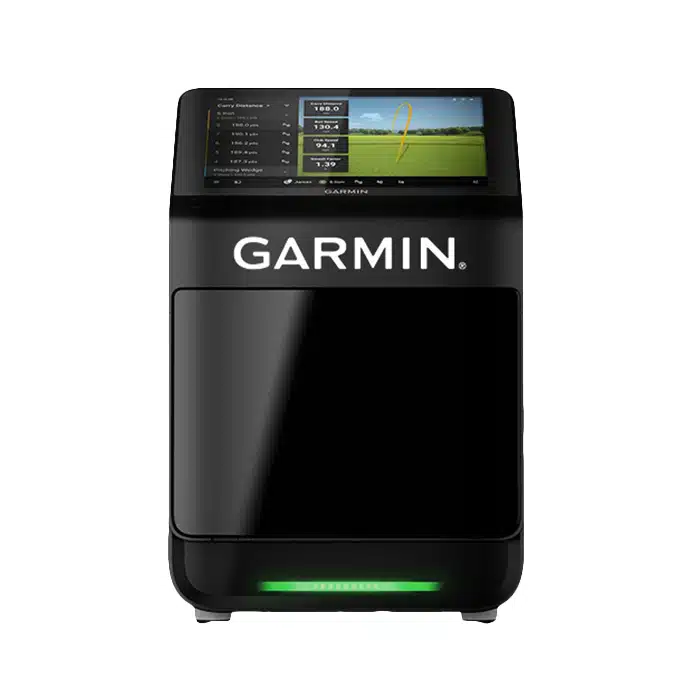
Experience top-tier golf precision and tracking with the Garmin Approach R50, designed for serious golfers seeking advanced performance.
How Do the R50 and Full Swing KIT Track Your Shots?
When you’re comparing these two launch monitors, the biggest difference comes down to how they actually see your golf shots. The R50 uses three high-speed cameras that directly capture over 15 ball and club metrics, including ball speed, launch angle, and spin rate. You’ll also get a slow-motion impact video showing exactly where the ball strikes your club face. Full Swing KIT takes a different approach with an overhead-mounted camera system using photometric technology to measure ball flight. The important part is that the R50’s camera-based setup is portable for indoor or outdoor use, while Full Swing requires a fixed ceiling mount. The R50 even includes an onboard touchscreen, so you’ll see your metrics instantly without needing extra hardware. The device also connects via Wi-Fi to integrate with other simulator programs, giving you flexibility beyond the preloaded features. The camera-based system eliminates special golf balls, though you’ll need to apply the included club tracking stickers for accurate club data.

R50 vs Full Swing KIT Accuracy: Real-World Testing Results
Outdoors, both units deliver tour-level precision. The Full Swing KIT’s Doppler radar tracked every shot flawlessly during testing, matching Foresight GC3 distances exactly. The R50’s triple-camera system showed minimal variance, just 0.82% difference in ball speed versus Trackman. the garmin approach r50 features overview highlights its advanced capabilities for serious golfers seeking precision in their game. With its user-friendly interface and robust analytics, the R50 makes it easy to track performance over time. Additionally, its portability allows players to take it anywhere, ensuring they can analyze their swings on the course or at the driving range. In the context of garmin approach r50 features comparison, both devices offer unique advantages in accuracy and ease of use. Users looking for advanced analytics might find the R50’s innovative technology particularly appealing. However, for those who prioritize simplicity and proven performance, the Full Swing KIT remains a formidable option.
Indoors is where they separate. The R50 maintains its accuracy in tight spaces, averaging 218.4 yards carry against Trackman’s 226 yards. The R50 excels in indoor settings with limited ball flight due to its camera technology. The Full Swing KIT, however, consistently reads a few yards short without complete ball flight tracking. Testing revealed the radar system showed 10-12 yard differences compared to the R50 on seven iron shots, with the R50 measuring 165 yards carry versus 173 yards on the radar unit.

Unlock your golf potential with the Full Swing KIT Launch Monitor, trusted by pros for pinpoint accuracy in swing analytics. This advanced device delivers real-time data on ball speed, spin, and launch angle, helping you optimize every shot. Whether you're a serious golfer or coach, Full Swing KIT provides the insights needed to elevate your game and lower your scores.
Full Swing KIT Built-In Simulator vs R50 Standalone Design
Although both launch monitors track your shots with impressive accuracy, they take fundamentally different approaches to how you actually use them. The Full Swing KIT integrates complete simulator software for 87,000+ courses directly into the unit, making it a true all-in-one simulator experience. You’ll need a separate screen or projector, though, since it’s sensor-only.
The R50 flips this design completely. You get a 10-inch touchscreen built right in, so you can practice anywhere without additional hardware. It runs for 4 hours on battery power and weighs just 9 lbs. Sure, you’ll need a Garmin Golf membership to access 43,000+ courses through Home Tee Hero, but the key point is, you can review metrics, watch impact videos, and practice independently without connecting anything else! The R50 also includes an HDMI output if you want to connect it to a larger display for a full simulator setup. The unit utilizes three high-speed cameras to capture accurate club and ball data during each swing.

What’s Included at the $5,000 Price Point
So you’re ready to spend $5,000 on a launch monitor, but what exactly lands on your doorstep at this price point? Both units arrive ready to use without requiring extra hardware purchases. The R50 includes 250 clubface stickers (you’ll need these for club data tracking), a 10-inch touchscreen, and 43,000+ preloaded golf courses. Full Swing KIT comes with its built-in 4K camera and customizable display showing four metrics simultaneously. The important point, neither requires you to own a gaming PC or buy additional sensors. However, the R50’s full feature set needs that $99/year subscription, while Full Swing KIT’s app works best on iOS devices. You’re getting tour-level accuracy either way, but the included accessories differ greatly between these premium options.
Which Launch Monitor Is Easier to Transport and Set Up?
Where you plan to use your launch monitor matters just as much as what it tracks, and that’s where portability becomes a dealbreaker for many golfers. The R50 wins this comparison hands-down. At 9 lbs with a built-in battery that lasts 4 hours, you can grab it and go, no outlet needed. The Full Swing Kit weighs 35 lbs and requires constant power, which limits where you’ll actually use it.
Set up speed? The R50’s 10″ touchscreen lets you configure everything right on the device, while the Full Swing Kit needs your phone or tablet for app-based setup. Both systems claim quick alignment (about a minute), but the key point is: the R50’s integrated screen and wireless connectivity make it genuinely grab-and-play, especially outdoors, where the Full Swing Kit struggles without power access. The R50’s compact dimensions of 16.5 x 10.6 x 7.5 inches also mean it fits easily in your trunk alongside your clubs and gear. Garmin includes a carrying case that makes transport and setup even more convenient. the garmin approach r50 performance analysis shows that it effectively provides accurate readings and enhances the golfing experience. With features designed to optimize performance, users can expect valuable insights into their swing metrics and shot distances. This combination of technology and ease of use makes the R50 an essential tool for both novice and seasoned golfers alike.
How the Full Swing KIT and R50 Apps Compare
Once you’ve got your launch monitor set up at the range or in your garage, you’ll spend most of your time staring at screens, either the device itself or the companion app on your phone. Here’s where things get interesting. The Full Swing app wins on design and usability, offering a slick interface that works seamlessly with iOS devices. You’ll get audio feedback through Bluetooth headphones, which is pretty convenient. The R50 app, on the other hand, works with PC and Android and gets praised as one of the best around. But there’s a catch: you’ll need a subscription ($9.99/month or $99/year) to access all features. Both apps display extensive data, though Full Swing’s overall experience feels more polished.

Frequently Asked Questions
Can I Use the R50 or Full Swing KIT for Club Fitting?
You can definitely use both for club fitting, though they’ve got some limitations. Both systems track the crucial data you’ll need: club head speed, face angle, club path, spin rate, and ball flight metrics. The R50 measures spin within 200 RPM accuracy, while the Full Swing KIT uses photometric cameras for precise indoor readings. The point is: they’re solid for basic fitting work, but you’ll need club tracking stickers on the Full Swing KIT for complete face-to-path accuracy.
Do Either Systems Work With Commercial Simulator Software Like TGC 2019?
Neither system works with TGC 2019, unfortunately. The R50 isn’t compatible despite Garmin advertising it for their R10 model, forum users and official responses confirm it won’t work. Full Swing Kit shows zero mentions of TGC 2019 support anywhere. However, the R50 does support other commercial software like E6 Connect, E6 Apex, GSPro, and Awesome Golf through its HDMI output, giving you plenty of solid alternatives!
What Are the Ongoing Subscription Costs for Each Device?
The R50 requires a Garmin Golf subscription for Home Tee Hero features; you’ll pay $9.99 monthly or $99 annually to access 43,000+ virtual courses. The important point is: you don’t need it for basic launch monitor functions. The Full Swing Kit’s subscription costs aren’t clearly documented, though some Full Swing units charge $500/year for a Gold Membership. Both devices work with third-party software like GSPro, which runs about $250/year separately.
Can I Use These Launch Monitors to Practice Putting?
With the Garmin R50, you can practice putting during virtual rounds on Home Tee Hero, but there’s no standalone putting mode. The system won’t track club data from your putts, even with the tracking sticker attached. You can adjust green speed and gimme distances, which is handy for course play. Unfortunately, there’s no info available about the Full Swing Kit’s putting capabilities from the search results.
Do the R50 and Full Swing KIT Require Calibration Before Use?
The R50 doesn’t need traditional calibration; you’ll just align the target during your initial session by placing balls in specific spots on the display, then use the laser to lock onto your ball. It’s built-in barometer automatically adjusts distances for temperature and elevation. As for the Full Swing Kit, there’s no available data on its calibration requirements, so you’d need to check their documentation directly.
Conclusion: Garmin Approach R50 vs Full Swing Kit
Both launch monitors deliver solid performance at the same $5,000 price point, but your choice really comes down to how you’ll use it. If you want an all-in-one setup with a built-in screen and quick practice sessions, the Full Swing KIT makes sense. But if you need something portable for the range or prefer using your own devices, the R50’s compact design wins out. You can’t go wrong with either option!

About the author
Paul Liberatore
Paul Liberatore is the founder of Golfers Authority and a former four-year golf gear contributor to Sports Illustrated. He tests golf equipment hands-on to help golfers make better buying decisions.