
The new PXG Secret Weapon is $499, and after getting fitted for the first one, here’s my take: it’s not a shorter driver, it’s a better 3-wood. If your 3-wood scares you on a tight tee shot, this is the club I’d look at first.
Is the PXG Secret Weapon Mini Driver worth buying?
PXG sells its mini driver as “driver distance with fairway wood control.” I’ll take the control all day. The driver distance? Not really.
When I got fitted for the first Secret Weapon, my driver averaged 250 and the Secret Weapon averaged 231. That’s about 20 yards. And honestly, that’s not a knock. That’s the whole point of the club.
Now there’s a new one. PXG announced it on October 22, it’s $499, and it only comes in 13 degrees. So I’m going to walk through what changed from the one I hit, where it actually earns a spot in your bag, the one catch, and whether it’s worth paying more than the old one cost.
Quick Overview
- It’s $499, up from $449.99 on the first one, in 13 degrees only, righty or lefty.
- You get a 300cc head on a 43.25-inch shaft, half an inch shorter than the old one and a good 1.5 to 2.5 inches shorter than most drivers.
- PXG says the face is more than 4 percent thinner than the last one, and the crown is matte carbon.
- There are still four weights on the sole, but they ship as two 7.5s and two 2.5s now instead of two 15s.
- Think of it as a 3-wood that goes farther, not a driver that goes straighter.

Replace your hard-to-hit 3-wood. Our PXG Secret Weapon Mini Driver review breaks down the spin rates, launch angles, and forgiveness that make this the ultimate tee-box safety net.
Spec Sheet
| Specification | Secret Weapon (2nd gen, Oct 2026) | First generation (Jan 2025) |
|---|---|---|
| Price | $499.00 | $449.99 at launch |
| Loft | 13 degrees only | 13 degrees stock |
| Hosel adjustment | Loft and lie; range not published | 11.5 to 13.5 degrees |
| Standard length | 43.25 inches | 43.75 inches |
| Head volume | 300cc | 300cc |
| Head mass | 215 g | Not listed |
| Standard lie | 58.5 degrees | Not listed |
| Face | Titanium, more than 4% thinner than the first gen (PXG) | Not listed |
| Crown | Matte carbon fiber | Not listed |
| Stock weights | Two 7.5 g and two 2.5 g (heel, toe, front, back) | Two 15 g and two 2.5 g |
| Optional weights | 2.5 g to 20 g | Not listed |
| Dexterity | Right- and left-handed | Not listed |
| Default shaft | Project X Denali Frost Blue 50 | Not listed |
| Flexes | Ladies, Senior, Regular, Stiff, X-Stiff | Not listed |
| Grip | PXG ICON Black, Standard | Not listed |
| MOI | Not published | Not published |
| Add-on | Torque wrench, $10 | Not listed |
My fitting video below is on the first-generation head, the $449.99 one. Same idea, same 300cc size, same 13 degrees.

The PXG Mini Driver Is a Better 3-Wood, Not a Shorter Driver
My fitter at PXG explained the first one better than any spec sheet. You’ve got a par 4 where the fairway pinches in right where your driver lands. Driver’s too much club. 3-wood feels like you’re giving away too much. So you try to squeeze a driver into a spot where it doesn’t fit.
That’s the shot this club is for.
It’s 13 degrees, which sits right between a driver and a 3-wood. The head is 300cc. A normal driver is 460, and a fairway wood is usually somewhere around 180 to 210. So when you set it down behind the ball, it looks like something in between, too. Bigger than your 3-wood, which is the confidence part. Smaller than your driver, which is the control part.
On my fitting, I had one go a little over 240, and my average came out about 20 yards behind my driver. That was the first head, not this one. But the new one keeps the same 300cc size, the same 13 degrees, and an even shorter shaft, so I wouldn’t expect it to suddenly turn into a driver.
So if you’re buying it to replace your driver, you’re probably going to be disappointed. If you’re buying it to replace your 3-wood off the tee, now we’re talking. That’s exactly the club my fitter said it takes the place of.
You Can Still Hit It Off the Deck, and That’s What Earns the Spot
This is the part that surprised me on the first one. A lot of mini drivers are really tee clubs. The first Secret Weapon actually worked off the ground.
I hit one off the deck that went 232 total, with plenty of height. Then I got under one, and it still went 210 down the middle. That’s a miss. And I’m not going to cry about a miss that goes 210 down the middle.
That matters on a par 5. Off the turf, you need height and distance together. You can’t have one without the other, or the ball either falls out of the sky or never stops on the green.
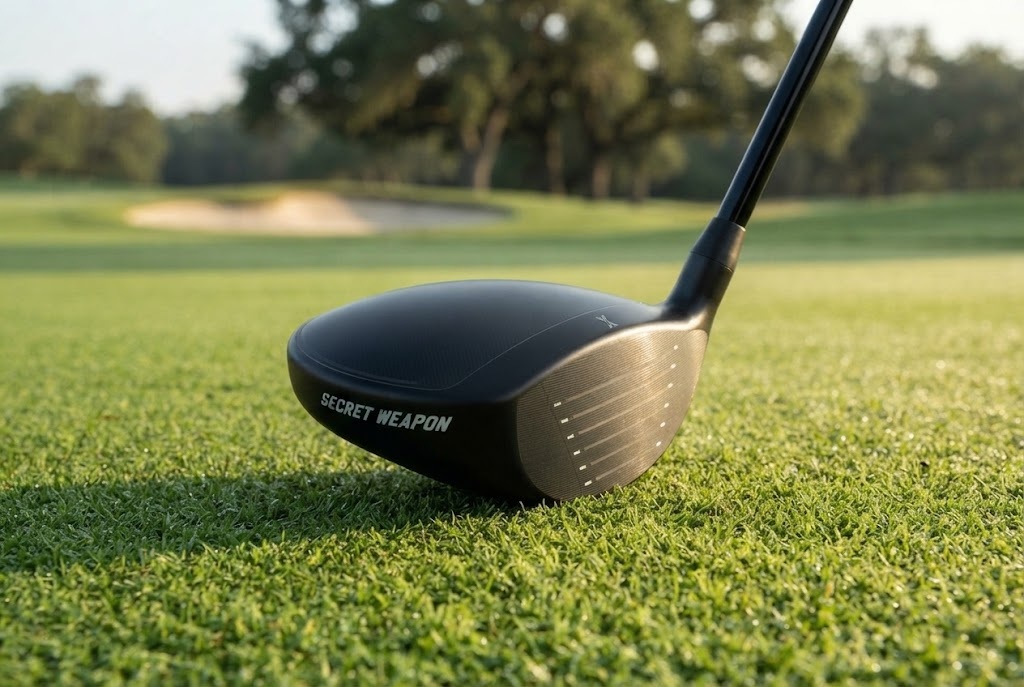
On the new one, PXG went with a lighter matte carbon crown, which pulls weight low and deep so it’s easier to launch. That’s the right direction for a club you want to hit off the fairway. Just remember it’s still a bigger, deeper head than a 3-wood. Give it a decent lie. Off a tight, thin lie, I’d still reach for something smaller, and my ultimate guide to fairway woods covers what that something is.
Most of the Changes Are Aimed at the Ones You Don’t Flush
So what actually changed? Two things you’ll feel, and a couple you won’t.
First, the face. PXG says it’s more than 4 percent thinner than the last one and pushed right up to the USGA limit. Basically, a thinner face flexes more, so the ball comes off hotter, especially when you don’t catch it dead center. PXG put a reinforced structure in the sole behind it so that thin face holds up, and it moved the weight it saved out to the edges of the head for more stability on mishits.
That one matters to me. My miss goes right, and it’s usually off the toe. If a head hangs onto its speed better out there, that’s yards I actually get back.
Second, the shaft. It’s 43.25 inches now, half an inch shorter than the first one. Shorter shaft, more control, less distance. That’s a trade PXG is making on purpose, and for a fairway finder, it’s the right one.
The crown went matte, too. It’s a small thing, but you’re looking at it on every single shot, and it’s a cleaner look standing over the ball.
Four Weights and a Hosel Make This a Club You Should Get Fit For
There are four weight ports on the sole: heel, toe, front and back. The old one came with two 15 gram weights and two 2.5s. The new one ships with two 7.5s and two 2.5s, and PXG sells extra weights anywhere from 2.5 all the way up to 20 grams.
So you can move the heavy ones toward the heel if you need help turning it over, toward the toe if you’re fighting a hook, or front and back to change how it launches. Then the hosel adjusts loft and lie on top of that. PXG hasn’t said how far the hosel goes on this generation. The first one went from 11.5 to 13.5.
Here’s my honest advice. Don’t order it with the stock setup and hope for the best. When I got fitted for the first one, they had it dialed in for my spec before I ever hit a ball, and that’s how you should buy this club. PXG has more than 200 fitting locations, and with four weights and an adjustable hosel, a fitting is how you actually get your money’s worth.
Stock, it comes with a Project X Denali Frost Blue 50 shaft and a PXG ICON Black grip, and you can pick ladies, senior, regular, stiff or X-stiff. If you plan on moving the weights yourself, add the $10 torque wrench.
$499 Undercuts Callaway, but It Costs More Than Every PXG Driver
Let’s talk money. The new Secret Weapon is $499. The first one launched at $449.99.
Next to the big-name rival, that’s fine. Callaway’s Quantum Mini is $549.99, so PXG saves you about fifty bucks.
But look at PXG’s own lineup. The Lightning driver starts at $449, the Black Ops driver is $399.99, and the Wildcat is $299.99. The mini driver costs more than every one of them.
So here’s the real question. If your driver is in play most of the time, buy the driver first. I went through the PXG Lightning driver and the PXG Black Ops driver in their own reviews. This club makes sense as your second wood, the one that comes out on the tight holes.
Two things help. PXG’s Heroes program takes 20 percent off for military, veterans, first responders, teachers and nurses, which drops it to $399.20. And PXG’s free shipping starts at $500, so the club by itself misses it by a buck. Add the torque wrench and you’re over the line.

What I Don’t Love
There’s a catch. There’s always a catch.
It’s 13 degrees, and that’s it. If you swing it fast and you wanted something closer to 11 degrees for the tee, it’s not here, and PXG hasn’t published how far the hosel moves on this one.
And PXG is selling a thinner face and “driver distance” without putting a single ball-speed number next to the old one. You’re paying $49 more for a thinner face, lighter weights and a matte crown. Maybe that’s worth it. But until somebody puts the old head and the new head side by side on a launch monitor, faster is a promise, not a number. If you already own the first one and you like it, I’d keep it.
Who It’s For
Buy it if:
- Your 3-wood scares you off the tee, but you still want more than a hybrid.
- Your home course has tight par 4s where the fairway pinches in right where your driver lands.
- You want one club you can tee up and still hit off the deck going for a par 5.
- You’ll actually get fit and set the weights for your miss.
Skip it if:
- Your driver already finds the fairway. Keep the $499.
- You want driver distance. Plan on 15 to 25 yards less.
- You need less than 13 degrees, or you own the first one and you like it.
Replace your hard-to-hit 3-wood. Our PXG Secret Weapon Mini Driver review breaks down the spin rates, launch angles, and forgiveness that make this the ultimate tee-box safety net.
- Big Distance.
- Fairway Finder.
- Highly Adjustable.
- Low Forgiveness.
- Flat Launch.
- Hollow Sound.
Frequently Asked Questions
Is the PXG mini driver good?
Yeah, it’s good, as long as you buy it for the right job. I got fitted for the first one and was honestly blown away by how well it worked off the tee and off the deck. It’s a fairway finder and a strong 3-wood replacement. It’s not a driver replacement.
Should I get an 11.5 or 13.5 mini driver?
With the new Secret Weapon, you don’t get to choose. It only comes in 13 degrees. The hosel adjusts loft, but PXG hasn’t published the range on this one, and the first one went from 11.5 to 13.5. If you’ll mostly hit it off the tee and you swing it fast, less loft makes sense. If you want to hit it off the deck, you want the loft.
Does a mini driver hit further than a 3-wood?
Usually, yes. With the Secret Weapon, expect something like 10 yards more than a 3-wood and about 15 to 25 yards less than your driver. That gap is exactly what it’s built to fill.
What’s the difference between the old and new PXG Secret Weapon?
Price, length and weights. The new one is $499 against $449.99, the shaft is 43.25 inches instead of 43.75, and the stock weights are two 7.5s and two 2.5s instead of two 15s. PXG also says the face is more than 4 percent thinner, and the crown is matte carbon. It’s the same 300cc head and the same 13 degrees.
Does the PXG Secret Weapon come left-handed?
Yes. You can build it righty or lefty on PXG’s site, and both come in 13 degrees.
Final Thoughts: PXG Secret Weapon Mini Driver Review
Here’s where I land. If you’ve got a tight home course and a 3-wood you don’t trust off the tee, the Secret Weapon is $499 well spent, and if you qualify for PXG’s Heroes discount, it’s $399.20. Get fit, set the weights for your miss, and pull it on the holes where the driver gets you in trouble. But if your driver’s already in the fairway, or you own the first one, keep your money. And if you’re still figuring out what belongs at the top of your bag, start with my ultimate guide to golf drivers.

About the author
Paul Liberatore
Paul Liberatore is the founder of Golfers Authority and a former three-year golf gear contributor to Sports Illustrated. He tests golf equipment hands-on to help golfers make better buying decisions.