
These two are not the same product in two sizes. The iO is a fixed indoor unit built for one dedicated bay, and TrackMan 4 is the portable box that sits behind you and works indoors or out. If your room is short from ball to screen, that single fact decides this for you before anything else does.

Unlock your full golfing potential with the TrackMan launch monitor, the gold standard in precision technology, trusted by top pros for game-changing insights.
What actually measures the ball in each of these?
Both units read the ball without stickers or markers, but they get there with different sensor stacks. TrackMan 4 runs what TrackMan calls Optically Enhanced Radar Tracking, which is two synchronized Doppler radar systems paired with radar-synchronized high-speed optics. One radar is a short-range, ultra-high-resolution sensor handling putting, club and impact data. The other is a long-range radar built to track the ball out. There is also a built-in camera, listed at HDR HD 720p at 60 fps and Full HD 1080p at 45 fps, that handles TrackMan’s patented target alignment.
The iO uses radar, infrared and high-speed imaging together, with a dual camera system: a tracking camera listed at up to 4,600 fps and a separate alignment camera. Neither unit asks you to put markers on your clubs or play a marked ball, so the practice routine is the same either way.
What I will not do here is tell you one of these reads a given number closer than the other. TrackMan has not published a universal accuracy tolerance for the iO that I can hold up next to the TrackMan 4 figures, and a TrackMan 4 spec sheet does not prove anything about the iO. They are separate products with separate hardware. If accuracy is the thing keeping you up at night, start with how accurate TrackMan simulators are and how the system works rather than trusting a side-by-side chart somebody built from two different data sheets.

How much room does each one need?
This is the real fork, and it is about depth. TrackMan 4 sits behind the golfer on the target line, and TrackMan’s published minimum indoor distance from the unit to the net is 4.7 m. TrackMan’s spec page pairs that metric figure with 16 ft. Run the math and 4.7 m is closer to 15.4 ft, so read the 16 ft as a conservative rounded allowance rather than an exact conversion. Plan against 4.7 m to the net and give yourself margin on top of it.
That distance is measured to the net, not to the ball, so the golfer, the hitting area and the unit itself all have to live inside that span. A lot of garages and basements that look fine on paper come up short once you stop measuring from the wall and start measuring from where the radar actually has to stand.
The iO changes the question. TrackMan does not publish a front or back tracking-distance minimum for it, which is the entire point of a fixed indoor unit in a shallow room. That does not mean you can build a bay with no clearance. TrackMan still specifies safe swing clearance and real installation clearance around the hitting area, and my iO source does not publish a ceiling-height spec, so nobody should promise you that any given ceiling will work. That is a question for TrackMan and for whoever is building the space, not something you settle off a product page.
So the honest version is this. If you have 4.7 m of clean depth from unit to net and then some, both are on the table. If your room is short from ball to screen, the iO is the one designed around that constraint, and TrackMan 4 will fight you until you confirm the clearance it needs.
Which one travels, and which one stays put?
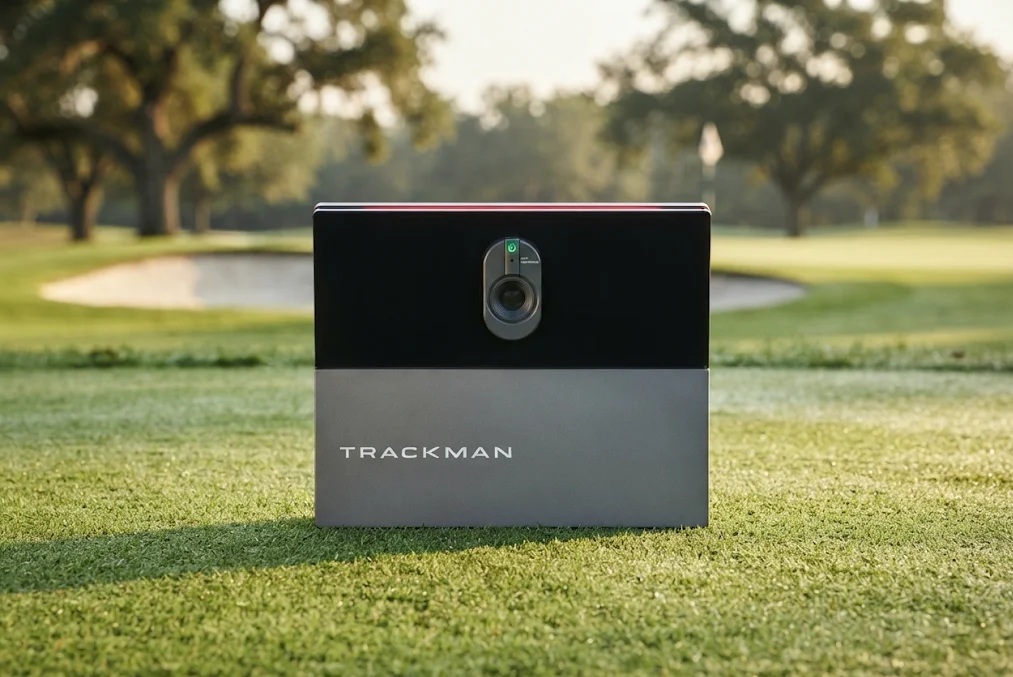
TrackMan 4 is the only one of the two you can pick up and take somewhere. It is listed at 300 x 300 x 45 mm, and TrackMan’s own technical page puts it at 6.6 lb while current US retailer copy says 6.2 lb. I am leaving both published figures as they are instead of pretending there is one clean number. It runs off a 10,400 mAh lithium-ion battery rated for 4-plus hours of play, charges over micro-USB, and connects by dual-band Wi-Fi at 2.4 and 5 GHz or hard-wired Ethernet. Authorized-retailer product copy calls it weather-resistant, though TrackMan does not publish an IP rating, so I would not treat a downpour as a test case.
That portability is why TrackMan 4 is the pick for anyone whose golf happens in more than one place. Range sessions outdoors, club fitting at a different facility, a coach who works out of two spots, a player who wants outdoor carry numbers on a given day. The unit levels itself automatically and aligns to the target with the built-in camera, but it is still a setup every time you move it.
The iO gives up all of that and buys you the opposite benefit. It is installed once in one room, and then it is simply there. No tripod, no battery to think about, no realigning, nothing sitting on the floor behind you waiting to get kicked. If your golf is one indoor bay in one house and always will be, the fixed install is a feature rather than a compromise. If you think you might want to hit outside twice a year, be honest about whether that is worth designing the whole purchase around.

Buy the Trackman iO launch monitor for ultimate indoor golf precision. Experience unmatched radar & infrared tracking technology. Order your unit today!
What do the packages and the ongoing cost look like?
Start with what is actually documented, and keep the two models separate, because the paperwork behind them is not the same.
On TrackMan 4, the first year of premium software comes with a new unit. On the October 7, 2026 price check, TrackMan’s published price after that first year was $1,100 per year. The free features are perpetual, but the premium tier is where the full course library, games, insights, practice tools, cloud, events and portal functions live. TrackMan’s purchase page lists 550-plus courses with monthly releases through TrackMan Performance Studio and Virtual Golf. Treat that $1,100 as a dated observation rather than today’s verified price, and ask TrackMan what the renewal costs when you order. What you should not assume is that a TrackMan 4 is a single payment and then nothing, because premium software access is sold on a subscription.
For the iO, get the quote to spell out exactly which software is included, how long that inclusion lasts, and what renewal looks like afterward. If a rep cannot put that on the quote, you do not have a complete price yet.
On hardware, TrackMan 4 launched in 2015 at $19,000. On October 7, 2026, TrackMan’s list price was $25,995, and that same $25,995 was showing at TrackMan, PGA TOUR Superstore and PlayBetter, while Carl’s Place listed TrackMan 4 from $25,995 up to $28,085 depending on configuration. That is a dated price check, not a standing offer, so confirm it before you buy.
Ask TrackMan for a configured quote on the package you actually want and treat that as the only real number. For context on how TrackMan prices full builds, the TrackMan simulator cost breakdown is a better starting point than any single headline figure.
What does matter on the iO, and what I would nail down in writing before signing anything, is the package tier. The Home package lists club speed. Home Complete and Commercial list additional club metrics. If you are buying an iO specifically to see club path, face angle and the rest of the club picture, the base package is not the one you want, and finding that out after installation is an expensive lesson. TrackMan 4, by comparison, publishes a full club and ball data set out of the box, including attack angle, dynamic loft, club path, face to path, spin loft, low point and impact location, plus a complete putting and green-reading set.
One more thing worth a direct question at quote time. TrackMan’s general purchase terms state a 12-month hardware warranty after delivery, and TrackMan separately describes an annual hardware subscription that functions as system warranty and support. Those are TrackMan 4 purchase-terms details in my source, so confirm what your specific order includes. For the iO, the warranty terms are not something I can state as published fact, so get them from the rep in writing rather than assuming they match another model.
The Built-In Screen Decides Whether You Need a Computer at All
The EYE MINI’s screen is what makes it a standalone device, and the LITE has no screen at all. The EYE MINI can run standalone, on an iPad, or on a PC, with wireless support. The EYE MINI LITE is PC only, over wired Ethernet, with no wireless and no mobile support.
So the honest way to read the August 8, 2026 price gap is as a total-system number. With the LITE you are not buying a launch monitor, you are buying the sensor half of a setup that also requires a Windows PC capable of running Uneekor’s simulator software, plus a run of Ethernet to wherever the unit sits. Uneekor’s own system guide specifies current CPU and GPU tiers, so an old office desktop in the corner of the garage is not a safe assumption. If you already own a gaming PC for GSPro, that cost is sunk and the LITE looks excellent. If you do not, add it to the math honestly.
With the EYE MINI, you can turn it on, hit balls, and read numbers off the unit with nothing else in the room. That is a genuinely different experience, and it is the reason I would push a range-bag buyer toward the EYE MINI review rather than the wired model.
So who should take which one?
Take the iO if your golf lives in one dedicated indoor room and that room is tight from ball to screen. The fixed install removes floor clutter and per-session setup. Just settle the package question first, because the club data you get depends on which tier you buy, not on the hardware alone, and get the included software written into the quote.
Take TrackMan 4 if you need the unit to move. Coaches working out of two locations, fitters who travel, players who want outdoor sessions, anyone whose practice is not tied to one room. It publishes the full club and ball data set without choosing a tier to get there. The depth requirement still applies.
If you already own a working TrackMan 4 and only ever use it in one indoor bay, there is no obvious reason to swap. TrackMan says units from 2016 remain in active use with ongoing software, course and feature updates, so an older unit is not being abandoned. The exception is the golfer whose room was always the problem, who has been living with a compromised setup, and who would rather fix the room than keep working around it. That person has a real case for the fixed indoor unit.
And if the whole TrackMan tier is more than your situation calls for, say so out loud before you spend. The full launch monitor guide covers the cheaper end, and GCQuad vs TrackMan and TrackMan vs Foresight cover how TrackMan sits next to camera-based systems.
Related video: TrackMan 4 context in my Full Swing KIT video
Frequently Asked Questions
Is the TrackMan iO a replacement for TrackMan 4?
No. They are different products with different sensor hardware, different mounting and different use cases. The iO is a fixed unit for a dedicated indoor bay, and TrackMan 4 is a portable unit that works indoors and outdoors. Specs from one do not describe the other.
Do either of them need club stickers or marked balls?
No. TrackMan states that neither club stickers nor marked balls are required for club and ball data, and the iO also lists no club markers and no ball markers. You can hit whatever ball is in your bag.
Does the TrackMan iO give full club data?
It depends on the package. The Home package lists club speed, while Home Complete and Commercial list additional club metrics. Confirm exactly which metrics your quoted package includes before you commit to an installation.
Will a TrackMan 4 bought years ago still be supported?
TrackMan says units going back to 2016 remain in active use with ongoing software, course, feature and performance updates. Premium software access is sold on a subscription, so hardware support and software access are two separate questions to ask about.
What does TrackMan 4 cost to run after the first year?
The first year of premium software is included with a new unit. On the October 7, 2026 check, TrackMan’s published price afterward was $1,100 per year, so confirm the current figure with TrackMan before you budget. Free features remain available permanently, while the course library, games, cloud and event functions are part of the premium tier.
Conclusion: TrackMan iO vs TrackMan 4
Buy the iO if you are building or finishing one indoor room, the depth is tight from ball to screen, TrackMan and your installer have confirmed the clearance the install needs, and you have in writing which club metrics your package tier includes and which software comes with it. Buy TrackMan 4 if the unit has to travel, if outdoor sessions matter, or if you want the published full data set without tier shopping, and if you genuinely have 4.7 m from the unit to the net indoors with room to spare.
Keep what you have if you own a TrackMan 4 that fits your room and you are only playing indoors, because the updates are still coming and there is no upgrade story that justifies replacing working hardware. If neither one fits, it is usually because the golf does not actually live in a single practice bay, or because the quote has not yet answered what software is included and what it costs to renew. At this level, the room and the paperwork decide more than the spec sheet does. If you are still early in the research, start with what a TrackMan simulator actually is and work forward from there.

About the author
Paul Liberatore
Paul Liberatore is the founder of Golfers Authority and a former three-year golf gear contributor to Sports Illustrated. He tests golf equipment hands-on to help golfers make better buying decisions.