
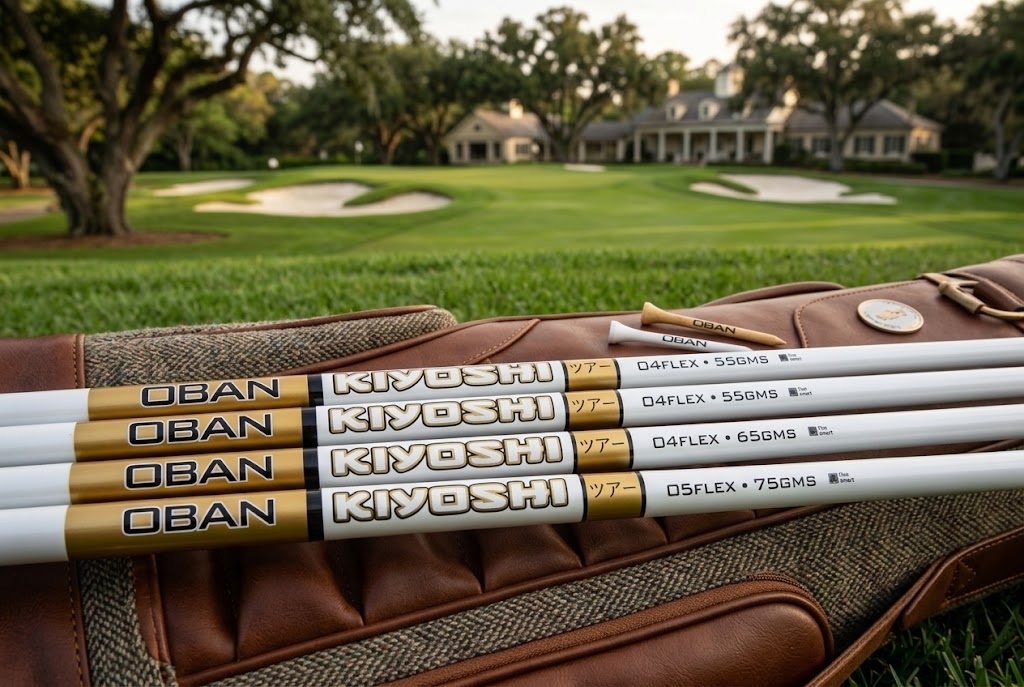
The Oban CT Steel Iron Shafts are a Japanese steel iron shaft family, and I think they’re worth a spot in your next iron fitting, as long as you test the right one of the four and not just the Oban name.
Is the Oban CT Golf Shaft worth buying?
First, let’s clear up which Oban we’re talking about. Oban makes graphite shafts for your woods too, like the Kiyoshi White driver shaft. This isn’t about those. This is the CT, Oban’s steel shaft for irons.
And here’s what most people miss about it. The CT isn’t one shaft. It’s four, and they’re not interchangeable.
So let’s get into what separates them, what Oban actually built into the steel, how you buy it, and who should skip it.
Quick Overview
- It’s a steel iron shaft, made in Japan from Japanese steel.
- There are four models right now: CT-100, CT-107, CT-115 and CT-125.
- Oban labels all four mid-high launch with low-mid spin.
- Oban sells it as a 13 Flex Fitting Experience, which doesn’t mean every model comes in 13 flexes.
- You get three finishes: Chrome, SILK and SILK NOIR.
Oban CT Spec Sheet
The construction, weight labels and finishes are Oban’s. The gram weights and flex ranges come from a custom builder’s spec table, not Oban, and they’re raw shaft weights, not your finished club.
| Spec | Oban CT Steel Iron Shafts |
|---|---|
| Type | Steel iron shaft |
| Made in | Japan |
| Material | Japanese steel |
| Construction | Seamless, cold extrusion, micro-taper step pattern |
| Design | Constant weight, taper tip |
| Launch and spin | Mid-high launch, low-mid spin on all four models |
| CT-100 | Lightweight; listed at 88-98 g raw, A to S flex |
| CT-107 | Mid-weight; no raw weight or flex range listed |
| CT-115 | Mid-weight; listed at 103-112 g raw, R to X flex |
| CT-125 | Heavy; listed at 121-125 g raw, S to X+ flex |
| Fitting | 13 Flex Fitting Experience |
| Finishes | Chrome, SILK (ceramic bead blasted), SILK NOIR (multi-process) |
The Number on an Oban CT Is the Model Name, Not the Weight
Look at the weight rows in that spec table. The CT-115 isn’t listed at 115 grams, and the CT-100 isn’t listed at 100. The number tells you where the shaft sits in the family. It doesn’t tell you what goes on the scale.
And that matters when you’re comparing it to what’s in your bag right now. If you’re coming from another steel shaft, don’t assume the CT-115 matches it just because the number sounds close. Compare raw weight to raw weight.
Then remember the shaft is only part of the club. Constant weight is about how the shafts in your set relate to each other. Your head weight, your playing length and your grip still decide what each finished iron weighs, so get those on your build sheet too.
Pick Your CT Off How You Load the Shaft, Not Just How Fast You Swing
You’ll hear that the Oban CT is built for fast swingers who like heavy iron shafts. That’s true of one model. The CT-125 is the heavy one, built for a medium-fast tempo, a medium-strong load and a medium-fast transition, and Oban calls it a stable profile for faster swing speeds.
The other three go the other way. The CT-100 is built for a medium tempo, a smooth to medium load and a slow to medium transition. The CT-107 keeps that smooth load with a medium transition. And the CT-115 is medium across the board: tempo, load and transition.
So here’s how I’d use that. If you’re smooth from the top and you don’t really load the shaft, start with the CT-100 or the CT-107. If you’re right in the middle, the CT-115 is the first one I’d hit. And if you’re quick from the top and you really load it, go straight to the CT-125.
Notice I didn’t give you a swing speed. Oban doesn’t either. These are tempo and load labels, so a fitter watching your transition and your strike will tell you more than a number off your driver. And if you need a regular flex, check the spec table before you fall for the heavy one, because the CT-125 isn’t listed in a regular.
Oban’s Pitch Is Japanese Steel and a Seamless Build
Oban’s whole story on the CT is how it’s made. It takes Japanese steel and cold extrudes it into a seamless shaft with a micro-taper step pattern. Oban says that gives you a responsive shaft that cuts down vibration and feels smooth through the swing.
Then Oban talks about weight, flex, balance and bend profile being dynamically synchronized. Basically, the shafts in your set are built to match each other from one iron to the next.
I like that pitch. Matched shafts are exactly what you want in a set of irons. But I’d buy it for the fit, not for the label on the website. Mid-high launch and low-mid spin describe how Oban designed the shaft. Your head, your loft and where you hit it on the face decide what you actually see on the launch monitor.
Same goes for the finish. SILK and SILK NOIR give you a satin look instead of Chrome. Oban doesn’t attach a launch or speed claim to any of the three, so pick the one you like looking at down by the ball.
You Buy the Oban CT as a Custom Build
You don’t just grab a CT and go. You get it through a fitter, or you order it built into your irons from an online custom shop.
Either way, you’re picking four things: the model, the flex, the finish and the build. Don’t assume every combination is in stock. Confirm the exact flex and finish you want in the model you picked before you pay.
If you’ve never done an iron fitting, watch my PXG Gen 8 iron fitting. It’s not an Oban fitting. But the fitter swapped heads, weights and shafts, and the whole point of the shaft swaps was finding the one that got my strikes centered more often. That’s the test you want to run with the CTs. Same head, different shaft, and let your strike pattern pick.
And if you’re not even sure steel is right for you anymore, read my breakdown of graphite vs steel shafts before you book the fitting.
What I Don’t Love
Here’s the catch. The CT is a fitting shaft. If you don’t want to get fitted, or at least hit a couple of models before you order, you’re guessing between four different shafts. And guessing is how you end up with the wrong one in all your irons.
The other downside is the CT-107. There’s no raw weight for it in the spec table above, so ask your fitter or builder what it actually weighs before you build a set around it.
And if you’ve been thinking about going to graphite in your irons, the CT is not for you. Every model in the family is steel. Look at a graphite-composite iron shaft like the Aerotech SteelFiber i95 instead.
Who It’s For
Buy it if:
- You’re getting fitted for irons, or you’re reshafting a set of heads you already like.
- You want a steel iron shaft designed for a mid-high flight with low-mid spin.
- You want to try lighter and heavier versions of the same steel family side by side.
- You care about the look and want a satin SILK or SILK NOIR finish instead of Chrome.
Skip it if:
- You want to buy a shaft without choosing a model, flex, finish and build.
- You want graphite in your irons.
- You’re happy with your current iron shaft and you’re hoping a new one adds yards all by itself.
Frequently Asked Questions
What is the weight of an Oban CT-115 shaft?
It’s listed at 103 to 112 grams raw. The 115 is the model name, not the weight in grams. Your finished iron’s weight still depends on the head, the length and the grip.
Is 115 a heavy shaft?
Not by Oban’s own labels. Oban calls the CT-115 mid-weight, and its heavy model is the CT-125. Whether it feels heavy to you depends on what you’re playing now, so compare it to your current shaft by raw weight.
Are Oban shafts worth it?
If you’re getting fitted and the CT that matches your load wins the fitting, yes. If you’re buying it off the name without hitting it, I’d keep your money until you’ve tested at least two of the four.
Is the Oban CT the same as the Oban Kiyoshi?
No. The CT is Oban’s steel iron shaft. The Kiyoshi White is a graphite driver shaft. Same brand, completely different club in your bag.
Can you buy Oban CT shafts without going to a fitter?
Yes. Online custom shops sell the CT and will build it into your irons. You’ll still have to pick the model, flex and finish yourself, which is why I’d get fitted first.
Final Thoughts: Oban CT Golf Shaft Review
If you’re getting fitted for irons this year, the Oban CT deserves a slot in the test. Let the fitting pick the model, then order it built with the model, flex and finish written on the build sheet. And if you’re still figuring out what you even need in a shaft, start with my ultimate guide to golf shafts.

About the author
Paul Liberatore
Paul Liberatore is the founder of Golfers Authority and a former three-year golf gear contributor to Sports Illustrated. He tests golf equipment hands-on to help golfers make better buying decisions.