No, not for most golfers. It’s an okay mat. The turf looks real, the cup is smart, and it’ll live on a patio. But it’s flat, fixed and one speed at $490, and the BirdieBall RollTech rolls truer for $293.99 with more in the box. Even the patio golfer has a BirdieBall option, the woven Tour Grade Turf. Buy the PrimePutt only if you want walnut and turf in the living room and you’re fine paying for the look.
Let’s get the hype out of the way first. The PrimePutt is the official putting mat of the Korn Ferry Tour Championship, it’s made in the USA, and its own site carries a 4.9-star rating. Every review roundup you’ll find puts it at or near the top of the category. And the price follows the reputation: $370 for the Compact, $490 for the Standard, $550 for the XL and $590 for the XXL. That’s four to six times what a good carpet mat costs, and roughly three times what BirdieBall charges for a 3′ x 10′ RollTech. So the question isn’t whether it’s a good mat. It’s whether it’s a $490 mat.
Here’s my honest answer after a season with it. It’s okay. The turf is dense half-inch nylon and it rolls well for turf, somewhere between a 9 and an 11 on the stimp depending on your floor. The walnut backstop looks like furniture. And the cup, shallow and shaped with a lip at the back, is the one idea on this mat I’d steal for every other mat. But turf is still a weave, and a weave has a pattern the ball can follow. There’s no break, no way to change the speed, and the three cups sit where they sit. What you’re really paying for is the look, the outdoor rating and that cup. If those three are your priorities, read on. If pure roll for the money is your priority, I’ll point you somewhere cheaper before this is over.

See how the realistic roll transforms your short game. Read real golfer ratings, pros, cons, and buying options.
Quick Overview
- $490 for the Standard 3′ x 9′; $370 Compact, $550 XL, $590 XXL
- Dense half-inch nylon turf, made in the USA, rolls at 9 to 11 on the stimp depending on your floor
- Three calibrated cups with a raised back lip, and no ball return on purpose
- Indoor and outdoor, with a furniture-grade walnut backstop
- 30-day money-back guarantee on the standard listing, 60 days on the Break 30 Challenge listing
PrimePutt Putting Mat Specs
The numbers that decide it: four sizes from $370 to $590, one speed, three cups, no return.
| Spec | PrimePutt Putting Mat |
|---|---|
| Price (verified Sep 3, 2026) | $370 Compact · $490 Standard · $550 XL · $590 XXL |
| Sizes | Compact 1.5′ x 9′ (one hole) · Standard 3′ x 9′ · XL 3′ x 12′ · XXL 3′ x 15′ |
| Surface | Dense nylon turf, half-inch pile, made in the USA |
| Green speed | 9 to 11 stimp, about 11 on hardwood and about 9 on carpet |
| Cups | 3 shallow calibrated cups with a raised back lip (1 on the Compact) |
| Ball return | None, by design |
| Alignment lines / break simulation | None / none |
| Backstop | Furniture-grade walnut |
| Use | Indoor and outdoor |
| Lay-flat time | Claimed seconds; in practice 1 to 2 hours on hardwood, several on carpet |
| App / subscription | None / none |
| Guarantee | 30-day money back on the standard listing; 60 days on the Break 30 Challenge listing; no stated warranty |
| Weight | Not published |
The Cups Are the Best Idea on This Mat
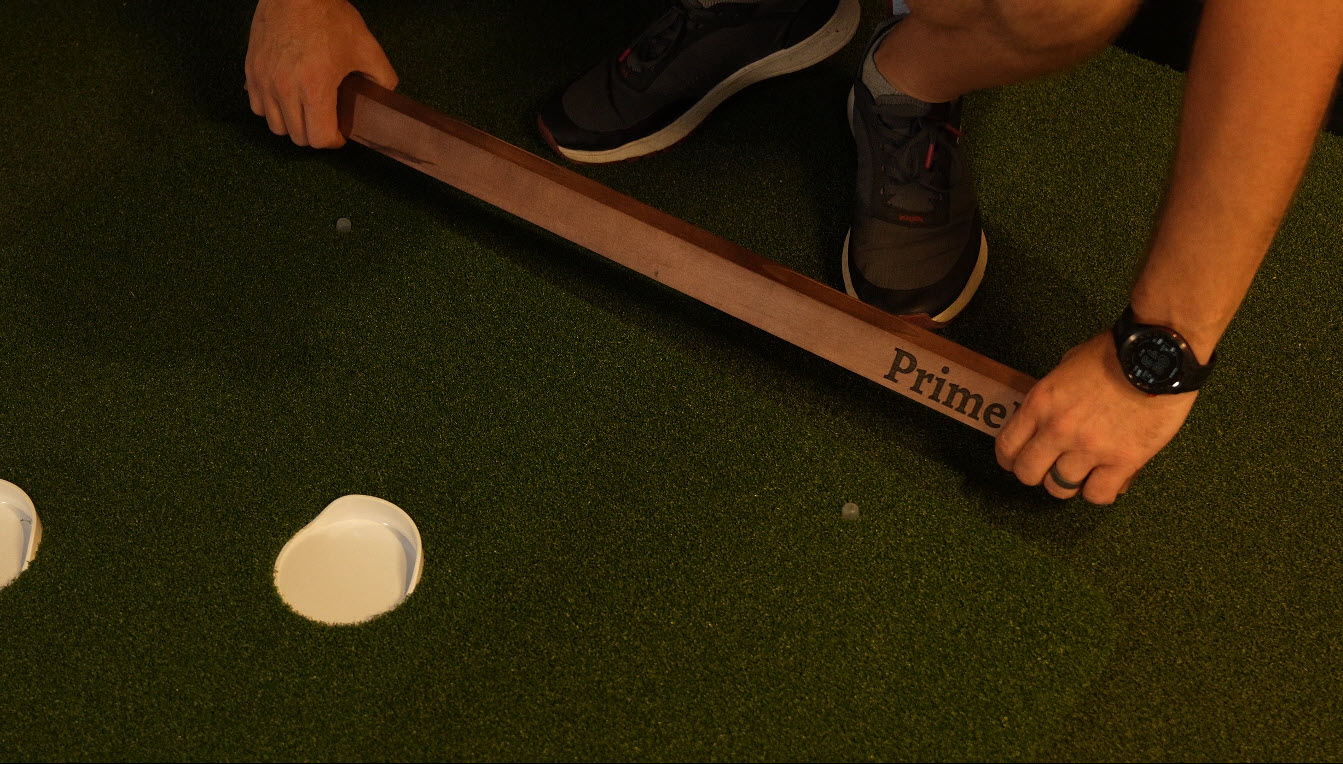
The calibrated cup is the one thing the PrimePutt does that none of the other mats in my roundup do, and it’s the real reason to consider it. Most putting mat holes are a simple cutout with no feedback. Anything that arrives in the neighborhood drops. The PrimePutt cup is shallow and shaped, with a raised lip at the back, and it produces three outcomes. A well-struck putt drops in. A putt hit too firmly rides the lip and bounces over. A putt that catches the edge at the wrong angle deflects away. What that actually means is you can’t cheat your speed. If you smash a putt that would lip out on the course, it’s very likely going to lip out here too.
That’s why there’s no ball return, and I’ll give PrimePutt credit for the reasoning. Any ramp-based return rewards a putt for reaching the hole with enough gas to climb the ramp, which is exactly the overhit putt the cup is built to reject. You can’t have both, so they kept the cup and dropped the return. It’s a deliberate choice, not a cost cut, and it holds up.
Here’s the catch, and it’s a practical one. No ball return means every putt gets retrieved on foot, and on the 3′ x 12′ and 3′ x 15′ mats that’s a lot of walking for a practice session. On the Standard it’s fine. Now, is the cup enough to carry a $490 price on its own? For me, no. It’s the best idea on the mat, and it’s a real edge over a cheap mat’s cutout holes. But the cups sit in three fixed spots, you drop them in and that’s where they live, so the variety runs out fast. It’s a great cup on a plain green.
The Turf Rolls Fine, and Fine Is the Problem at $490
The PrimePutt rolls well for turf, and turf is the ceiling. The surface is a dense half-inch nylon that creates friction the way real grass does, instead of the low-resistance glide you get from carpet. That’s the whole pitch, and it’s true as far as it goes. On my floor it plays like a medium-speed course green, somewhere in the 9 to 11 range. On hardwood it runs closer to 11 and on carpet closer to 9, so where you put it changes what you practice on. If your reference point is a big-box carpet mat, you’ll notice the difference immediately, and you’ll like it.
There’s a catch, though. There’s always a catch. Woven turf has a pattern, and a ball rolling across that pattern can follow the weave instead of your stroke, especially as a putt dies near the cup. Some golfers who bought one in 2026 say the ball wobbles on the PrimePutt when it should roll pure, and that record hasn’t been resolved. Mine settled down once it had lain flat for a day, which brings up the second thing. PrimePutt says it unrolls flat in seconds. In practice it’s one to two hours on hardwood and several hours on carpet, and I’d bet some of the early wobble complaints are mats that got putted on too soon. Give it a day.
Now put that next to the BirdieBall RollTech, which is what I keep on my own floor. It’s poured foam with no weave at all, so there’s no pattern for the ball to follow, and you can press your foot into it and watch it recover like a real green. The 3′ x 10′ is $161.99 and the 4′ x 14′ Deluxe is $293.99. So the cheaper mat has the stronger claim to a pure roll, and that’s the fact this review can’t get around. The PrimePutt’s turf is good turf. It just isn’t $490 better than foam that rolls truer.
It Survives a Patio, but So Does BirdieBall’s Turf
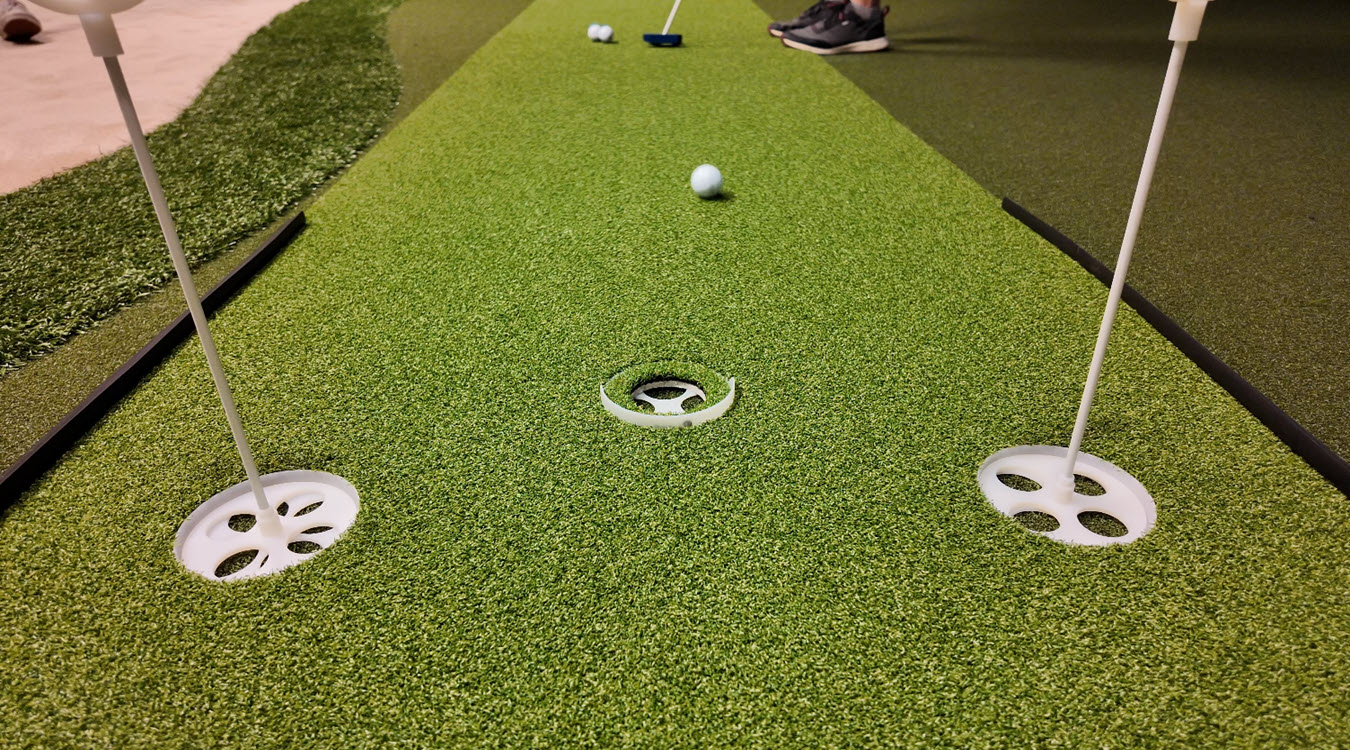
The PrimePutt’s real advantage is durability, and it’s the one argument for the price that holds up at all. Most putting mats are built for one surface. Take them outside and moisture warps the backing. Leave them on carpet too long and the backing degrades, the surface flattens and the roll changes. The PrimePutt is built to survive all of it. The nylon tolerates moisture, pets and foot traffic, all of which will destroy a foam mat. That’s why it’s rated for indoor and outdoor use, and it’s the reason a foam RollTech is off the table for anyone with a dog that has claws or a patio they actually use. But BirdieBall makes a woven nylon mat for exactly that golfer, the Tour Grade Turf, rated indoor and outdoor, and a 3′ x 10′ is $435 against the PrimePutt’s $490 for a 3′ x 9′.
It also looks the part. The backstop is furniture-grade walnut, it catches putts that run past the hole without a bounce-back, and it’s the reason you can leave this mat out in a living room without it looking like gym equipment. The whole thing is made in the USA, with rubber backing and cups made from the same plastic as a regulation golf cup, so you get the familiar sound when you hole one. Setup is unroll and putt. No pumps, no batteries, no app, no subscription.
So here’s who that matters to. If your mat has to live on a deck, or the dog has the run of the house, the PrimePutt is an okay pick, and the Tour Grade Turf is the one I’d look at first. What the PrimePutt adds is the walnut and the look. It’s not the truest-rolling option, it’s not the most versatile, and you’re paying for looks and toughness rather than practice features. That’s a fair trade for a few golfers. It’s not the trade most golfers need.
Four Sizes, and the Cheap One Isn’t the Same Mat
PrimePutt sells four sizes, and only three of them are the product people are reviewing. The Standard, XL and XXL are all 3 feet wide, which is enough to stand on the mat in a natural putting posture. That width is a real advantage over the narrow mats in this category, where you stand beside the mat and putt across it. The Compact at $370 is a foot and a half wide with one hole. You save on the sticker and you lose the stance realism that justifies the whole range, so the Compact is a different experience, not a cheaper version of the same one.
Length is the other decision. The Standard at 3′ x 9′ is the one most golfers buy, and for most rooms it’s the right call. The XL at 3′ x 12′ is $550 and the XXL at 3′ x 15′ is $590. PrimePutt moves its prices around, too. I’ve seen the XXL at $620 on one of its listings and the Standard at $449 on a Labor Day sale, so check the price on the page you land on. Longer means longer lag putts, and it also means more walking to fetch balls, because there’s no return. Buy the length your room and your patience can handle.
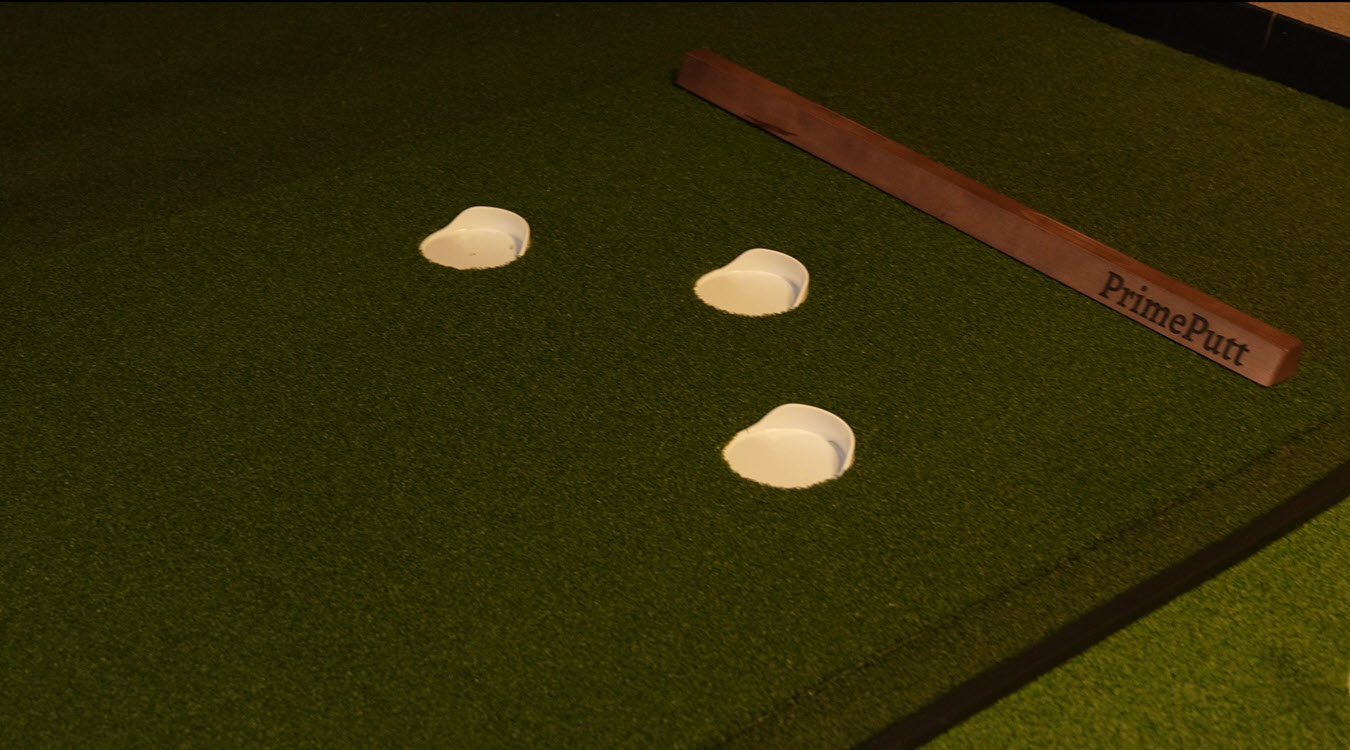
What you don’t get at any size is variety. There are three cups on the 3-foot models, in three fixed positions, and there’s no way to move a hole, plug one, or add a break. Compare that to the RollTech, where the 4′ x 14′ Deluxe gives you four holes with plugs and the Ultimate gives you six, plus a contour shim set for $69.99 if you want a breaking putt. So the PrimePutt’s size ladder is really a length ladder. Every size practices the same putt to the same three spots. That’s fine for a stroke-grooving mat. It’s thin for a $490 one.
The 30-Day Program Is the Price Tag’s Best Argument
The strongest thing PrimePutt bundles with the mat isn’t turf, it’s a plan. Every mat comes with a 30-day program from a PGA coach. You benchmark on day one, run the drills, retest on day 30, and if you don’t make more putts, you get your money back. On the standard product listing the money-back window is 30 days. Buy through the Break 30 Challenge listing, same mat and same prices, and both guarantees run a full 60 days. For a lot of golfers, the plan is the reason the mat gets used instead of rolled up in a closet, and that’s worth something real.
The rest of the ownership math is clean. There’s no app, no subscription, no batteries and no consumables, so what you pay on day one is what you pay. Against a camera mat that costs $699 plus a monthly fee, the PrimePutt’s three-year cost is lower despite a similar sticker. Accessories are sold on their own too: a putting mirror is $50, a short-game mat is $70, and a recorded stroke review with a coach is $69, though the Break 30 Challenge listing bundles the mirror and the lesson in with the mat.
One honest gap. PrimePutt doesn’t publish a warranty period. The guarantee is a return window, not a warranty, so if the turf or the backing fails in year two you’re on your own. For a $490 mat sold on durability, I’d want that in writing. Is the program enough to swing the decision? Not for me. If you know you’re the golfer who needs a structured plan to practice, it helps. If you’ll practice anyway, it’s a nice extra on an expensive mat, and the RollTech at $293.99 leaves you money for the contour shim set instead.
What I Don’t Love
It’s flat forever, and it’s one speed forever. There’s no shim, no contour, no way to build a break into it, and no way to change the green speed after you buy it. PrimePutt calls all of that deliberate, and their reasoning is fine: a real green has no printed lines, and a flat surface gives a bad stroke nowhere to hide. But every putt on a real course breaks, and a $339.99 PuttOUT AirBreak simulates that while a $490 PrimePutt doesn’t. There are no alignment lines either, so if you want start-line work you’re adding a mirror or a gate.
Then there’s the price against the roll. BirdieBall’s foam RollTech skips the weave entirely, so it has the better case for a pure roll, and the 3′ x 10′ costs $161.99. Add the unresolved wobble complaints from golfers who bought a PrimePutt in 2026, and the lay-flat time that runs hours instead of the seconds on the box, and the premium gets hard to defend on performance. You’re paying for turf, toughness and the cup. That’s a real product. It’s just an okay one at this price, and the golfer it disqualifies is anyone who wants their mat to do more than hold still and look good.
See how the realistic roll transforms your short game. Read real golfer ratings, pros, cons, and buying options.
- True-Roll Performance.
- Premium, Heavy-Duty Backing.
- Professional Aesthetics.
- Premium Price Point.
- Significant Footprint.
- Analog Experience.
Frequently Asked Questions
Is PrimePutt the best putting mat?
No, not for most golfers, and I say that as someone who owns one. The PrimePutt is the best looking turf mat in the category and it has the smartest cup, a calibrated one with a raised back lip that rejects an overhit putt. But it’s flat, it’s one speed, the three cups are fixed, and at $490 for the Standard it costs a lot more than a BirdieBall RollTech Deluxe that rolls truer at $293.99. The best putting mat is the one that rolls truest at a speed you can match to your course, and that’s the RollTech. The PrimePutt is the best mat for a patio.
Is PrimePutt worth it?
It’s okay, for a specific golfer. At $490 for the 3′ x 9′ Standard you’re paying for dense nylon turf that looks like a real green, a furniture-grade walnut backstop, indoor and outdoor use, and a calibrated cup that bounces out an overhit putt. You also get a 30-day coaching program with a money-back guarantee, and there’s no app or subscription after that. It isn’t worth it if you want to practice breaking putts, change your green speed or move the holes around, because it stays flat, one speed, holes fixed, all by design. For that golfer the RollTech does more for less money.
Which is better for indoor putting, BirdieBall or PrimePutt?
BirdieBall, if the mat stays indoors. The RollTech is poured foam with no weave, so the ball tracks straight without the wobble a woven surface can add on a dying putt, and you order it at the stimp you play, 9 to 10, 10 to 11 or 11 to 13. A 3′ x 10′ costs $161.99 and my 4′ x 14′ Deluxe was $293.99, shim and four holes included. The PrimePutt only makes a case if you want the turf look and the raised-lip cup, and if the mat has to go outside, the Tour Grade Turf is the BirdieBall I’d look at first. Indoors, on roll and on price, it’s the BirdieBall.
Do indoor putting mats really work?
Yes, if the surface rolls true and you use it. A cheap carpet mat can teach you a bad stroke, because the weave pushes the ball off line and you can’t tell whether the miss was you or the mat. A mat that rolls true at a speed close to your course lets you groove face angle and pace in a few minutes a night, and that’s most of putting. The PrimePutt’s dense nylon rolls at 9 to 11 on the stimp and its cup gives honest pace feedback, so it works. So does a RollTech at a third of the price. The mat that works is the one you’ll unroll.
What is the best putting mat in 2026?
The BirdieBall RollTech, for most golfers. I put it at the top of my 2026 roundup because its foam surface rolls truer than any woven mat I’ve used. It’s built at the green speed you order. And the Deluxe I own comes with four holes, cups, flags and a deepening shim for $293.99. The PrimePutt is fine if turf and walnut are what you want, and BirdieBall’s woven turf handles the patio and the dog for less. If you want the closest thing to a real green indoors for the least money, buy the RollTech and put the difference toward the contour shim set.
Final Thoughts: PrimePutt Putting Mat Review
Here’s how I see it. The PrimePutt is a good-looking, tough, well-made turf mat with one genuinely smart idea in the cup, and it’s an okay mat for a golfer who wants the walnut look inside. It does what it says. At $490 for the Standard it also asks you to pay a premium for turf and toughness while giving you nothing to practice except a flat, one-speed putt to three fixed holes. There’s no break, no adjustable speed, no alignment lines and no ball return, all on purpose.
The problem isn’t the mat. It’s what sits next to it. The BirdieBall RollTech rolls truer, changes speed, builds breaks with a shim, and costs $161.99 to $293.99 depending on size. So for most golfers who want a better putting stroke at home, that’s the money I’d spend, and I’d say so even though the PrimePutt pays me more. If your dog or your patio rules the RollTech out, look at the Tour Grade Turf first. Buy the PrimePutt if you want the walnut, and use the 30-day program, because that’s the best thing in the box. Still deciding? Start with my best putting mats guide, and I’ll see you on the course.

About the author
Paul Liberatore
Paul Liberatore is the founder of Golfers Authority and a former four-year golf gear contributor to Sports Illustrated. He tests golf equipment hands-on to help golfers make better buying decisions.